The stipulated conventional cell is a square of side . Although introduced as a centered rectangular lattice, this equal-side case is a square Bravais lattice viewed with a rotated primitive basis. A corner-to-center separation iswhich is shorter than the separation between adjacent conventional corners. Consequently the first contact of equal circles occurs atThe conventional square represents two lattice points: one from its four shared corners and one from its center. Its packing fraction is thereforeEquivalently, one circle occupies each primitive area . This is square circle packing; the drawing does not define a triangular close-packed lattice.
A unit cell is a repeat region whose lattice translations tile the plane. A primitive unit cell represents exactly one lattice point and has the minimum repeat area for a lattice basis.
Cell A is nonprimitive; cell B is primitive. A represents two points and has area . B has four shared corner points and no additional interior point, represents one point and has area . Fractional corner counting refers to the tiling, not to fractional physical atoms.
Using the printed axes, take a lower vertex of cell B as origin. One allowed pair of primitive lattice translation vectors isBoth vectors connect nearest lattice points, have length , and are perpendicular. Their determinant has magnitude , consistent with a primitive area. Exchanging them or reversing their directions gives equivalent basis conventions; the corresponding reciprocal lattice vectors must then use the same convention.
A visibly different primitive parallelogram is generated byIts vertices, relative to one lattice point, are , , and . Its area isThe basis change has integer matrix with determinant one. It is invertible over the integers, so the new vectors generate every original lattice point, not merely a sublattice. The cell is therefore primitive despite being sheared relative to cell B.
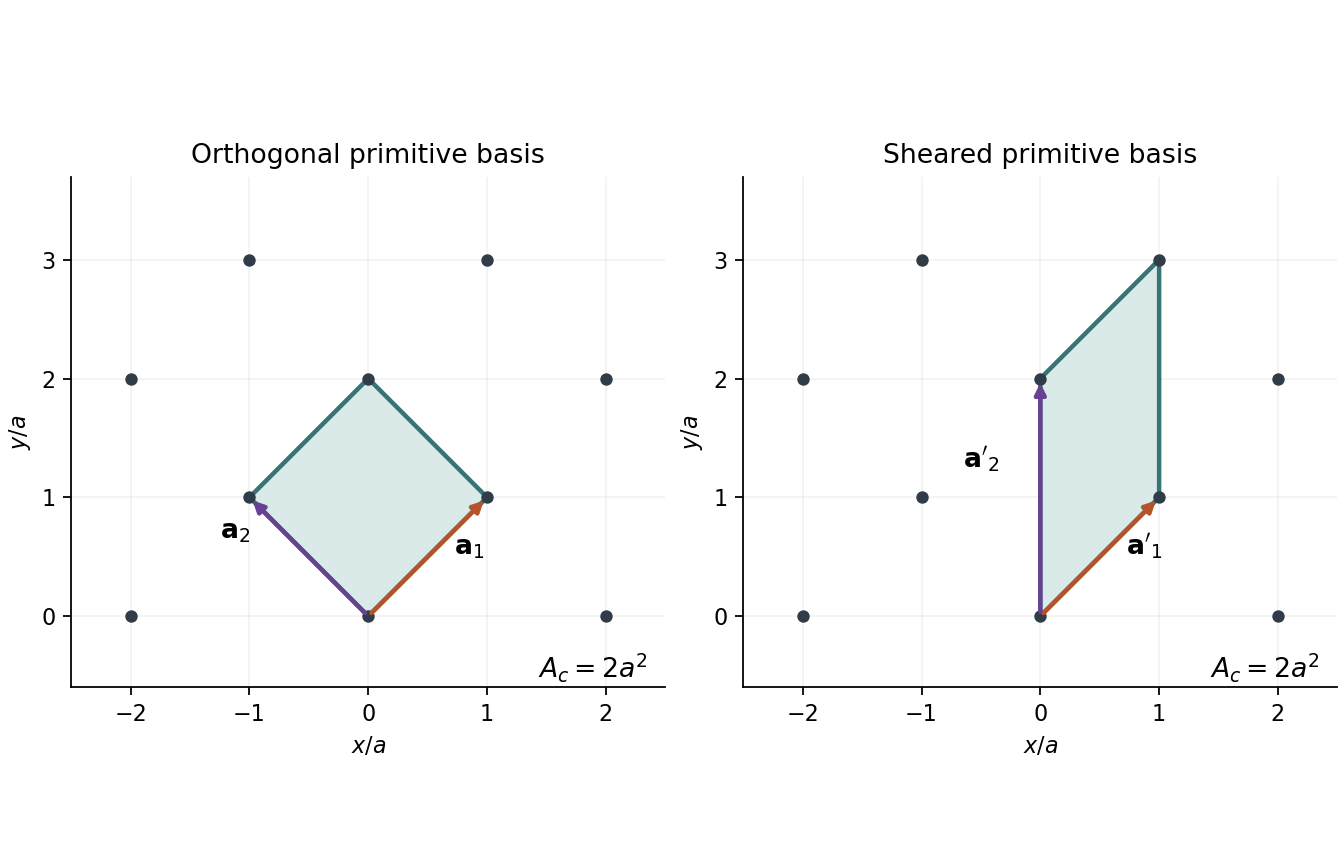
Two primitive bases generate the same centered-square lattice
. Original coordinate construction from the derived translation vectors, with axes measured in units of . The left cell uses the diagonal orthogonal basis; the right uses a determinant-one shear. Both highlighted parallelograms have area and one lattice point per cell. Details.
Articles by others on the same topic
There are currently no matching articles.