The stipulated conventional cell is a square of side . Although introduced as a centered rectangular lattice, this equal-side case is a square Bravais lattice viewed with a rotated primitive basis. A corner-to-center separation iswhich is shorter than the separation between adjacent conventional corners. Consequently the first contact of equal circles occurs atThe conventional square represents two lattice points: one from its four shared corners and one from its center. Its packing fraction is thereforeEquivalently, one circle occupies each primitive area . This is square circle packing; the drawing does not define a triangular close-packed lattice.
A unit cell is a repeat region whose lattice translations tile the plane. A primitive unit cell represents exactly one lattice point and has the minimum repeat area for a lattice basis.
Cell A is nonprimitive; cell B is primitive. A represents two points and has area . B has four shared corner points and no additional interior point, represents one point and has area . Fractional corner counting refers to the tiling, not to fractional physical atoms.
Using the printed axes, take a lower vertex of cell B as origin. One allowed pair of primitive lattice translation vectors isBoth vectors connect nearest lattice points, have length , and are perpendicular. Their determinant has magnitude , consistent with a primitive area. Exchanging them or reversing their directions gives equivalent basis conventions; the corresponding reciprocal lattice vectors must then use the same convention.
A visibly different primitive parallelogram is generated byIts vertices, relative to one lattice point, are , , and . Its area isThe basis change has integer matrix with determinant one. It is invertible over the integers, so the new vectors generate every original lattice point, not merely a sublattice. The cell is therefore primitive despite being sheared relative to cell B.
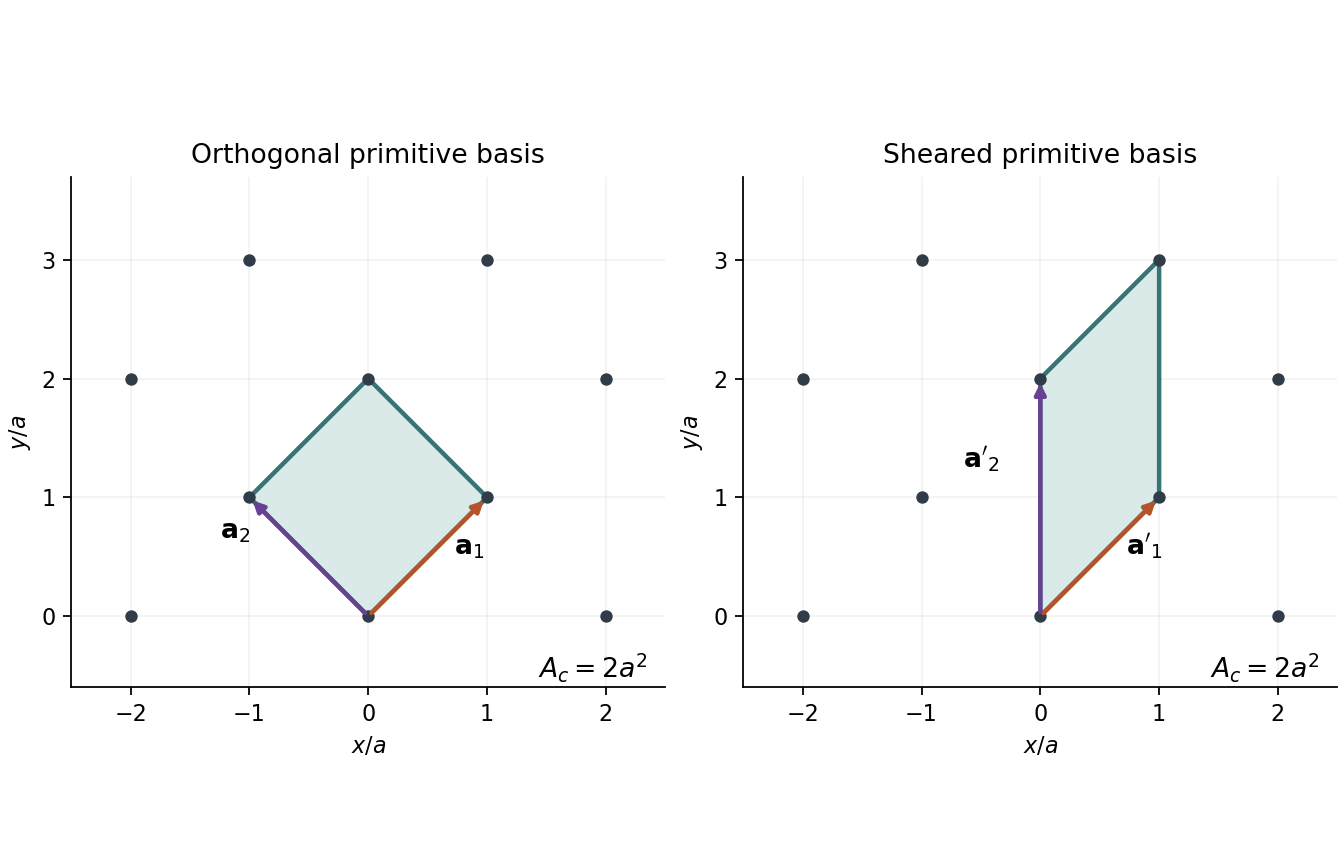
Two primitive bases generate the same centered-square lattice
. Original coordinate construction from the derived translation vectors, with axes measured in units of . The left cell uses the diagonal orthogonal basis; the right uses a determinant-one shear. Both highlighted parallelograms have area and one lattice point per cell. Details.
For direct-lattice points , a lattice-periodic plane wave must have the same phase at every translated lattice point:Thus , with integer , and the reciprocal lattice isIts spacing is . These plane waves execute an integer number of complete cycles within a direct-lattice period, so their wavelength magnitudes are for .
A general electronic Bloch wave need not itself be lattice-periodic: wavevectors differing by have the same translation phase. The reciprocal lattice labels that equivalence, while a large finite specimen with periodic boundary conditions has a much finer grid of allowed electronic wavevectors.
Construct Bragg planes by taking the midpoints between the reciprocal origin and the other reciprocal lattice points. In one dimension these are points at , for nonzero integer .
The first Brillouin zone is the interval bounded by the nearest two such points:The second Brillouin zone consists of the next intervals on both sides:Boundary points may be assigned to one adjacent zone to avoid double counting. The first zone is reached from the origin without crossing a Bragg point; the second is reached after crossing one. Each zone has total length . In particular, the two separated pieces of the second zone are not the entire translated first-zone interval centered at .
With the chosen basis, let . The reciprocal lattice conditions giveso . Similarly, and giveAll reciprocal points areThus, in coordinates measured in , the two integer coordinates have the same parity. The reciprocal lattice is another rotated square Bravais lattice, with nearest-neighbor spacing .
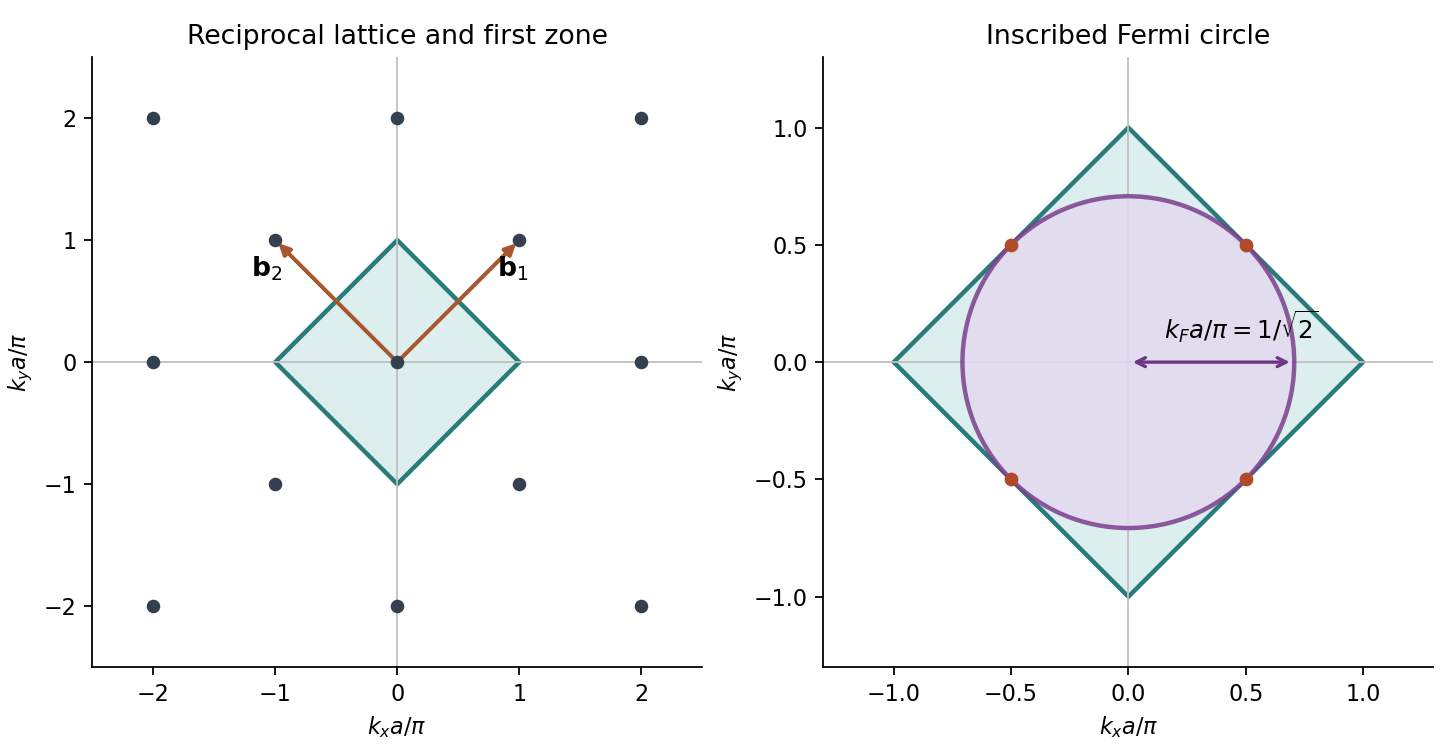

The first Brillouin zone is the origin-centered Wigner-Seitz cell of the reciprocal lattice. Its nearest reciprocal points are and . The perpendicular bisectors follow fromConsequently the zone isIt is the diamond with verticesThe reciprocal-space sketch above shows these boundaries. Its area is , where . This area check rules out mistakenly using the nonprimitive conventional cell to define a smaller first zone.
For an isotropic two-dimensional free-electron model, the occupied states form a disk centered at the reciprocal origin. Its Fermi circle first touches a zone side when its radius equals half the distance to a nearest reciprocal point:The contact points have coordinates with all four sign combinations. The distance to a zone vertex is , which is larger; that distance would describe contact with a corner after the circle had already crossed a side.
There are primitive cells and therefore lattice points. The specified reciprocal-space density counts distinct allowed wavevectors; each supports two electron spin states. Filling the disk at zero temperature givesUsing and ,The circle fills a fraction of the first-zone area, while one spin-degenerate band has two states per primitive cell; these give the same result. A single-spin count would instead be , omitting the physical twofold spin degeneracy of this model. The circle has only just reached the sides, so the zone corners remain unfilled: first contact does not mean filling the entire first band.
Articles by others on the same topic
There are currently no matching articles.