For an ordinary fixed field satisfying , the ground manifold remains lowest. The magnetization therefore vanishes as : the molecules are overwhelmingly in the stipulated nonmagnetic states. On warming, thermal excitation creates magnetic molecules and initially increases the response. At higher temperature, orientational randomization wins over the growing magnetic population, giving a maximum and then an inverse-temperature tail.
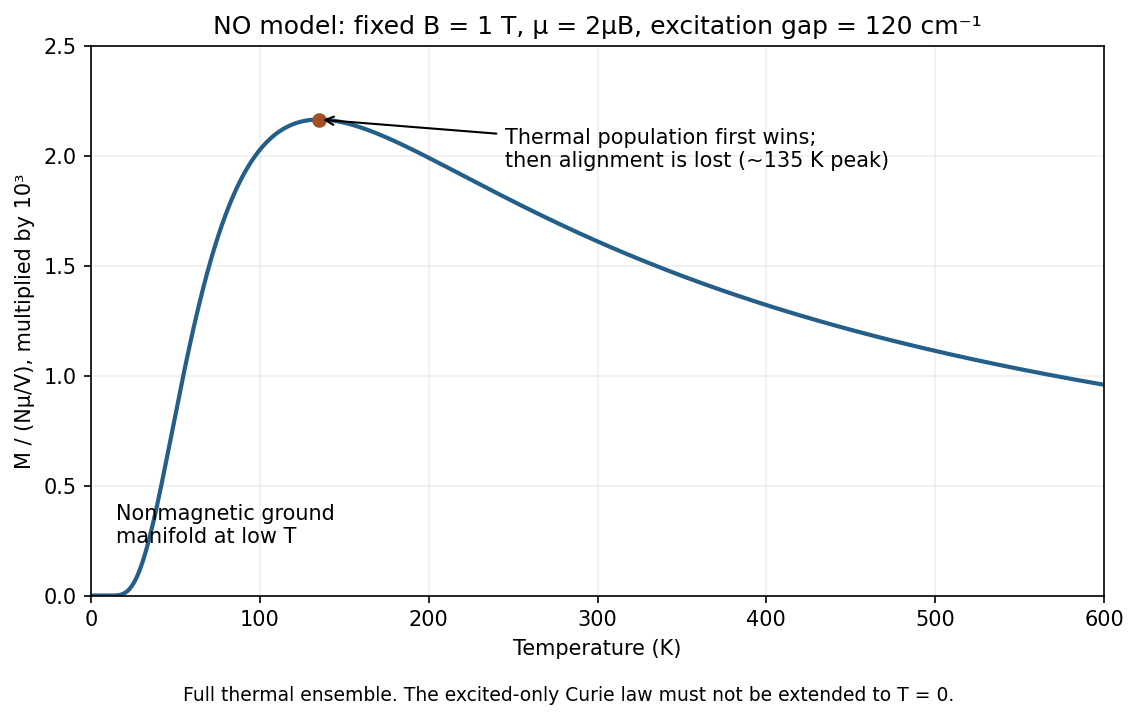
Original full-ensemble NO magnetization for an illustrative fixed 1 T field, including the nonmagnetic ground manifold
. Details. 
In the weak-field regime,Its maximum occurs near K. At high temperature the excited fraction tends to one half, while each magnetic molecule's alignment decreases as , so . The low-temperature suppression must be evaluated from the full partition function; extending the weak-field expansion to at a fixed field would exceed its domain.
The sketch assumes the simplified moments stated in the question. For an arbitrarily strong field with , an aligned magnetic level crosses below the nonmagnetic states and the low-temperature conclusion changes. Real NO has additional rotational and magnetic structure beyond this deliberately restricted model.
Articles by others on the same topic
There are currently no matching articles.