Inside the infinite square well, the stationary wavefunctions can be chosen real:They vanish outside the well and at its impenetrable endpoints. A sine meets the left boundary condition; the right one requires . The putative function is identically zero, so it is not a quantum state. The constants are fixed by wavefunction normalization.
Wavefunction normalization requires unit total probability:Choosing an irrelevant overall phase to be zero givesThe amplitude has units of inverse square root length, so is dimensionless.
Within the well, the potential is zero and the Hamiltonian is purely kinetic:The infinite walls are encoded in the operator's boundary conditions , rather than differentiated as part of the interior expression. Sincewe obtainThese positive energy eigenvalues grow quadratically with the quantum number; the ground state has a nonzero confinement energy.
For distinct positive integers , use the product-to-sum identity in the inner product:Every endpoint sine vanishes. For , the normalization integral is one; the expression with a denominator should not be substituted directly. Thus the normalized functions form an orthonormal set, .
Project the expansion onto one normalized basis function. Orthogonality removes every other coefficient:Consequently,This is a Fourier sine series in normalized form. For a square-integrable , completeness gives convergence in the norm of the function space; pointwise convergence requires the usual additional regularity. If is a normalized wavefunction, the Born rule gives probabilities and .
Set and . The wrapped spatial form isHence the differential expression for the quantum rotor acts asThe box expression becomes , so consistency givesthe moment of inertia of a point mass a distance from the axis. Equivalently, transforms the kinetic operator directly. Being an eigenfunction of this differential expression is not yet sufficient: the ring boundary conditions must also hold.
For a wavefunction normalized with the angular measure , use . This change of normalization convention does not change the energy eigenvalue.
A smooth quantum rotor with no flux or twist requires bothFor the sine family, holds for every positive integer , butThe derivatives match only for . Equivalently, must be periodic for every , not merely vanish at the chosen join. Odd would produce a cusp in a periodic continuation and do not belong to the smooth free-ring Hamiltonian's domain.
Solving gives an exponential. The periodic boundary condition quantizes its phase winding:These are normalized with respect to . The corresponding complex Fourier series isUnlike the wrapped sine subset, this orthonormal basis includes the constant state and both sine and cosine combinations. If one retains arc-length normalization instead, replace by and integrate with .
For the allowed states, the normalized standing wave is a quantum superposition of two opposite angular momentum eigenstates:The Born rule therefore predictsThe expectation value is zero, but a single measurement never gives zero for these states. Their uncertainty is . The two components have the same rotor energy , so a definite energy does not imply definite angular momentum.
Differentiate the Gaussian before substituting into the Hamiltonian:ThusAn energy eigenvalue must be independent of , so the coefficient of vanishes. Normalizability requires , givingThe constant term is the quantum harmonic oscillator's zero-point energy; a Gaussian width balances its kinetic and potential contributions.
For a normalized state and a Hermitian quantum observable , its quantum uncertainty is the standard deviation of repeated measurement outcomes:Here . It is a property of the state and observable, not an instrumental error; the required moments must be finite.
In the position representation, multiplies by and . Acting on an arbitrary differentiable test function shows the commutator explicitly:Therefore , whose expectation value is in every normalized state in the relevant domains. The Robertson uncertainty principle givesThis is a lower bound, not a claim that every state saturates it.
To evaluate the second position moment, differentiate the Gaussian integral with respect to its positive parameter:For the momentum second moment, apply the momentum operator twice:Both means vanish, soThe ground state attains the bound proved above and is therefore a minimum uncertainty state. A wider Gaussian reduces momentum spread while increasing position spread: the product remains at this lower limit. Other states, including excited oscillator eigenstates, generally give a larger product.
Write . The creation and annihilation operators obeyConsequently,The resulting function is not zero: its squared norm isThus is the normalized first excited state, up to phase. More generally the creation operator raises the energy by one quantum : . The factor is required because applying it to a higher state does not preserve normalization.
A polar diatomic molecule can absorb microwaves through its permanent electric dipole moment. In the linear rigid rotor approximation,The electric-dipole selection rule is in absorption. It givesso adjacent lines are separated by . ThereforeAssign a line near to for positive integer . The first member is , the next , and so on; if the recorded window misses the lowest lines, their absolute frequencies fix the integer offset. At high temperature many rotational states are populated, so the strongest line need not be .
This is the leading rotational pattern, not a claim that real ZnF lacks spin or hyperfine structure. Fine splittings and centrifugal distortion can perturb the ideal lines; they do not explain the three systematically displaced progressions as economically as vibrational excitation.
The two extra progressions are rotational transitions within thermally populated and vibrational levels. Isotopic purity rules out attributing them to different isotope masses. Their rotational constants areThe Boltzmann distribution makes each higher vibrational manifold less populated, so its rotational spectrum is weaker. A Morse oscillator explores larger separations as it is excited: the bond's vibrationally averaged moment of inertia increases and the rotational spacing decreases. More precisely, involves an average of the inverse square separation; it is not simply the inverse square of the mean separation.
The observed decrement is constant to the given precision:This fits the leading vibration-rotation interaction law .
An equilibrium bond length requires , not merely the ground-vibrational-state constant. Extrapolating the linear vibration-rotation interaction law givesUsing integer isotope masses, the reduced mass isFor two nuclei , soUsing instead gives pm, an effective vibrational separation. The small difference is precisely why the weaker vibrational progressions matter when the target is equilibrium geometry. Higher terms in and the rigid-rotor approximation limit this estimate's precision.
A vibrational fundamental is the transition . A first vibrational overtone is . A hot band starts from a thermally populated vibrationally excited level, such as .
For a strictly harmonic potential and a dipole linear in displacement, the allowed transitions have . A fundamental and a hot band then share the same frequency, while the overtone has zero intensity. Anharmonicity separates the adjacent gaps and can give overtone intensity; nonlinear displacement dependence of the dipole can also contribute. A hot band is defined by its lower state, not merely by being weak.
The strong band is , while the weak band is the first vibrational overtone . Let and . Subtracting the Morse oscillator levels givesTwice the fundamental is , slightly above the overtone because the higher vibrational gap is smaller. Eliminate :soThe implied dimensionless anharmonicity constant is . The overtone's weakness follows from its being forbidden in the leading harmonic/linear-dipole model, rather than a lack of population in its lower state.
The relevant allowed absorption is . Under the stipulated population-only intensity model, the vibrational levels are nondegenerate andSet this ratio to and solve:The energy in the exponential is the measured gap, not the harmonic constant . At this temperature, , so considering the first thermally excited manifold is sensible. Actual band intensity ratios also involve transition moments and rotational structure; the calculation follows the question's simplifying assumption.
Anharmonicity places the hot band atonly below the fundamental. It can be detected with adequate spectral resolution and signal-to-noise; it is not guaranteed to appear as a separate peak in an unresolved band contour. The predicted ten-percent population-based intensity is appreciable, but overlapping rotational branches and linewidth can hide it beneath the stronger fundamental. No instrumental resolution or linewidth is supplied, so an unconditional assertion of visibility or invisibility would go beyond the information given.
The molecular symmetry operations must be closed under composition. Write the proposed nonidentity operations as and . Their product cannot equal any proposed member:Each conclusion contradicts the distinct operations stipulated. Therefore at least a fourth symmetry operation must exist. For a mirror plane containing the twofold axis, the product generates another mirror plane; for a plane perpendicular to it, the product is inversion. A tilted plane may generate still more operations, but cannot evade group closure.
One choice is the C2v molecular point group, . The additional operation is a second reflection, sinceA bent water molecule has this symmetry. Choose the axis along its bond-angle bisector and put the molecule in the plane: reflection in exchanges its two hydrogen atoms, while reflection in fixes their positions.
With , and , composition givesEvery entry belongs to the set, proving closure. is the identity element; every element is its own inverse. Associativity follows because these are actual spatial transformations: composing functions is associative. Thus all group axioms hold, and the group is isomorphic to the Klein four-group.
A symmetry-closed orbital basis, often called a complete basis in this context, is a linearly independent set whose span is carried into itself by every group operation. No transformed basis function requires a function outside that span. This is completeness for the chosen group representation, not a claim that a small atomic-orbital set spans the full electronic Hilbert space.
A representation matrix specifies the linear transformation produced by a molecular symmetry operation . With the column convention,Its character of a representation is the matrix trace,The character is unchanged by a simultaneous change of basis and is constant on a conjugacy class, which is why character tables have one column per class.
Use the ordered basis at the origin. Choose as the principal improper-rotation axis, along the two axes, and the diagonal mirror planes as . Use active operations with , so the matrix columns give the transformed orbitals. For these real p orbitals the matrices are the ordinary vector transformation matrices.
One representative from each D2d molecular point group class isFor example sends , and . Choosing the opposite sense of transposes its xy block but leaves every character and the final decomposition unchanged.
Taking the matrix trace of those matrices givesThe one-dimensional subspace has characters , identifying . The pair has characters , identifying . ThereforeThe dimensions add to three, as required. The pair must be retained together: a ninety-degree improper rotation mixes them, so either one alone is not a complete symmetry basis.[ref]
Ideal gaseous phosphorus pentachloride is a trigonal bipyramid with D3h molecular point group symmetry. There are five chlorine sites and three 3p orbitals per site, hence a fifteen-dimensional basis. A moved atom contributes zero to the character; each fixed chlorine contributes the trace of the three-dimensional polar-vector matrix acting on its local p orbitals.For example, a axis through one equatorial chlorine fixes that site but rotates its p-vector basis with trace . Counting that atom as would be incorrect.
Apply molecular character reduction with class sizes and group order twelve:For , this gives ; for , . The full result isThe dimension check is . As an additional transparent separation, the two axial chlorines supply , while the three equatorial ones supply . These are all chlorine 3p orbitals, including both radial and tangential functions; a five-orbital ligand-sigma basis would answer a different question.
The highest expected orbital degeneracy is five. Ideal buckminsterfullerene has Ih molecular point group symmetry. Its irreducible orbital representations include five-dimensional and representations; no single-valued orbital irrep has higher dimension.
This counts distinct spatial molecular orbitals. It does not multiply by electron spin, and it excludes accidental coincidences between unrelated irreps. In a real environment, symmetry lowering can split these degeneracies.[ref]
The ideal eclipsed ion has D4h molecular point group symmetry. Put the Mo–Mo axis along , with the metal atoms at , and orient the four chloride positions around each metal along .
There is a axis, perpendicular twofold axes, a horizontal plane through the midpoint, vertical mirror planes and an inversion centre at the bond midpoint. The eclipsed arrangement makes the two chloride squares coincide in projection along . These labels refer to the ideal molecular geometry, rather than small crystal-packing distortions.
Let and be corresponding real 4d orbitals on the upper and lower metals, with identical global-axis phases. Their symmetry-adapted linear combinations arewith the normalization shown in the negligible-overlap approximation; including overlap changes the denominator but not the symmetry. Inversion exchanges the centres and each local d orbital has even intrinsic parity, so the plus combinations are gerade and the minus combinations ungerade.The reversal of bonding phase for is important: the facing lobes have opposite signs when the two atomic orbitals share the same global phase convention, so their difference is bonding. Each irrep is two-dimensional. Thuswith total dimension ten. Rotating by interchanges the names of the two delta families; all labels here retain the chloride-aligned axes fixed above.
Ignoring ligand perturbations initially, end-on overlap gives the largest sigma bond splitting, side-on overlap gives the two pi bonds, and the two four-lobed overlaps give weaker delta bonds. A useful qualitative ordering isThe original diagram shows the ten orbitals, including both members of each level.
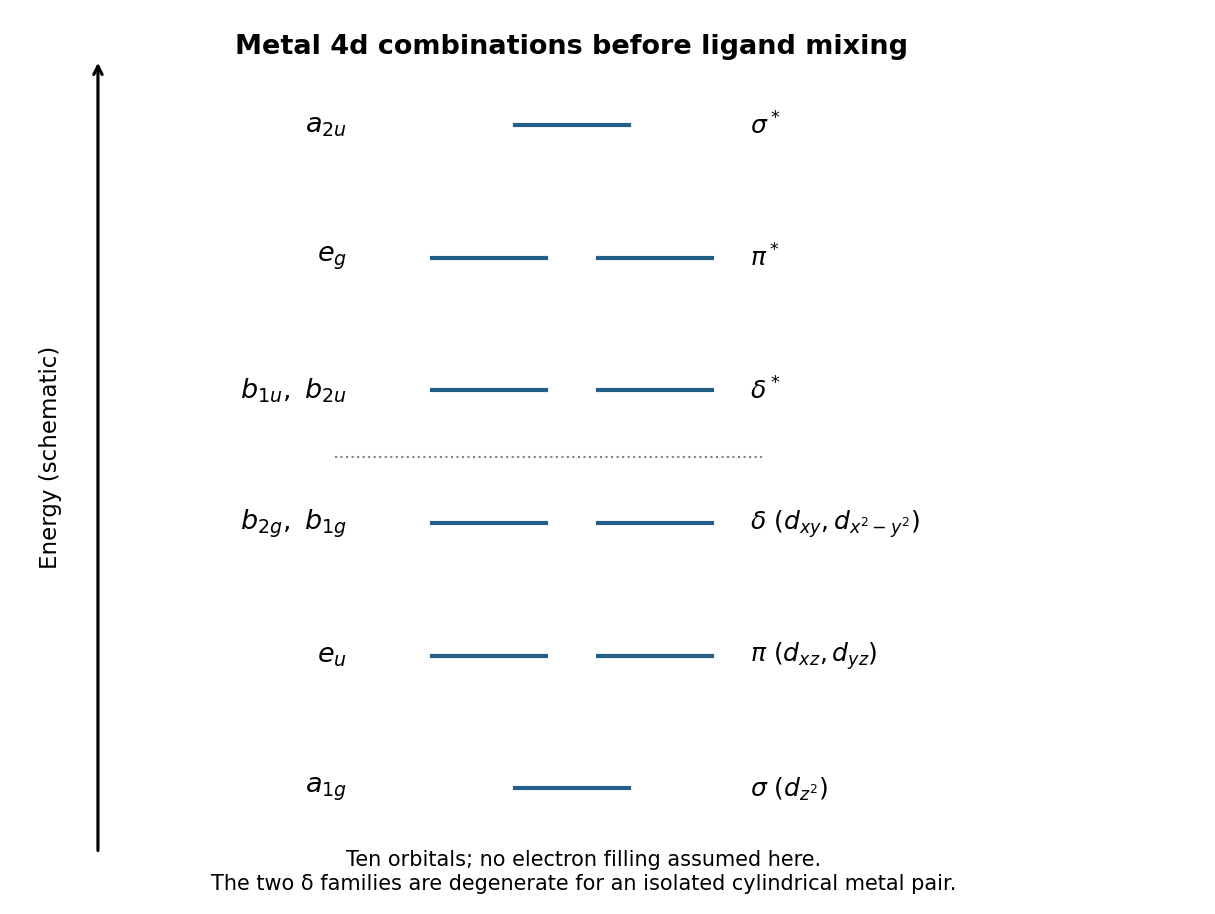
For the strictly isolated collinear metal pair, cylindrical symmetry makes and related by rotation, so the two delta bonding levels are degenerate, as are their antibonding partners. The displayed D4h molecular point group labels anticipate the ligand environment, which can split those different irreps. Symmetry supplies labels and degeneracies; the relative separation of unrelated levels is a qualitative overlap model, not a numerical prediction.
Eight chloride ions contribute charge . For an overall charge, the two metals together contribute , so each is formally Mo(II). Molybdenum is in group six, giving four d electrons per centre and eight metal-based electrons in total.
In the ligand-perturbed configuration developed below, they occupy , with no Mo–Mo antibonding electron. Therefore the formal bond order isThis is one sigma bond, two pi bonds and one delta bond. Before including ligands, the two ideal delta channels are degenerate and the allocation of their last two electrons is not determined by the bare energy sketch alone; the ligands remove that ambiguity and select the surviving low delta channel. The eight-electron bonding count still gives formal order four.
The occupied bonding groups are experimentally meaningful: molybdenum X-ray emission resolves three metal–metal bonding energy groups in this ion, alongside a deeper metal–chloride bonding feature.[ref]
Direct evidence for the quadruple metal-metal bond in the octachlorodimolybdenum(II) ion using X-ray emission spectroscopy by Derek E. Haycock and others. Primary X-ray emission report, abstract and pages 262–263
Choose the phase of each inward-pointing ligand sigma donor orbital positive toward its own Mo centre. The eight donors then transform by site permutation. In the usual D4h molecular point group class order their characters areOnly and a chloride-containing vertical mirror plane leave ligand functions individually fixed. For example fixes the four donors at and exchanges the other four; the four fixed functions retain their signs.
Molecular character reduction givesThe dimensions sum to . Equivalently, take each square's four combinations: the all-in-phase pattern, the alternating x-versus-y pattern, and a two-dimensional pair. Combine corresponding patterns between upper and lower squares to obtain the six irreps above.
A ligand symmetry orbital can mix with a metal combination only if their irreps match. Since the donor levels lie below the metal levels, mixing produces a lower ligand-dominated bonding orbital and a higher metal-dominated antibonding orbital. In a two-level model with ,The requested metal-dominated levels are shown in the right-hand column; the lower ligand-dominated partners are deliberately outside this diagram.
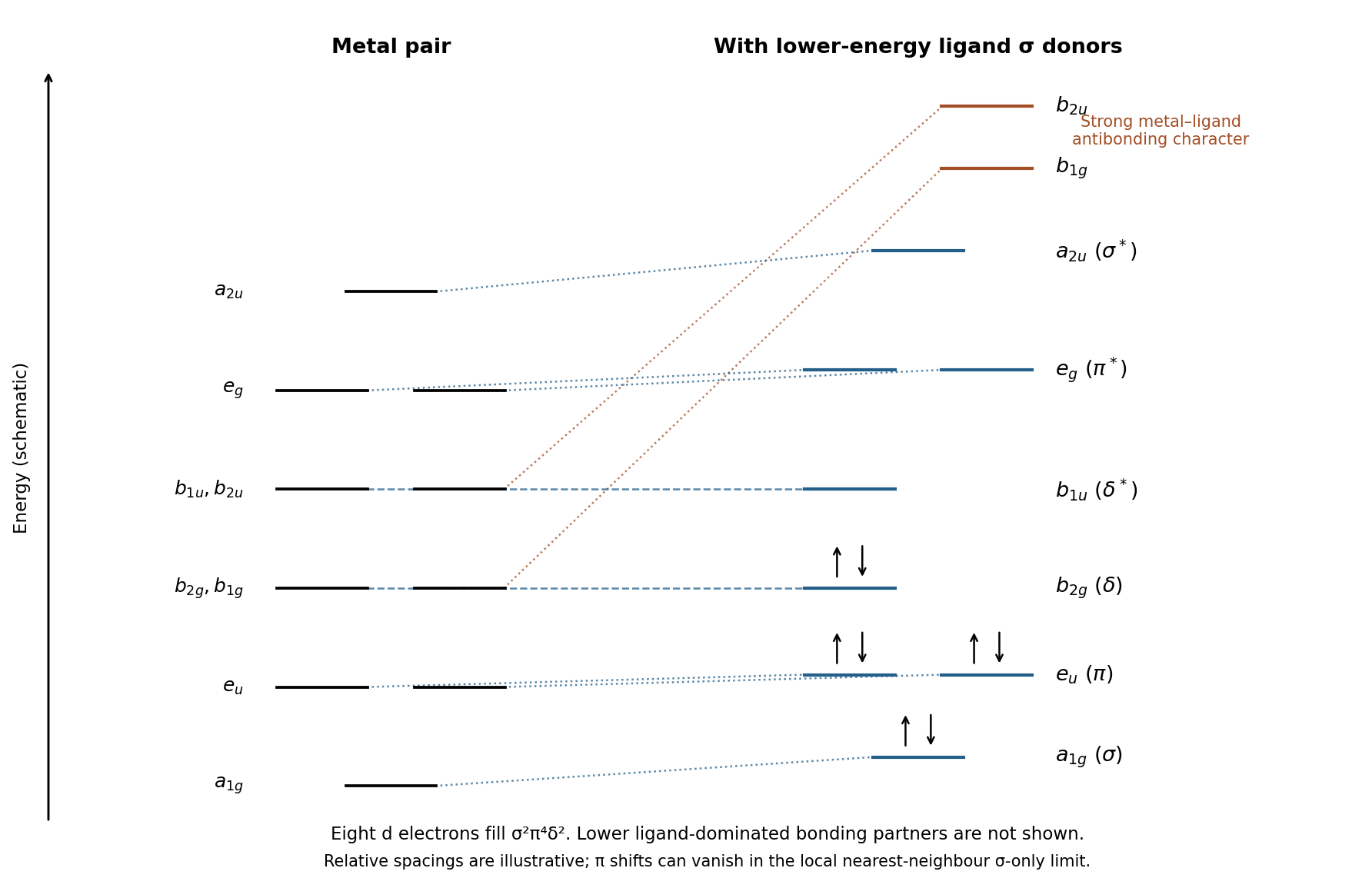


The lobes point directly at the chlorides, so their and combinations are strongly destabilized. The combinations can also interact through their equatorial density. The symmetries have ligand partners, so weaker shifts are symmetry-allowed; their local nearest-neighbour sigma overlap vanishes in the ideal planar geometry, making their shifts much smaller in that approximation. Symmetry allowance alone never sets an overlap integral's size.
There are no ligand sigma combinations of or symmetry, so the -derived delta pair is unaffected by the stipulated sigma-only mixing. In particular the low level survives while the other delta bonding channel becomes strongly metal–ligand antibonding. The plotted spacings and ordering of remote unoccupied levels are schematic; the robust conclusion is the four low Mo–Mo bonding orbitals separated from antibonding or strongly ligand-destabilized orbitals.
The ligand field leaves one low sigma bond orbital, two low pi bond orbitals and one low delta bond orbital. Their closed-shell occupation isIt requires eight metal d electrons, or four per Mo, hence Mo(II). With eight ligands, charge balance givesOxidizing removes an electron from a Mo–Mo bonding orbital; reducing populates a higher orbital with Mo–Mo antibonding or strong metal–ligand antibonding character. Thus the state has the particularly favourable filled bonding configuration in this model. This is an orbital explanation of a preferred charge, not a claim that charge alone determines solution redox stability independently of counterions or solvent.
The eclipsed geometry also follows naturally from the occupied delta bond: it aligns the four-lobed functions. Twisting the chloride squares toward a staggered geometry reduces this overlap and weakens that contribution to the quadruple bond.
Take the eight Mo–Cl bond-length changes as a stretching basis. These scalar coordinates have the same permutation representation as the eight sigma donors:Infrared spectroscopy detects modes transforming as a dipole component: is and is . There are therefore two IR fundamentals, one and one doubly degenerate frequency.
Raman spectroscopy detects modes transforming as polarizability components. The relevant modes are , and , giving three Raman fundamentals, of which is doubly degenerate. The remaining stretch is silent in both ordinary spectra.
Thus the prediction isThe zero follows from infrared and Raman mutual exclusion: the molecule has inversion symmetry, dipole components are ungerade, and polarizability components gerade. This counts resolved fundamental frequencies of the ideal ion, not separate lines for degenerate components, isotope splittings or accidental numerical overlaps between distinct modes.
Treat each species as a dilute classical ideal gas: molecules of the same species are indistinguishable, while different species are distinguishable. Let be the number of molecules of species , its molecular partition function with energies measured from a chosen internal reference, and that reference energy per molecule relative to a common chemical energy convention. Then the mixture's canonical partition function factorizes:The corrects the overcounting of indistinguishable particles. The exponential restores the species-dependent reference energies that matter for reactions. Thus the Helmholtz free energy isUsing Stirling's approximation, , and differentiating at fixed yieldsThe ideal-gas does not depend on the number of molecules, so no additional term appears. These are chemical potentials per molecule; multiply by the Avogadro constant for a molar chemical potential. The result assumes the thermodynamic, nondegenerate-gas limit.
Let be a molecular number density and define the volume-independent molecular partition function density . Then . Also define the reaction reference-energy differenceSubstitution into the equilibrium chemical-potential relation givesAn equilibrium constant expressed using concentration activities is dimensionless:Here every has units , and is the chosen standard concentration, initially one molecule per cubic metre. The factor is essential: without it the association quotient has units of volume.
Use the supplied separable molecular model,with electronic factors unity. The integer masses are , and . The rotational symmetry numbers are respectively : rotating either hydrogen or methanal by about its appropriate symmetry axis exchanges identical hydrogens, whereas CO has distinct ends.
With the given conversion , a spectroscopic constant corresponds to a temperature . At K the partition-function factors areFor instance,The vibrational partition functions here include their zero-point Boltzmann factors. The given reference-energy change must therefore be used consistently with that convention; adding a second vibrational zero-point energy correction would double count it. Because the numerical energy change is per mole, its exponential uses , not :Consequently,This tiny dimensionless value refers to the extremely dilute one-molecule-per-cubic-metre standard state. It is not a concentration-independent statement about the fraction of carbon monoxide converted in a particular cloud. The calculation follows the supplied classical rotational and harmonic vibrational formulas, without adding separate nuclear-spin factors.
Convert the new standard concentration to the number-density convention:For this association, , so it is proportional to . ThereforeBoth dimensionless constants describe the same physical equilibrium; changing the reference changes the numerical activity quotient because two reactant molecules form one product molecule.
Articles were limited to the first 100 out of 167 total.
Articles by others on the same topic
There are currently no matching articles.