Set the ground electronic energy to zero and write the excitation energy as , or the characteristic temperature K. Counting each doubly degenerate manifold once gives the single-molecule electronic partition functionFor independent molecules the electronic factor is . Hence the electronic internal energy isThe equal degeneracies cancel from the excited-state probability. At low temperature the ground manifold dominates and ; at high temperature both manifolds have equal populations, giving . These are electronic contributions only, excluding translation, rotation and vibration.
Differentiate the electronic energy at fixed volume:At , : thermal energy is insufficient to populate the upper manifold. At , : the two populations are already approaching equality and the electronic energy has a finite ceiling.
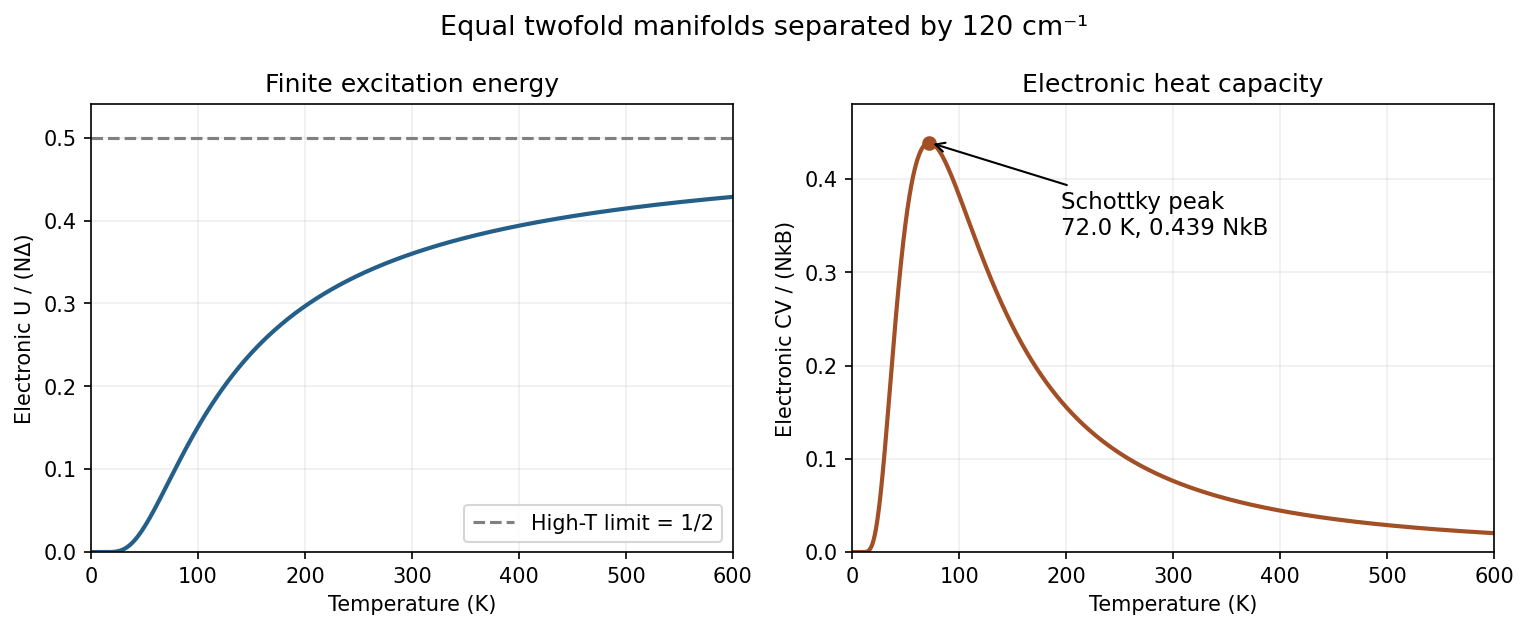
Original electronic internal-energy and Schottky heat-capacity curves for the two-manifold model from 0 to 600 K
. Details. 
Between these limits the heat capacity has a Schottky anomaly, peaking near K at . The energy rises monotonically toward ; its slope is largest at the heat-capacity peak. At 600 K it has not reached its infinite-temperature limit exactly.
For the two field-sensitive orientations alone, choose the unsplit excited-manifold energy as reference and put . The restricted single-molecule partition function isIf the ground-manifold zero used above is retained, this restricted contribution is instead . The extra factor is independent of , so it does not change magnetization conditional on occupying the excited manifold.
There are two magnetic states total; multiplying this expression by another factor of two would double count them. For the full thermal ensemble, the nonmagnetic ground states must be added:Although the omitted ground-state term has no direct field dependence, it affects normalization inside . Thus the restricted expression describes molecules constrained to the excited manifold; it cannot by itself give the magnetization of all thermally equilibrated NO molecules.
Following the restricted model in the preceding part, its electronic factor for independent magnetic molecules is . Its field-dependent Helmholtz free energy is thereforewhere denotes terms independent of the field. Equivalently, the change from zero field is . Retaining the excited-state offset simply adds to the restricted free energy.
If instead counts all molecules in thermal equilibrium, the correct electronic expression isThe ordinary translational indistinguishability factor is field independent and does not alter either magnetic derivative.
Differentiation of the restricted free energy gives the magnetizationIn the weak-field limit , , soThe printed coefficient is inconsistent with the stated moment . The requested expression without the factor four would follow from in this restricted model. This discrepancy is present in the original PDF, rather than introduced by its transcription.
For completeness, differentiating the full thermal free energy givesIts weak-field form isAt this approaches , so restoring the two nonmagnetic ground states does not recover the printed coefficient either. The inverse-temperature Curie law form is valid, but the population factor and moment squared must be retained consistently.
For an ordinary fixed field satisfying , the ground manifold remains lowest. The magnetization therefore vanishes as : the molecules are overwhelmingly in the stipulated nonmagnetic states. On warming, thermal excitation creates magnetic molecules and initially increases the response. At higher temperature, orientational randomization wins over the growing magnetic population, giving a maximum and then an inverse-temperature tail.
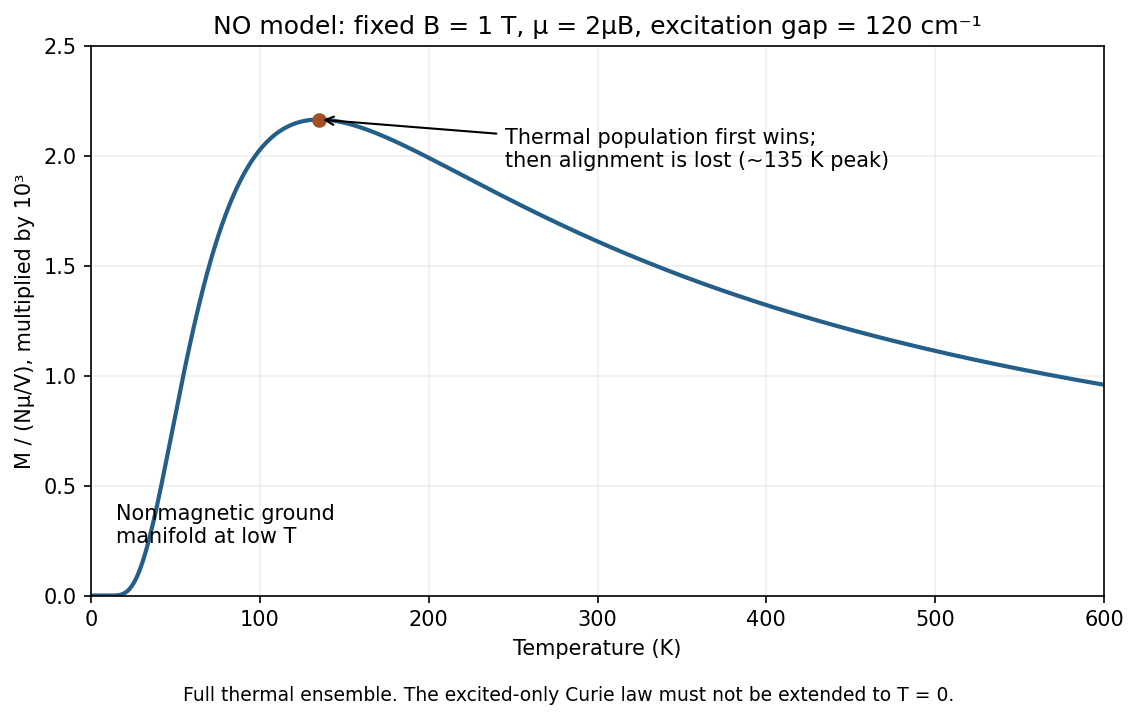
Original full-ensemble NO magnetization for an illustrative fixed 1 T field, including the nonmagnetic ground manifold
. Details. 
In the weak-field regime,Its maximum occurs near K. At high temperature the excited fraction tends to one half, while each magnetic molecule's alignment decreases as , so . The low-temperature suppression must be evaluated from the full partition function; extending the weak-field expansion to at a fixed field would exceed its domain.
The sketch assumes the simplified moments stated in the question. For an arbitrarily strong field with , an aligned magnetic level crosses below the nonmagnetic states and the low-temperature conclusion changes. Real NO has additional rotational and magnetic structure beyond this deliberately restricted model.
Articles by others on the same topic
There are currently no matching articles.