The C=O length is invariant under every operation, so its stretch is . If are the two C–H bond-length changes, their sum and difference giveHence . These are stretching symmetry coordinates; the two motions can mix in actual normal modes, and mass-weighted atomic motions need not have the schematic arrow lengths below.
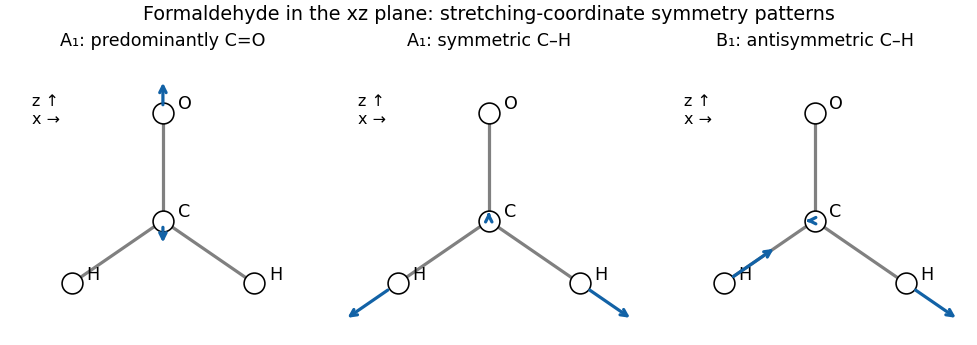

There are three stretching fundamentals, although four stretching-region features are listed. The low feature at is predominantly C=O stretch (). The two features at and are the symmetric and antisymmetric C–H stretches; their order is not determined by this mode count alone.
The feature is consistent with the first C=O vibrational overtone, close to and shifted downward by anharmonicity. Its symmetry is , so symmetry permits the weak anharmonic transition. It is not a fourth stretching fundamental. The combination-band evidence in the next part distinguishes the two C–H assignments.
Articles by others on the same topic
There are currently no matching articles.