Let be a vibrational normal mode coordinate with symmetry . The harmonic vibrational ground state is totally symmetric; the one-quantum state transforms as . Integration over a symmetry-invariant domain annihilates any integrand lacking the totally symmetric representation. Thus a fundamental requiresfor some Cartesian component . For the one-dimensional irreducible representations used here, this means , or . Equivalently, expanding the electric dipole moment givesthe derivative can be nonzero only if and have compatible symmetry. This is the symmetry criterion for vibrational infrared activity; it permits a transition without guaranteeing a large intensity.
With along C=O and the molecule in the plane, formaldehyde has , , and . It belongs to the C2v point group, . Keeping this axis convention is essential when assigning the labels and .
For operations ordered as , the characters of the twelve Cartesian displacements areOnly atoms left fixed contribute: all four for and , but only C and O for and . Multiplying their counts by the Cartesian traces gives these numbers. Subtractto obtain . The character table reduction givesThe dimensions sum to , as required. The mode is the out-of-plane wag with this axis convention.
In this C2v point group convention, , , and . Therefore all six normal modes have symmetry-allowed infrared fundamentals: , absent accidental coincidences or vanishing intensities.
For Raman spectroscopy, examine the polarizability tensor: , , and ; is also Raman-allowed but no vibration occurs here. All six vibrations are therefore Raman-active too, giving . The centrosymmetric mutual-exclusion rule does not apply to formaldehyde.
The C=O length is invariant under every operation, so its stretch is . If are the two C–H bond-length changes, their sum and difference giveHence . These are stretching symmetry coordinates; the two motions can mix in actual normal modes, and mass-weighted atomic motions need not have the schematic arrow lengths below.
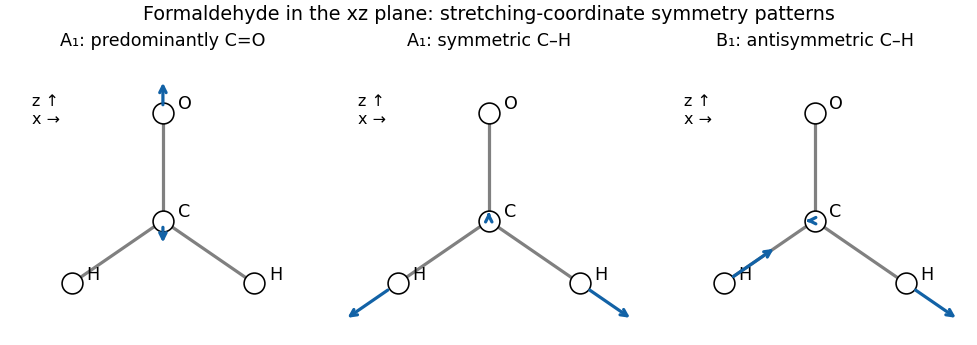

There are three stretching fundamentals, although four stretching-region features are listed. The low feature at is predominantly C=O stretch (). The two features at and are the symmetric and antisymmetric C–H stretches; their order is not determined by this mode count alone.
The feature is consistent with the first C=O vibrational overtone, close to and shifted downward by anharmonicity. Its symmetry is , so symmetry permits the weak anharmonic transition. It is not a fourth stretching fundamental. The combination-band evidence in the next part distinguishes the two C–H assignments.
The out-of-plane displacements in the wag transform as , hence as . A one-quantum combination of two distinct normal modes transforms as the product of their irreducible representations. The observed feature satisfiesA combination of the wag with an stretch has symmetry and can absorb through . In contrast, has no electric-dipole component in and is forbidden in the stated symmetry model. The missing feature near therefore identifies the stretch as .
The completed assignments areThe allowed combination obtains intensity through anharmonic/dipole-coupling terms; a purely separable harmonic model with a strictly linear dipole has no combination bands. The argument uses both the observed combination and the selection rule: absence of a feature by itself would not generally prove a forbidden symmetry.[ref]
Formaldehyde vibrational data in the NIST Chemistry WebBook. Gas-phase fundamentals: CH2 symmetric stretch 2783, antisymmetric stretch 2843, CO stretch 1746, wag 1167 cm−1, with the same symmetry convention
Articles by others on the same topic
There are currently no matching articles.