Take with real , and . The operator domain matters: use sufficiently smooth wavefunctions for which the following boundary terms vanish at both infinities. A real multiplication operator givesTwo applications of integration by parts giveThus the potential energy and kinetic energy operators obey the stated Hermitian operator identity on this common domain. For , one application of integration by parts instead givesThe derivative is anti-Hermitian, rather than Hermitian; the minus sign cannot generally be removed. Multiplication by makes the corresponding momentum operator Hermitian. These integrations establish the requested symmetry identities; full self-adjointness of an unbounded operator additionally requires equality of its domain with its adjoint's domain.
Let with . The Hermitian operator identity and conjugate linearity of the first slot of the inner product implyThe squared norm is positive, so : every such eigenvalue is real.
For two eigenfunctions, apply the same Hermitian operator identity across the two states:Hence . Distinct eigenvalues therefore imply orthogonal eigenfunctions. Within a degenerate eigenspace, orthogonality is a possible basis choice, rather than a consequence for every pair of vectors.
Multiply the eigenfunction expansion by and integrate over the common domain. Orthogonality and wavefunction normalization giveThus . For a normalized , the Born rule identifies as the probability of this basis outcome.
The decisive observation is that is itself an eigenfunction:On the regular Legendre polynomial domain, integration by parts has endpoint factor , so the boundary form vanishes for regular functions at . The interval alone is not an endpoint condition; regularity is the usual condition selecting the Legendre polynomials. Their eigenvalues are , and the normalized function isThereforeEquivalently, the Hermitian operator identity gives , and nondegeneracy leaves only one possible nonzero coefficient. The unnormalized function has squared norm , consistent with this coefficient.
The quantum variational principle states that the energy expectation of an admissible trial wavefunction is at least the ground state energy:For the discrete, complete orthonormal basis assumed here, expand in Hamiltonian operator eigenfunctions, , with and . ThenEvery summand is nonnegative. Equality holds precisely when all occupied components lie in the ground eigenspace. Thus minimizing trial energies supplies upper bounds on , with exact equality if the trial family contains a ground state.
The Pauli principle requires the complete wavefunction of identical fermions to be antisymmetric under exchanging the full coordinates, including spin:It is the total spatial-and-spin state that changes sign; the spatial factor alone need not be antisymmetric.
Let and be orthonormal atomic orbitals. The normalized spatial factors areFor the singlet state, use the antisymmetric spin factorFor the three components of the triplet state, useEach total wavefunction obeys the Pauli principle. At coincident spatial coordinates,Consequently the triplet pair probability density vanishes at coincidence, even for its component. This zero is stronger than the trivial statement that any exact point has zero integrated probability in a continuum.
In atomic units, define the Coulomb integral and exchange integral byExpanding the four products in the expectation of yieldsThe one-electron terms have the same value for these two states. Within this common-orbital approximation,so . The exchange integral is nonnegative: it is the positive Coulomb quadratic form of the transition density , or equivalently has a nonnegative Fourier representation. The triplet is lower. Actual orbital relaxation and correlation make the common-orbital an approximate physical splitting.
Keeping the same two spin states but incorrectly imposing boson exchange symmetry would require a symmetric total wavefunction. The spin-antisymmetric singlet state would then accompany , while the spin-symmetric triplet state would accompany . Thusand . The ordering reverses: the triplet would be destabilized by relative to the singlet. A genuinely spinless boson would have no singlet/triplet spin distinction; this comparison changes exchange symmetry while retaining the question's spin degrees of freedom.
If two fermions occupied the same complete spin orbital , their antisymmetrized product would beThe zero vector cannot represent a normalized quantum state. This is the Pauli exclusion principle: at most one identical fermion occupies any complete one-particle state. Two electrons may occupy the same spatial orbital with opposite spins, because and are different spin orbitals.
The and atomic orbitals of chromium are close enough in energy that electron-electron terms can overturn the simple filling order. The configuration permits five singly occupied orbitals and a parallel-spin electron. Relative to , it removes the pair and permits more parallel-spin exchange interactions, lowering the Coulomb-and-exchange contribution enough to offset the orbital promotion cost.
As qualitative bookkeeping, six parallel electron spins give same-spin pairs, compared with in high-spin . The individual exchange integrals are unequal, so this is an explanation of the tendency, rather than a quantitative atomic energy calculation. The observed ground state configuration is .[ref]
The closed argon core contributes . In the half-filled shell, Hund's rules put one parallel-spin electron in each orbital. This gives and the orbital term . Adding the parallel electron, with and , givesThe spin multiplicity is seven. The magnetic projection labels run , while . The term symbol agrees with the observed neutral-chromium ground level.[ref]
Energy levels of neutral chromium in the NIST Handbook. Cr I, ground level a7S3
For one normal mode, the fundamental is , with other modes initially in their ground levels. In the linear-dipole harmonic approximation, the transition moment is nonzero for , so a vibrational fundamental is normally much stronger than its overtones, provided the mode has vibrational infrared activity.
The first vibrational overtone is , with . It lies near twice the fundamental wavenumber, generally slightly below it because of anharmonicity. The linear-dipole harmonic model forbids it; anharmonic wavefunctions or higher terms in the dipole expansion give a weak intensity. Thus it is generally weaker than the corresponding fundamental.
The second vibrational overtone is , with , near three times the fundamental wavenumber. It requires higher-order departures from the linear-dipole harmonic model and is ordinarily weaker again. These are qualitative intensity trends; resonances can redistribute intensity between nearby vibrational states.
A hot band starts from a thermally populated vibrationally excited state, for example . It can satisfy and need not have a small transition moment, but its lower-state population is reduced by the Boltzmann distribution:It is therefore usually weak at low temperature and grows relative to the fundamental on heating. Anharmonicity shifts its frequency away from the transition; in a polyatomic molecule, excitation in another mode can also produce a hot-band sequence.
A useful vibration-rotation expression, with energies measured from the potential minimum, isHere is the vibrational quantum number, the rotational angular-momentum quantum number, the harmonic spectroscopic wavenumber, a dimensionless anharmonic coefficient, and the vibrational-state-dependent rotational constant. is its equilibrium value and describes vibration-rotation coupling. All wavenumber constants use the same inverse-length units; is the Planck constant and the speed of light.
The elementary harmonic rigid rotor result follows by setting , with and , where . The molecule's electronic energy would add a common constant.
A diatomic molecule has vibrational normal mode: the bond stretch. For hydrogen chloride, opposite longitudinal displacements change the electric dipole moment, so the mode has vibrational infrared activity. The following original sketches show one phase of this motion and the three water modes; arrow lengths are schematic, not mass-weighted amplitudes.
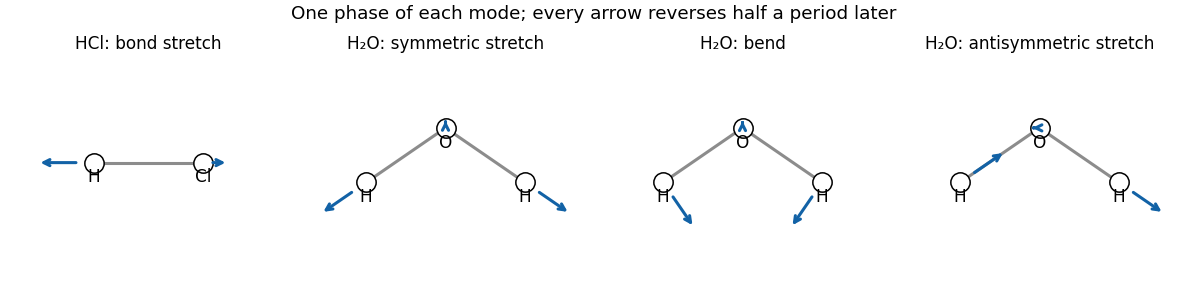
A nonlinear triatomic molecule has vibrational normal modes. For water they are the symmetric O–H stretch, the H–O–H bend, and the antisymmetric O–H stretch, shown above. In the symmetric stretch both O–H lengths increase together; in the antisymmetric stretch one increases while the other decreases; the bend predominantly changes the bond angle. All three change a component of the electric dipole moment and are infrared-active. Every arrow reverses half a period later; motion of oxygen maintains the molecular centre of mass.
This is a rovibrational spectrum: the vibrational excitation is accompanied by quantized molecular rotation. The high-wavenumber R branch has , and the low-wavenumber P branch has . In the simplest common- approximation,Consecutive lines within either branch are therefore separated by roughly , while the gap between P(1) and R(0) is roughly . There is no Q branch: for this diatomic parallel transition, the electric-dipole rotational selection rule allows , and the line strength vanishes.
The intensity envelope comes from rotational populations, approximately , together with the rotational line strengths. The paired peaks arise from the two chlorine isotopologues, and : their different reduced masses shift both rotational and vibrational spacings. The more abundant gives the stronger member. The changing spacing away from the band centre reflects and, at higher , centrifugal distortion; it is not evidence for additional vibrational fundamentals.
Use the two-body reduced mass, rather than the chlorine mass or hydrogen mass alone:The bond force constant givesThe requested “frequency in cm−1” is a spectroscopic wavenumber; the ordinary frequency is the value in s−1 above. This calculation uses the question's force constant in the harmonic model, rather than replacing it with a tabulated spectroscopic constant.
Read the stronger members of the inset doublets at about , and . Their spacings are roughly –, so the common- estimate isUsing the harmonic wavenumber from the preceding calculation and labelling lines by the lower-state ,These are graph-based estimates. Finite reading precision and different upper/lower rotational constants limit their accuracy to a few cm−1; extra decimal places would not be justified. The R1 result refers to , while R0 is the line nearest the high-wavenumber side of the band gap.
Let be a vibrational normal mode coordinate with symmetry . The harmonic vibrational ground state is totally symmetric; the one-quantum state transforms as . Integration over a symmetry-invariant domain annihilates any integrand lacking the totally symmetric representation. Thus a fundamental requiresfor some Cartesian component . For the one-dimensional irreducible representations used here, this means , or . Equivalently, expanding the electric dipole moment givesthe derivative can be nonzero only if and have compatible symmetry. This is the symmetry criterion for vibrational infrared activity; it permits a transition without guaranteeing a large intensity.
With along C=O and the molecule in the plane, formaldehyde has , , and . It belongs to the C2v point group, . Keeping this axis convention is essential when assigning the labels and .
For operations ordered as , the characters of the twelve Cartesian displacements areOnly atoms left fixed contribute: all four for and , but only C and O for and . Multiplying their counts by the Cartesian traces gives these numbers. Subtractto obtain . The character table reduction givesThe dimensions sum to , as required. The mode is the out-of-plane wag with this axis convention.
In this C2v point group convention, , , and . Therefore all six normal modes have symmetry-allowed infrared fundamentals: , absent accidental coincidences or vanishing intensities.
For Raman spectroscopy, examine the polarizability tensor: , , and ; is also Raman-allowed but no vibration occurs here. All six vibrations are therefore Raman-active too, giving . The centrosymmetric mutual-exclusion rule does not apply to formaldehyde.
The C=O length is invariant under every operation, so its stretch is . If are the two C–H bond-length changes, their sum and difference giveHence . These are stretching symmetry coordinates; the two motions can mix in actual normal modes, and mass-weighted atomic motions need not have the schematic arrow lengths below.
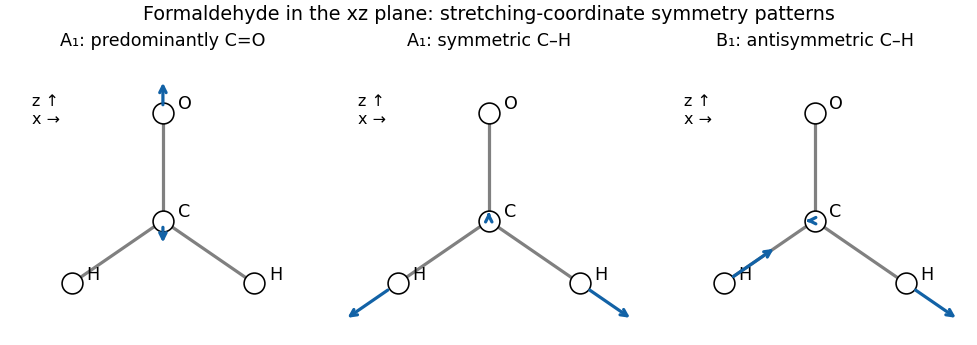


There are three stretching fundamentals, although four stretching-region features are listed. The low feature at is predominantly C=O stretch (). The two features at and are the symmetric and antisymmetric C–H stretches; their order is not determined by this mode count alone.
The feature is consistent with the first C=O vibrational overtone, close to and shifted downward by anharmonicity. Its symmetry is , so symmetry permits the weak anharmonic transition. It is not a fourth stretching fundamental. The combination-band evidence in the next part distinguishes the two C–H assignments.
The out-of-plane displacements in the wag transform as , hence as . A one-quantum combination of two distinct normal modes transforms as the product of their irreducible representations. The observed feature satisfiesA combination of the wag with an stretch has symmetry and can absorb through . In contrast, has no electric-dipole component in and is forbidden in the stated symmetry model. The missing feature near therefore identifies the stretch as .
The completed assignments areThe allowed combination obtains intensity through anharmonic/dipole-coupling terms; a purely separable harmonic model with a strictly linear dipole has no combination bands. The argument uses both the observed combination and the selection rule: absence of a feature by itself would not generally prove a forbidden symmetry.[ref]
Formaldehyde vibrational data in the NIST Chemistry WebBook. Gas-phase fundamentals: CH2 symmetric stretch 2783, antisymmetric stretch 2843, CO stretch 1746, wag 1167 cm−1, with the same symmetry convention
The planar para-quinone framework has three mutually perpendicular twofold axes, inversion through its centre, and the associated mirror planes. With horizontal, along the two C=O bonds and perpendicular to the molecule, it belongs to the D2h point group, .
Write for the orthonormal atomic orbital on numbered site , with every positive lobe pointing along . A normalized set of symmetry-adapted linear combinations isEach has unit squared coefficient sum, and every distinct pair has zero inner product. The orbital representation therefore reduces to . For example, the fully symmetric site sum still has orbital symmetry because a orbital itself changes sign under operations that reverse . Ignoring that sign would assign the wrong representations.
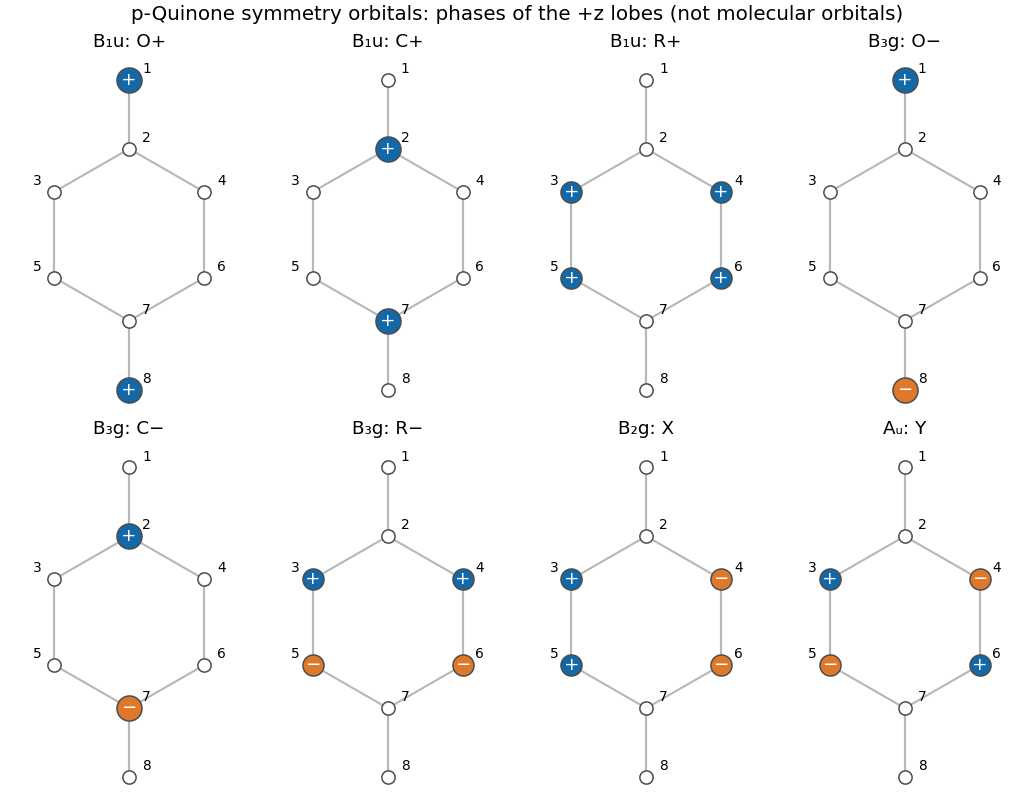

Set , with the usual bonding convention . In the Hückel method, the dimensionless matrix has diagonal entries one on oxygen sites 1 and 8, zero on carbon, and unit entries between bonded neighbours. In the bases and above, its blocks areThe one-dimensional and blocks have and , respectively. The characteristic polynomial of the block factors asso its three molecular orbital energies areFor the block the matrix trace is zero. Thus its three values sum to zero, and the pair supplied in the paper gives the remaining one as . Directly, its secular equation is , whose roots are approximately , and . The supplied pair is approximate, so from its trace and from the exact block should not be mistaken for an additional physical splitting.
All eight energies, ordered from low to high for , areThe eight electrons fill the four lowest molecular orbitals. The equality at is an accidental degeneracy of this parameterized model, not a multidimensional representation of .
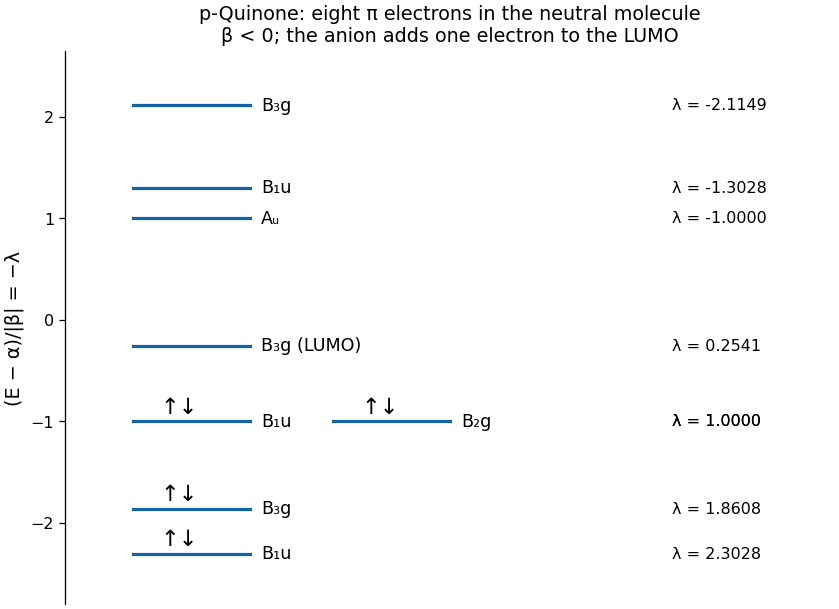
Original Hückel method energy-level diagram for neutral para-quinone, with eight electrons and its unoccupied level
. Details. 
The extra electron occupies the lowest unoccupied molecular orbital of the neutral molecule, the orbital at the middle root of . WriteThe first and third rows of the block giveChoosing the overall phase so that site 1 is positive gives . In the original site order,The squared coefficients sum to one. Within this fixed-orbital Hückel orbital charge density approximation, the added electron contributes site populationsThus the oxygen sites receive the largest added negative charge, each receiving an increment of approximately . Including the four doubly occupied neutral orbitals gives an anion population of about on each oxygen, on sites 2 and 7, and on each remaining carbon. Thus oxygen also has the largest total population in this model. A coefficient's sign is an orbital phase, not the sign of its electric charge. Predicting an actual charge density would additionally require orbital relaxation and a population-analysis convention; the stated result is the requested orbital model.
Articles by others on the same topic
There are currently no matching articles.