The alcohol oxygen attacks sulfur of methanesulfonyl chloride, chloride leaves, and triethylamine removes the O–H proton. This gives an O-mesylate with retention of the carbon configuration: the original carbon–oxygen bond has not been displaced.
An accessible chair places the mesylate axial. triethylamine then removes the anti axial hydrogen on the carbon between the ketone and mesylate. Its C–H bond forms the new C=C bond while the C–O bond expels mesylate. The result is the conjugated cyclohexenone.
The neighboring carbon on the acetonide side has its relevant axial position occupied by its oxygen substituent, rather than an anti axial hydrogen. The elimination toward the ketone is therefore favored both by the trans-diaxial geometry and by conjugation of the resulting alkene with C=O. The acetonide remains intact. No inversion of the original alcohol carbon is required during mesylation, and it becomes planar during elimination.
B is the major product: the newly formed OH is the dashed bond in the printed zigzag structure. Retain the existing solid-wedge OH and the configuration at the carbamate-bearing carbon.
zinc coordinates the ketone oxygen and the adjacent hydroxyl oxygen, forming a five-membered O–Zn–O chelate. This constrains rotation around the carbonyl–alpha-carbon bond. In the favored chelated conformation the bulky group shields one face of the ketone, while the alpha hydrogen leaves the other more accessible. hydride attacks from that less crowded face, the carbonyl bond opens onto oxygen, and aqueous work-up gives the second alcohol.
Mapping this Cram chelation model back onto the printed zigzag gives B, not A. Merely placing a new OH “on the same side” of an unrotated page drawing is not a valid chelation argument: the reactive chelate and that drawing use different conformations. Zinc-borohydride reductions of alpha-hydroxy ketones are experimentally known to favor the corresponding anti-1,2-diol family under chelation control.[ref]
The reagent combination can generate zinc borohydride and related zinc-associated reducing species. The stereochemical justification is coordination-controlled facial selectivity; it does not require identifying a unique solution aggregate from the reagent list. The quoted yield is not itself a measurement of a 95:5 diastereomeric ratio.
The first step is a vinylogous aldol condensation at C5 of the unsaturated lactam. Number nitrogen N1, the lactam carbonyl C2, and then the methoxy-substituted alkene C3=C4 and the methylene group C5.
hydroxide reversibly removes a C5 proton. The resulting vinylogous enolate is delocalized through C5–C4–C3–C2–O: it is not necessary to create an unstabilized isolated carbanion beside nitrogen. Its C5 nucleophilic contributor attacks acetone. protonation gives a C5-linked tertiary alcohol, . Further removal of the remaining C5 hydrogen and elimination through an aldol-dehydration sequence forms C5=C(Me)2, leaving the original methoxy enol ether in place.
In the second step, aqueous acid hydrolyses that enol ether to a ketone at C4. protonation at C3 gives an oxygen-stabilized cation at C4. water attacks C4, proton transfers form a hemiacetal-like intermediate, and loss of methanol followed by deprotonation produces C4=O and the C3 methylene group.
The lactam carbonyl and N–H group remain, as does the exocyclic isopropylidene group. This accounts for replacement of the C3=C4–OMe unit by C3H2–C4=O without inserting a new oxygen into the ring skeleton.
The hydroxyl group first binds aluminium, normally by deprotonation to an aluminium alkoxide with release of hydrogen. Coordination also brings aluminium close to the alkyne. directed trans-hydroalumination then puts hydride on the alkyne carbon proximal to CH2O and aluminium on the distal carbon.
One useful mechanistic description has external hydride attacking the coordinated alkyne opposite the aluminium-containing face. The resulting vinylaluminate is stabilized by a five-membered O–Al–C–C–CH2 chelate. This is not the ordinary undirected syn addition of a neutral dialkylaluminium hydride. Propargylic-alcohol-directed trans-hydroalumination with Red-Al gives vinylaluminate intermediates that can be intercepted by electrophiles.[ref]
trans-Hydroalumination and alkylation by Neil F. Langille and Timothy F. Jamison. Abstract, stereoselective vinylalanate formation from propargylic alcohols
iodine replaces the distal C–Al bond with C–I without scrambling the alkene geometry; aqueous work-up releases the alcohol. hydride and iodine are consequently trans across the alkene, while iodine and the CH2OH group are on the same side.
By Cahn-Ingold-Prelog priority rules priority the product is therefore : CH2OH outranks H at one alkene carbon and I outranks CH2R' at the other. Describing the two carbon chains as trans would not make this an alkene, because the iodine changes which substituent has higher priority.
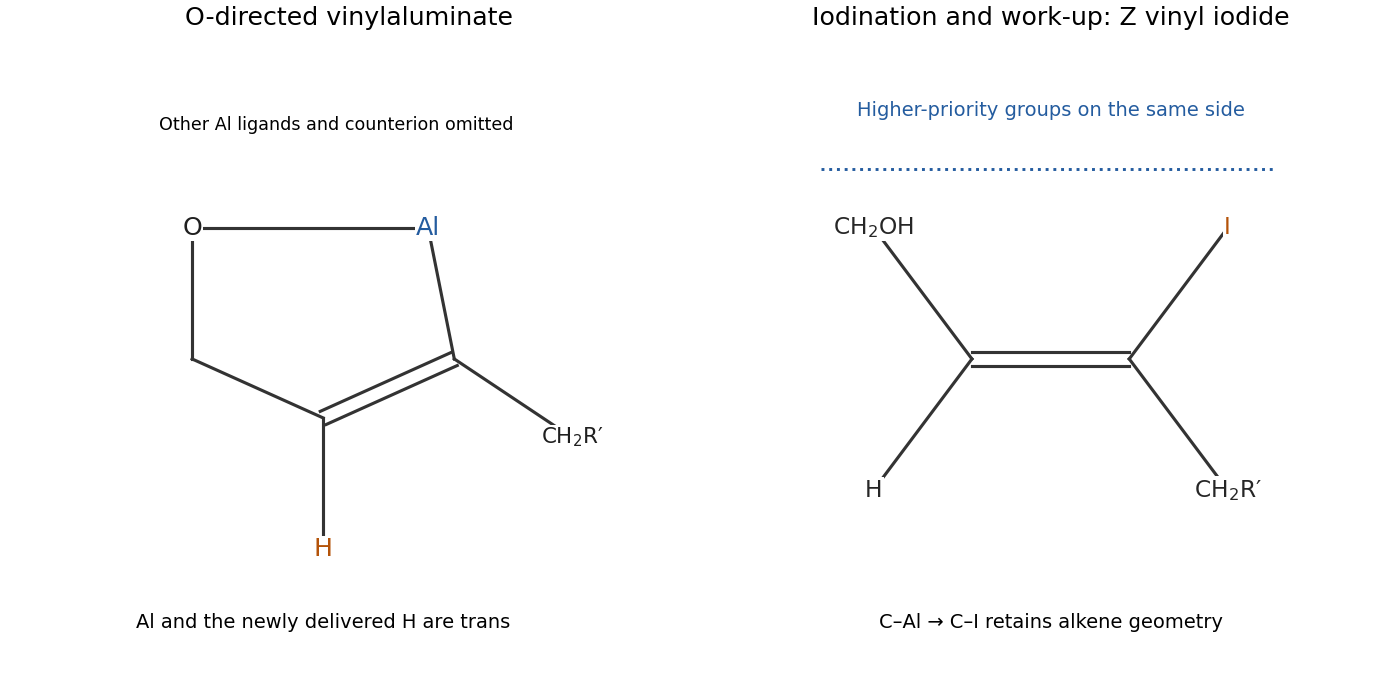
Directed anti hydroalumination, stereoretentive iodination and the Z priority assignment
. Details. 
Articles by others on the same topic
There are currently no matching articles.