The hydroxyl group first binds aluminium, normally by deprotonation to an aluminium alkoxide with release of hydrogen. Coordination also brings aluminium close to the alkyne. directed trans-hydroalumination then puts hydride on the alkyne carbon proximal to CH2O and aluminium on the distal carbon.
One useful mechanistic description has external hydride attacking the coordinated alkyne opposite the aluminium-containing face. The resulting vinylaluminate is stabilized by a five-membered O–Al–C–C–CH2 chelate. This is not the ordinary undirected syn addition of a neutral dialkylaluminium hydride. Propargylic-alcohol-directed trans-hydroalumination with Red-Al gives vinylaluminate intermediates that can be intercepted by electrophiles.[ref]
trans-Hydroalumination and alkylation by Neil F. Langille and Timothy F. Jamison. Abstract, stereoselective vinylalanate formation from propargylic alcohols
iodine replaces the distal C–Al bond with C–I without scrambling the alkene geometry; aqueous work-up releases the alcohol. hydride and iodine are consequently trans across the alkene, while iodine and the CH2OH group are on the same side.
By Cahn-Ingold-Prelog priority rules priority the product is therefore : CH2OH outranks H at one alkene carbon and I outranks CH2R' at the other. Describing the two carbon chains as trans would not make this an alkene, because the iodine changes which substituent has higher priority.
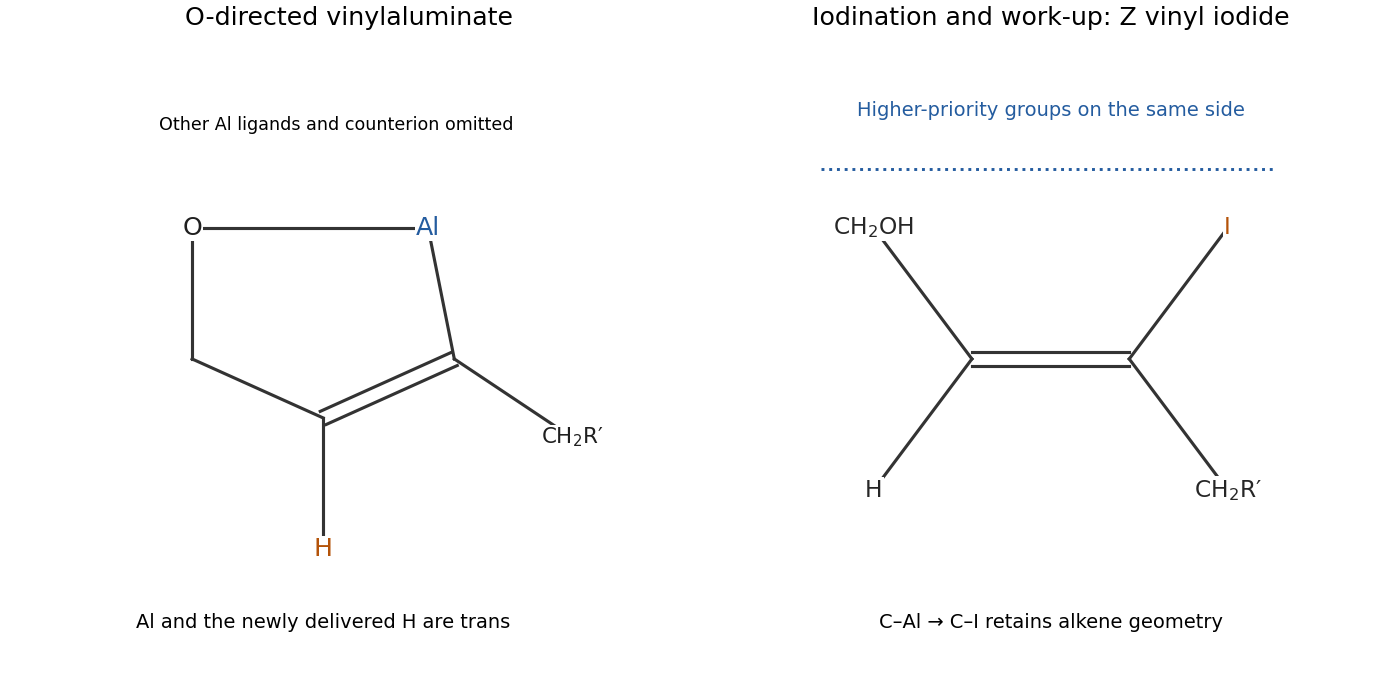
Directed anti hydroalumination, stereoretentive iodination and the Z priority assignment
. Details. 
Articles by others on the same topic
There are currently no matching articles.