Let be normal to the Cp ring through its centre. The five carbon orbitals form symmetry-adapted linear combinations with angular patterns , , and . The all-in-phase combination has sigma symmetry about this axis and can interact with . The pair matches by pi symmetry, while the pair matches by delta symmetry. Rotating within either degenerate pair changes the drawing but not the physical interaction.
For the usual eta-five geometry, the metal interactions are ranked qualitatively pi > delta > sigma. The lobes overlap effectively with the occupied ring combinations. The delta interaction is weaker and involves the higher, initially unoccupied Cp combinations; the interaction with the ring is particularly weak because its axial and equatorial parts contribute little net overlap in this geometry. Thus the statement that a sigma bond is always stronger than a pi bond cannot be transferred indiscriminately to this delocalized ring–metal overlap problem. metal and orbitals also have the symmetry of the coordination ligand combination and contribute to overall bonding, so weak overlap does not mean the entire sigma-symmetry channel is absent.
In ionic electron counting, Cp is with six pi electrons in its three occupied ring combinations, hence a six-electron donor. The same coordination ligand is assigned five electrons in neutral counting.
In a metallocene, several orbitals with substantial metal character are nonbonding molecular orbitals or only weakly bonding or antibonding with respect to the strong Cp–metal framework. Adding or removing a small number of electrons from them can therefore change oxidation state or spin without destroying the principal ring–metal bonds. This allows stable compounds on either side of the 18-electron count: for example, the usual neutral counts for chromocene, ferrocene, cobaltocene and nickelocene are respectively 16, 18, 19 and 20. The 18-electron rule remains a useful reference, but occupation of a weakly antibonding orbital is much less disruptive than occupation of a strongly antibonding orbital. Redox stability also depends on geometry, substituents and reaction conditions, so this is a bonding explanation of the observed flexibility rather than a guarantee of equal stability for all counts.
Use neutral electron counting consistently: each terminal Cp supplies five electrons, while the eight pi electrons of neutral pentalene must be allocated across the shared fused framework rather than counted twice as two independent Cp coordination ligands. One set of 18-electron-consistent proposals is:
- Iron: syn - pentalene with an Fe–Fe single bond. The two iron–Cp fragments lie on the same face. Assigning four pentalene electrons to each iron gives before direct bonding; the Fe–Fe bond contributes one electron to each count, giving 18. Its direct bond naturally accounts for the especially short metal–metal separation. An anti arrangement cannot retain this short same-face bond.
- Cobalt: - pentalene without a Co–Co bond. The count is at each metal. Syn and anti arrangements are possible at this formal level because there is no required direct bond. Removal of the bond relative to iron accounts for a larger separation.
- Nickel: slipped - coordination to the two outer allylic portions. The fusion bond remains an uncoordinated alkene in this limiting bonding picture, while each outer three-carbon portion contributes three electrons in neutral counting: . Equivalent ionic counting gives a nickel(II) centre, a six-electron Cp and a four-electron allyl ligand. Moving the metal binding sites toward the outer three-carbon portions increases the separation further. Syn and anti arrangements can again be drawn.
The original schematic shows the donor regions and the required iron–iron bond; dashed metal-to-region lines denote delocalized coordination rather than localized carbon–metal single bonds.
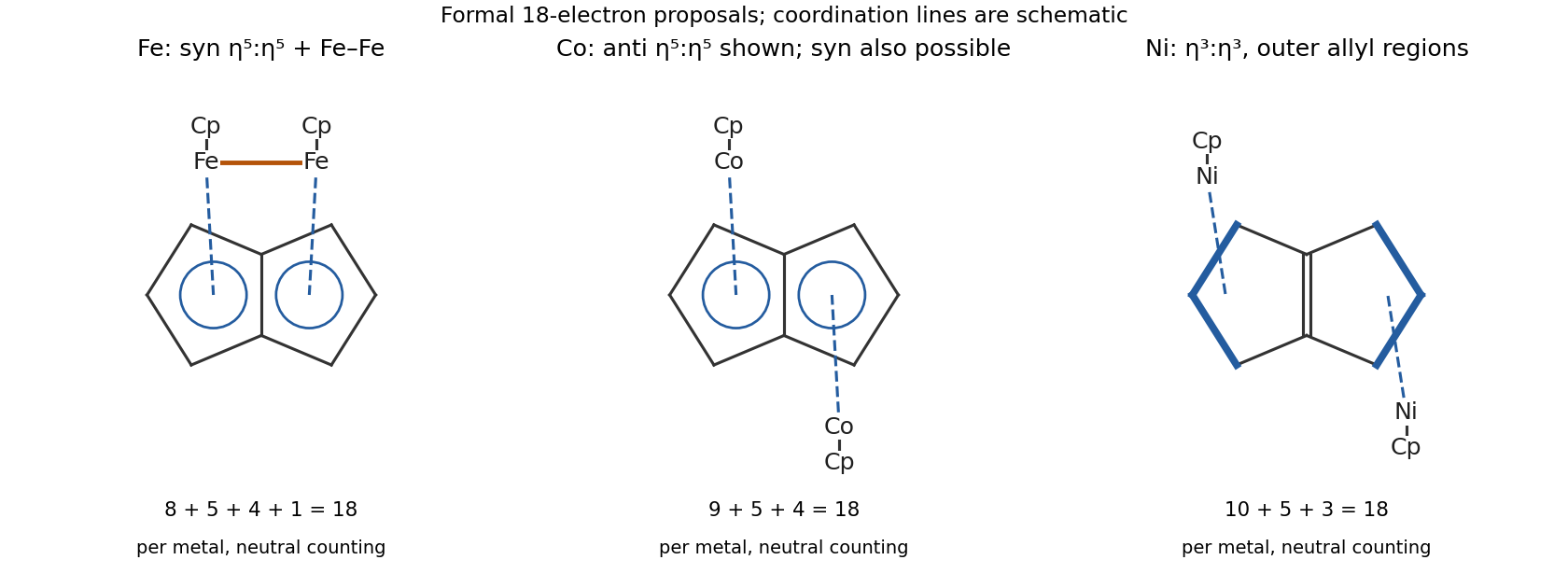
These proposals explain the requested electron counts and distance ordering. electron counting alone does not establish the unique ground-state structure: orbital calculations on related pentalene complexes also identify stable formally electron-deficient arrangements. In particular, the formal requirement of a metal–metal bond in the proposed 18-electron iron model should not be converted into a claim that every known iron pentalene complex adopts that model.[ref]
The Versatility of Pentalene Coordination to Transition Metals: A Density Functional Theory Investigation by S. Bendjaballah and others. Discussion of syn/anti coordination, hapticity and electron-count exceptions
One equivalent of butyllithium removes one proton per hydrocarbon, giving the hydropentalenyl monoanion . It does not give the doubly deprotonated pentalenide. salt metathesis with half an equivalent of iron(II) chloride therefore gives the sandwich complexEach coordination ligand binds through its aromatic five-membered portion and retains an uncoordinated double bond in the fused ring. The orientation of this unsymmetrical fused appendage makes the two coordinated coordination ligand faces distinguishable. Pairing matching and opposite planar configurations gives a racemic form, , and a meso form, . This describes the two stereoisomeric classes, rather than assigning the two easily interconverting rotations of ordinary ferrocene as separate configurational isomers. The molecular structure and double-bond disorder of bis(hydropentalenyl)iron have been examined crystallographically.[ref]
Bis(η⁵-hydropentalenyl)iron by Elies Molins and others. Acta Crystallographica C 52, 2414–2416: parallel coordinated rings and double-bond isomer disorder
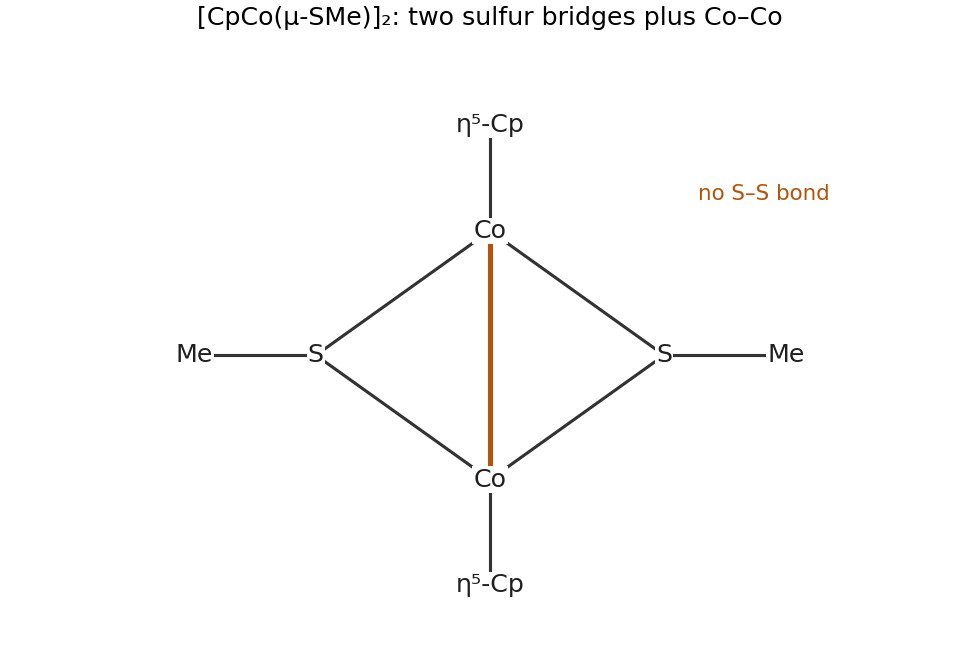
Cleavage of the disulfide supplies one methylthiolate per cobalt. A monomer would have only electrons by ionic counting. Dimerization with two bridging thiolates supplies a second sulfur interaction at each cobalt, and a direct Co–Co bond completes each count. Thus a suitable structure is with a Co–Co single bond, containing an diamond:Each cobalt is formally : Cp and methylthiolate each carry one negative charge. The stoichiometry isThe molecular formula reduces to the required empirical formula. The sulfur–sulfur bond has been cleaved, both sulfur atoms now bridge the metals, and the loss of two CO molecules per cobalt is balanced. Formally cobalt(I) is oxidized to cobalt(II), while the disulfide is reduced to thiolate.


Articles by others on the same topic
There are currently no matching articles.