Label the carbon next to the carbonyl and the OH-bearing carbon . The three limiting routes are E1, E1cb and E2 elimination. They differ in whether C–O cleavage, C–H cleavage, or both occur in the first elementary event. In the following original transition-state structures, dotted lines denote changing bonds, marks developing partial charge, and the bracketed structures carry . Unmarked skeletal bonds remain present. The dotted line parallel to C–C denotes the developing pi bond, in addition to its existing sigma bond.
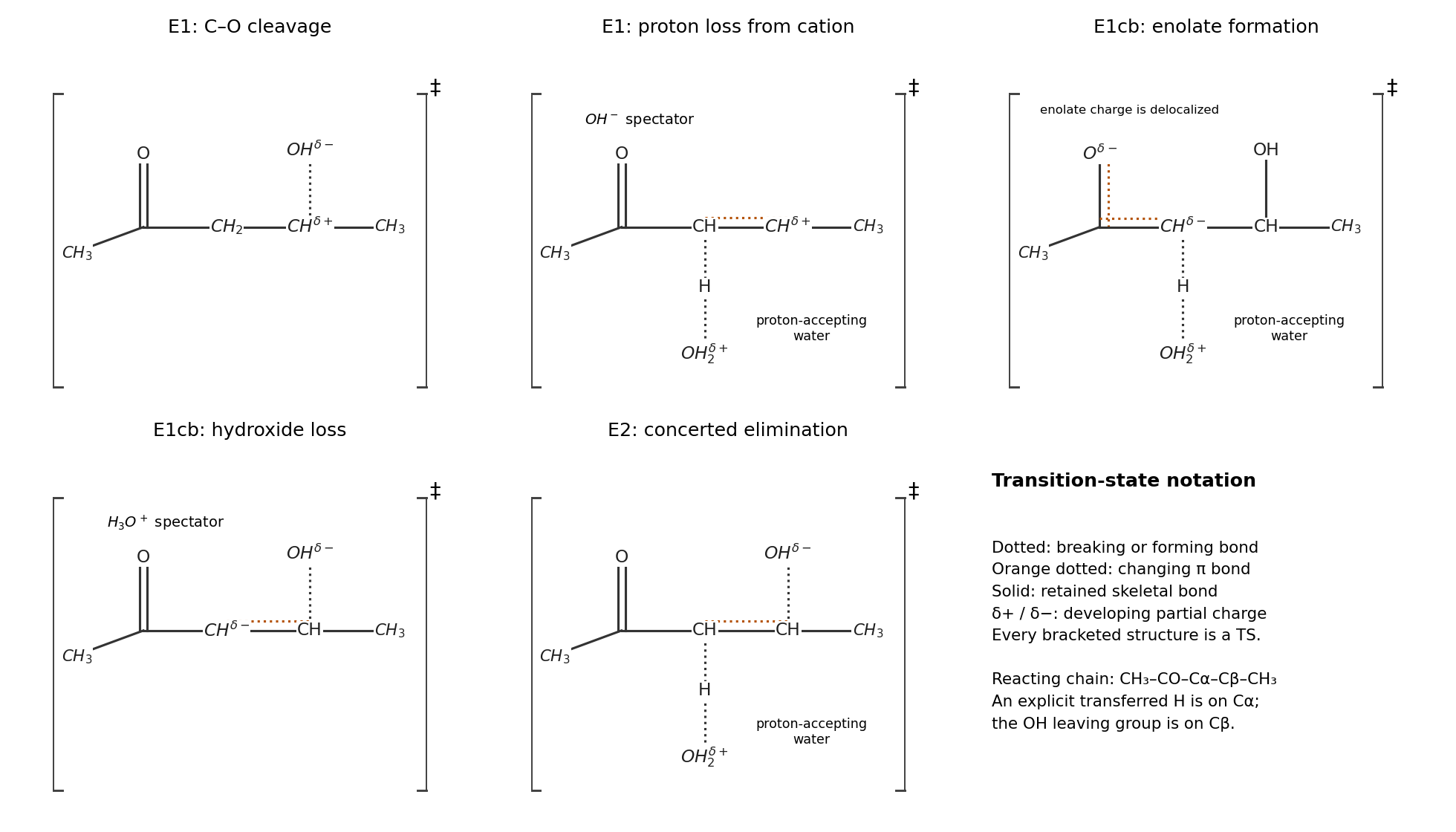
The five transition states in E1, E1cb and concerted E2 limiting elimination pathways
. Details. 
For E1, C–OH heterolysis occurs first. The electron pair in that bond goes to O, producing . Its first transition state has a partly broken C–O bond, developing positive charge on C and negative charge on the leaving O. Next, water uses a lone pair to remove the alpha proton; the C–H electron pair forms the C=C pi bond. This second transition state has partly broken C–H, partly formed water-O–H, and a partly formed C–C pi bond. Positive charge is transferred from the organic cation toward the incoming water/hydronium unit. hydroxide from the first step is a spectator in the second.
For E1cb, water first removes the alpha proton to form a resonance-stabilized enolate plus hydronium:The first transition state has partly broken C–H and partly formed O–H, with developing negative charge delocalized over the alpha-carbon/carbonyl-oxygen system and positive charge on the proton-accepting water unit. The enolate then expels hydroxide: use the carbon-centred contributor to send its alpha-carbon lone pair into C–C, while the C–O pair goes to oxygen. This second transition state has a partly formed alkene pi bond and partly broken C–O, with negative charge moving from the enolate framework onto the departing hydroxide. hydronium is a spectator in this second step.
For E2, water removes the alpha proton as hydroxide leaves in the same elementary step. Three electron-pair movements are simultaneous: water lone pair to H, C–H to the C–C pi bond, and C–O to O. Its single transition state therefore contains all three changing bonds: C–H, water-O–H and C–O, together with the developing pi bond. The departing O becomes negative, the proton-accepting water unit becomes positive, and partial charge at carbon depends on the synchrony of proton loss and leaving-group departure. The reacting conformation should align C–H and C–O approximately in an antiperiplanar conformation for efficient elimination.
These are formal limiting pathways for the displayed net process, not three claims of equal reaction rates in neutral water. In particular, unassisted loss of OH to a secondary carbocation is strongly disfavoured, and water is a weak base for making an enolate. The enolate pathway benefits from resonance stabilization and the final product is a conjugated enone, but actual rate and dominant pathway depend on chemical conditions. The displayed hydroxide and hydronium also rapidly neutralize each other; retaining them separately here tracks which bond cleavage supplied each species. No biological catalysis is needed to describe these chemical mechanisms.
TODO — user-deferred biology. This part is deferred at all four labelled sites (1–4), under the instruction to skip biological subquestions. No biological answer has been researched or supplied.
Articles by others on the same topic
There are currently no matching articles.