Number the ring with chlorine at C1 and the methylsulfonyl group at C4. The new nitro group is at C2, equivalently C6 by the starting ring's symmetry: the product is 1-chloro-2-nitro-4-(methylsulfonyl)benzene. Both substituents favour this site. Although chlorine deactivates the ring inductively, its lone pair donation stabilizes ortho/para Wheland intermediates. The sulfone is strongly electron withdrawing and meta directing; attack ortho or para to it produces especially unfavourable cationic contributors to resonance in chemistry. C2 is ortho to chlorine and meta to sulfone, whereas C3 has the opposite, less favourable relationship.
sulfuric acid protonates nitric acid, followed by loss of water to produce the nitronium ion. A ring pi bond attacks nitrogen, giving the Wheland intermediate with the new C–N bond. deprotonation at the attacked carbon restores aromaticity. This is electrophilic aromatic substitution: the aryl chloride and the sulfone both remain attached. The formula check is . It confirms replacement of one ring hydrogen rather than chlorine, but directing effects, rather than the formula alone, establish the position.
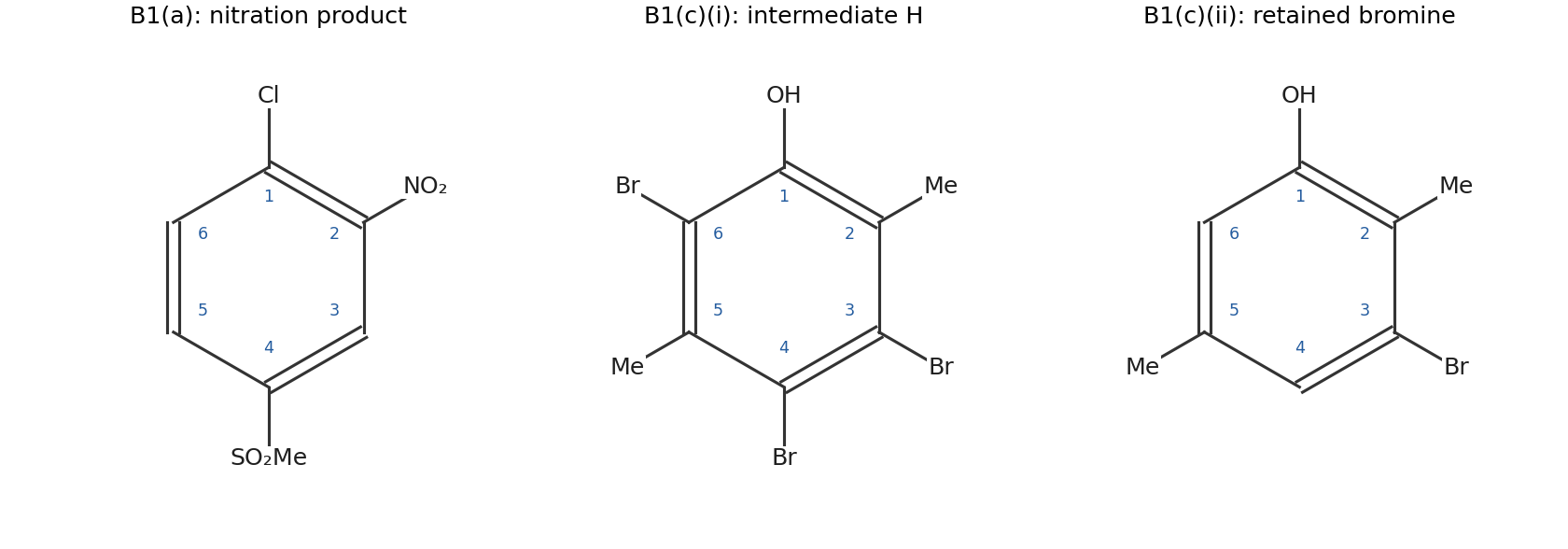
Independently drawn aromatic substitution products and the sites selected by protodebromination
. Details. 
The malonate carbon receives two allyl groups. With , attached through its first carbon, the product issodium hydride removes a methylene proton from diethyl malonate; molecular hydrogen formation accompanies production of an enolate stabilized by resonance in chemistry. Its carbon attacks the bromomethylene carbon of allyl bromide in an SN2 reaction, expelling bromide. The monoalkylated malonate still has one hydrogen between the carbonyls. Excess base removes that hydrogen, and a second equivalent of allyl bromide produces a second carbon–carbon bond. The final malonate carbon has no remaining hydrogen and cannot undergo a third analogous deprotonation there.
The two alkenes are preserved because the substitution occurs at the primary carbon bearing bromine. Counting the introduced groups gives for the diallylated diethyl ester. Its two identical allyl groups also mean that the central carbon is not a stereocenter. This stage is the alkylation portion of the malonic ester synthesis.
hydroxide attacks an ester carbonyl to form a tetrahedral intermediate. Collapse expels ethoxide, and acid–base transfer gives the carboxylate and ethanol. Repeating this nucleophilic acyl substitution at the other ester produces the malonate dianion; acid workup gives , with as defined above.
On heating, one carboxylic acid group is lost through a six-membered cyclic proton-transfer/bond-cleavage arrangement. A carbonyl oxygen of the retained group accepts the proton from the departing carboxyl OH as its C–C bond breaks and carbon dioxide forms; electron redistribution gives the enol-like form of the retained acid. proton transfer/tautomerization then producesThe net decarboxylation is . The central carbon gains a hydrogen, both allyl substituents survive, and only one carboxyl group is removed. It would be incorrect to draw hydrolysis directly giving the final acid without accounting for this carbon loss. The favourable cyclic pathway is characteristic of malonic acid decarboxylation.
The first base equivalent removes O–H; the second removes the alpha C–H. The first equivalent of lithium diisopropylamide converts the carboxylic acid to its lithium carboxylate. A further equivalent removes the remaining hydrogen on the carbon between the two allyl groups, giving a carboxylic acid dianion:The second negative charge has enolate-like delocalization into the carboxyl group; lithium coordination and aggregation are not represented by this simple charge-bookkeeping structure. The carbon nucleophile attacks methyl iodide with C–I bond cleavage, forming the new C–Me bond. acid workup reprotonates the carboxylate, giving . The two equivalents are therefore chemically necessary for the stated carbon alkylation rather than simply an arbitrary excess. A single equivalent is consumed predominantly by the much more acidic carboxylic proton. The product has formula and still has two identical allyl groups, so this methylation does not create a stereocenter.
Number the phenolic carbon C1, with methyl groups at C2 and C5. All three remaining aromatic hydrogens are replaced: is 3,4,6-tribromo-2,5-dimethylphenol. The starting phenol is ; replacing three hydrogens gives , agreeing with the intermediate's composition. Bromination of methyl side chains would not follow the stated Lewis acid-promoted aromatic pathway.
aluminium tribromide polarizes Br–Br. The aromatic ring attacks the electrophilic bromine end, forming a Wheland intermediate; removal of the proton on the attacked carbon restores aromaticity. Repetition fills C4 and C6, the available para and ortho positions activated by OH, and C3, which is activated by the methyl substituents when the other positions are occupied. The formula fixes the extent of substitution without requiring an experimentally unreported order for the individual brominations. The preparative perbromination/selective-debromination sequence is documented in the primary synthetic work.[ref]
Total Synthesis of (Nor)illudalane Sesquiterpenes Based on a C(sp3)-H Activation Strategy by Romain Melot and others. 2019, Scheme 6, upper route from 2,5-xylenol
The bromines ortho and para to OH are removed, leaving the meta bromine at C3. A suitable polar mechanism begins with electrophilic ipso protonation of a brominated carbon. protonation at C4 or C6 gives a Wheland intermediate stabilized by donation of the phenolic oxygen lone pair; an important contributor has an O-protonated cyclohexadienone-like framework. Corresponding protonation at C3 lacks this direct stabilization by resonance in chemistry from OH.
iodide can capture/reduce the departing electrophilic bromine as the C–Br bond electrons restore the aromatic pi system. Thus the incoming hydrogen remains on carbon while bromine is removed, unlike ordinary electrophilic substitution in which the incoming electrophile remains and a proton leaves. bromine trapping can be represented through IBr formation followed by reaction with further iodide to give iodine and bromide. For each replacement the balanced net reduction isApplying it at C4 and C6 gives 3-bromo-2,5-dimethylphenol, with formula . This explains why the position least activated by OH is the one at which bromine survives. It is a proposed acid-assisted protodebromination mechanism consistent with the selectivity; the preparative sequence alone does not prove every proton-transfer or halogen-transfer intermediate. It should not be drawn as iodide simply displacing bromide from an unactivated aryl carbon.
Articles by others on the same topic
There are currently no matching articles.