The Dewar-Chatt-Duncanson model has two complementary interactions. The filled alkene orbital donates to an empty metal orbital, and an occupied metal orbital back-donates into the empty alkene orbital. The metal acceptor has the symmetry of the sum of the two ligand lobes facing it; the back-donor has opposite phases at the two carbon positions and matches the antisymmetric combination.Both channels strengthen metal–alkene attachment. Donation removes some electron density from the internal bonding orbital, while back-donation populates its antibonding partner, so coordination generally reduces C–C bond order. The schematic shows orbital phase signs, not positive and negative electric charges.
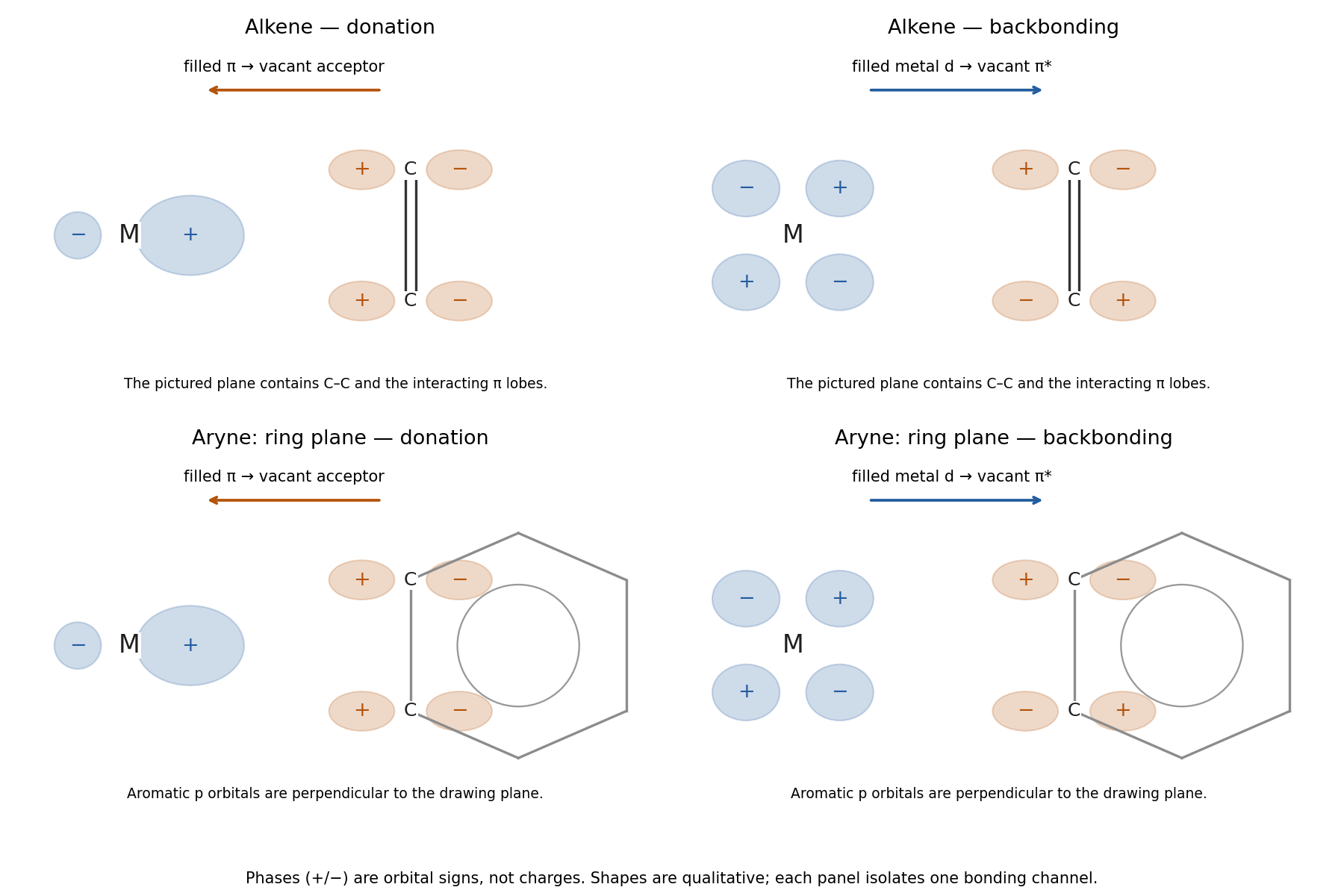
Symmetry-matched alkene donation and backbonding, and the in-plane bonding channel of a coordinated aryne
. Details. 
The chloride complex has Pt(II), , whereas the neutral bis(phosphine) complex has Pt(0), in the neutral-ethene assignment. The lower-valent, phosphine-supported Pt(0) centre back-donates more strongly into ethene , weakening and lengthening its internal C–C bond. This accounts for the longer distance compared with in the Pt(II) complex.
Both are formally 16-electron complexes: for the chloride species and for the phosphine species. Thus the difference is not simply a difference in total valence count. It reflects the energies and occupations of the metal–ligand molecular orbitals. The increased reduction of the ethene ligand gives the Pt(0) complex more metallacyclopropane character; the two descriptions are bonding limits, not distinct products inferred from the distances alone.
Articles by others on the same topic
There are currently no matching articles.