The Dewar-Chatt-Duncanson model has two complementary interactions. The filled alkene orbital donates to an empty metal orbital, and an occupied metal orbital back-donates into the empty alkene orbital. The metal acceptor has the symmetry of the sum of the two ligand lobes facing it; the back-donor has opposite phases at the two carbon positions and matches the antisymmetric combination.Both channels strengthen metal–alkene attachment. Donation removes some electron density from the internal bonding orbital, while back-donation populates its antibonding partner, so coordination generally reduces C–C bond order. The schematic shows orbital phase signs, not positive and negative electric charges.
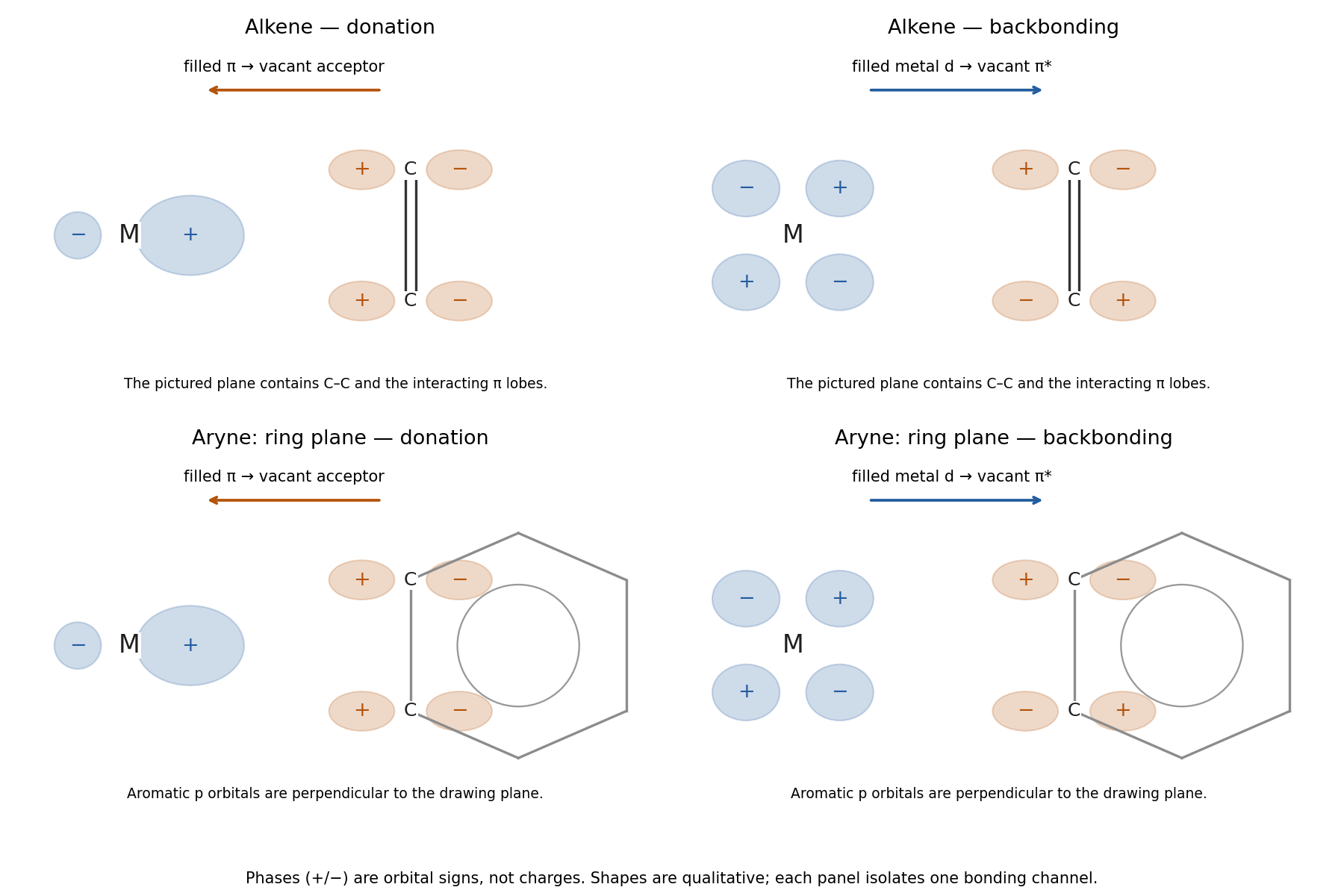
Symmetry-matched alkene donation and backbonding, and the in-plane bonding channel of a coordinated aryne
. Details. 
The chloride complex has Pt(II), , whereas the neutral bis(phosphine) complex has Pt(0), in the neutral-ethene assignment. The lower-valent, phosphine-supported Pt(0) centre back-donates more strongly into ethene , weakening and lengthening its internal C–C bond. This accounts for the longer distance compared with in the Pt(II) complex.
Both are formally 16-electron complexes: for the chloride species and for the phosphine species. Thus the difference is not simply a difference in total valence count. It reflects the energies and occupations of the metal–ligand molecular orbitals. The increased reduction of the ethene ligand gives the Pt(0) complex more metallacyclopropane character; the two descriptions are bonding limits, not distinct products inferred from the distances alone.
The metal interacts with the extra in-plane bonding system of benzyne, not by replacing the ordinary out-of-plane aromatic pi system. Take the ring and metal to lie in the plane, with the metal-to-C–C-midpoint direction along and C1–C2 along . The carbon orbitals directed toward the metal form an occupied symmetric combination and an empty antisymmetric combination.
The occupied in-plane combination donates into an empty metal orbital of matching symmetry. An occupied metal -type orbital overlaps with the in-plane combination, providing back-donation. These are the same symmetry principles as alkene binding, rotated into the plane of the ring. The carbon orbitals perpendicular to the ring continue to participate in its aromatic system. The strained formal triple bond therefore does not supply two independent, ordinary out-of-plane alkene interactions.
Strong population of the in-plane acceptor can be described as reduction of the aryne to a dianionic, metallacyclopropene-like ligand. That description emphasizes two M–C sigma bonds and loss of the extra C–C pi bond. It is particularly useful for early-metal aryne complexes. The lower panels of the orbital schematic distinguish the interacting in-plane orbitals from the perpendicular aromatic set.
A useful strongly bound limit is Zr(IV), , and Ta(V), , with an aryne dianion in each complex. Charge balance uses two Cp ligands for zirconium, and Cp* plus two methyl ligands for tantalum:Equivalently, an unreduced neutral-aryne description starts from Zr(II) and Ta(III), both , and transfers that pair strongly into the aryne acceptor. These are alternative bookkeeping limits for the same covalent interaction; saying that a formal assignment has no available electrons must not erase the strong metal–carbon bonds in the reduced-ligand description.
Both ligands have therefore lost much of the extra in-plane C–C bonding of free benzyne and approach the same reduced, approximately double-bond-length C1–C2 framework. Their identical C–C distances are consistent with similar aryne reduction in both complexes. The distance is intermediate in a delocalized ring, so it should not be converted into an exact integer bond order.
The M–C distances depend additionally on metal size, effective nuclear attraction and orbital overlap. The high formal charge of Ta(V), the size effects associated with the lanthanide contraction, and effective covalent bonding favour shorter Ta–C contacts than Zr–C contacts. This is consistent with versus . Different coordination envelopes and ancillary ligands also contribute, so this pair is not a controlled measurement of a radius or a metal–carbon bond energy. Similar internal ligand bond order can coexist with different metal–ligand distances.
A neutral, simple -NO contributes three electrons to the two-metal unit overall. In neutral bookkeeping it is an LX-type bridge: a two-electron donor component plus the odd electron of neutral NO. For a symmetric bridge, this can be apportioned as electrons to each metal in a covalent count; it is not three electrons independently to each metal.
An equivalent ionic description represents the bridge as NO donating two electrons to each metal, four overall. The extra negative ligand charge must then be included when assigning metal oxidation states. Mixing the four-electron ionic donation with a neutral-NO charge assignment would double-count an electron.
The terminal nitrosyls are linear in both proposed electron-precise structures; the formal M–M bond orders are V–V double and Fe–Fe single. Use three-electron terminal linear NO donors, three-electron -NO bridges, and five-electron neutral Cp donors in covalent counting.
For the vanadium dimer the two metal fragments together containA metal–metal bond of order adds to each local count, so gives and 18 electrons per V. For an ionic cross-check, Cp is , each linear terminal NO is conventionally NO, and each bridge is represented as NO. ThusEach V then has electrons.
The iron species is monoanionic, and is a pyrazolate bridge binding through its two nitrogens. This is a four-electron donor overall in ionic counting, or three overall in neutral counting. The carbonyl bridge supplies two electrons overall. The covalent fragment total is consequentlyTherefore gives . In the formal NO description,Each Fe receives electrons. The negative formal oxidation state follows from the chosen nitrosyl assignment and the overall charge; omitting that charge would change the count.
Bent terminal NO ligands would supply fewer neutral-count electrons and demand much higher formal M–M bond orders to attain 18-electron counts. The linear assignments give the ordinary double and single bond solutions. Since NO is a non-innocent ligand, these oxidation states are formal bookkeeping limits, not measured metal charges; actual nitrosyl bending and M–M bond strengths require structural and spectroscopic evidence.[ref]
Principles of structure, bonding, and reactivity for metal nitrosyl complexes by John H. Enemark and Richard D. Feltham. Coordination Chemistry Reviews 13, pp. 339–406; formal nitrosyl assignments and distinction from actual electron distribution
Articles by others on the same topic
There are currently no matching articles.