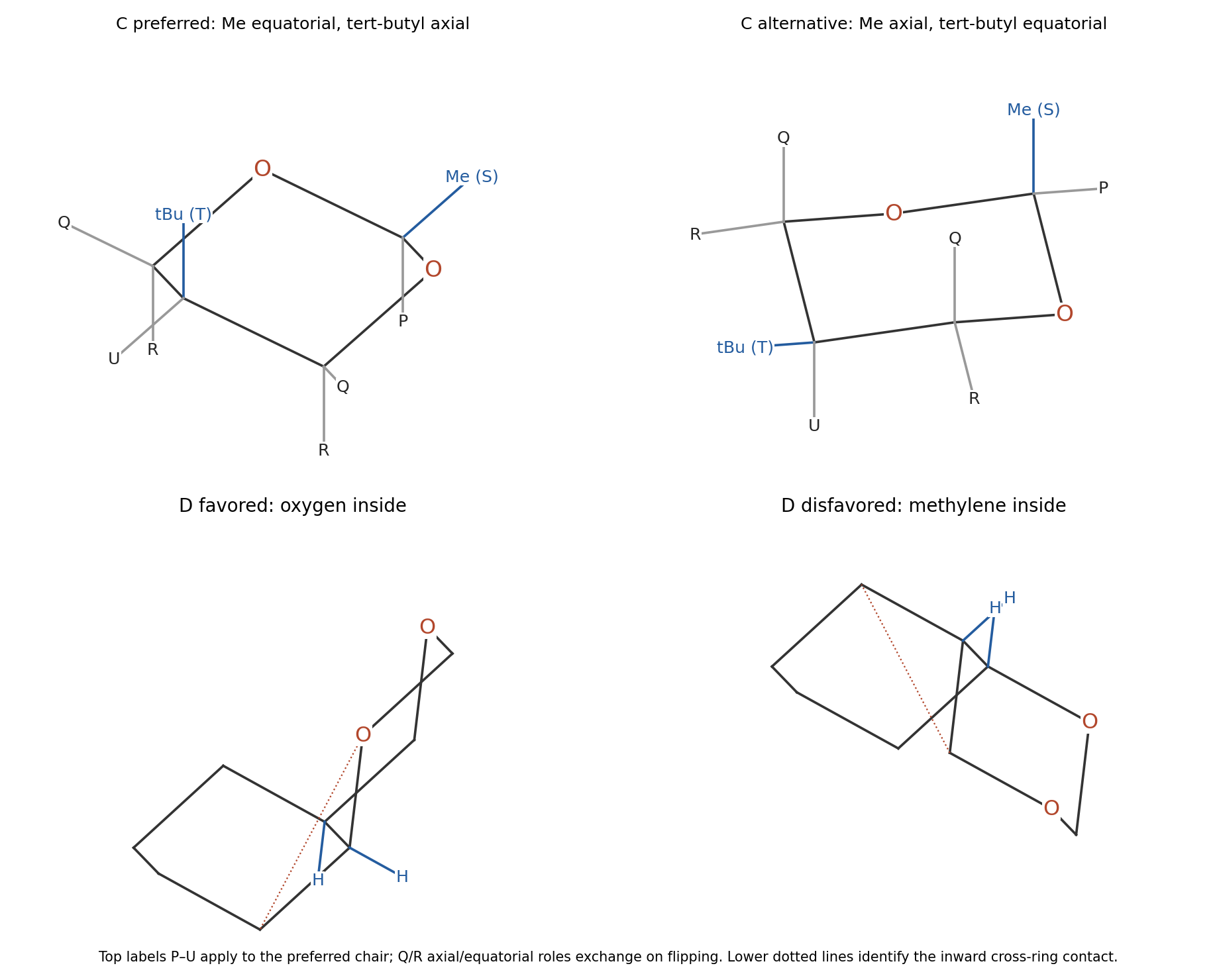
Number the dioxane O1–C2–O3–C4–C5–C6, with methyl at C2 and tert-butyl at C5. Their cis relationship is maintained on ring inversion, but because they occupy opposite ring positions, one is axial and the other equatorial in either chair. The two alternatives are C2–Me equatorial/C5–tert-butyl axial, and C2–Me axial/C5–tert-butyl equatorial.
The key signal is U, the C5 methine, with only small vicinal couplings, 3.7 and 1.3 Hz. An axial H5 would have large trans-diaxial couplings to axial hydrogens on C4 and C6. Their absence identifies H5 as equatorial, hence the preferred conformer has axial tert-butyl and equatorial methyl. It is not sufficient to guess from tert-butyl bulk. The tert-butyl singlet itself supplies no vicinal H–H coupling information about its orientation.

Articles by others on the same topic
There are currently no matching articles.