Number the dioxane O1–C2–O3–C4–C5–C6, with methyl at C2 and tert-butyl at C5. Their cis relationship is maintained on ring inversion, but because they occupy opposite ring positions, one is axial and the other equatorial in either chair. The two alternatives are C2–Me equatorial/C5–tert-butyl axial, and C2–Me axial/C5–tert-butyl equatorial.
The key signal is U, the C5 methine, with only small vicinal couplings, 3.7 and 1.3 Hz. An axial H5 would have large trans-diaxial couplings to axial hydrogens on C4 and C6. Their absence identifies H5 as equatorial, hence the preferred conformer has axial tert-butyl and equatorial methyl. It is not sufficient to guess from tert-butyl bulk. The tert-butyl singlet itself supplies no vicinal H–H coupling information about its orientation.
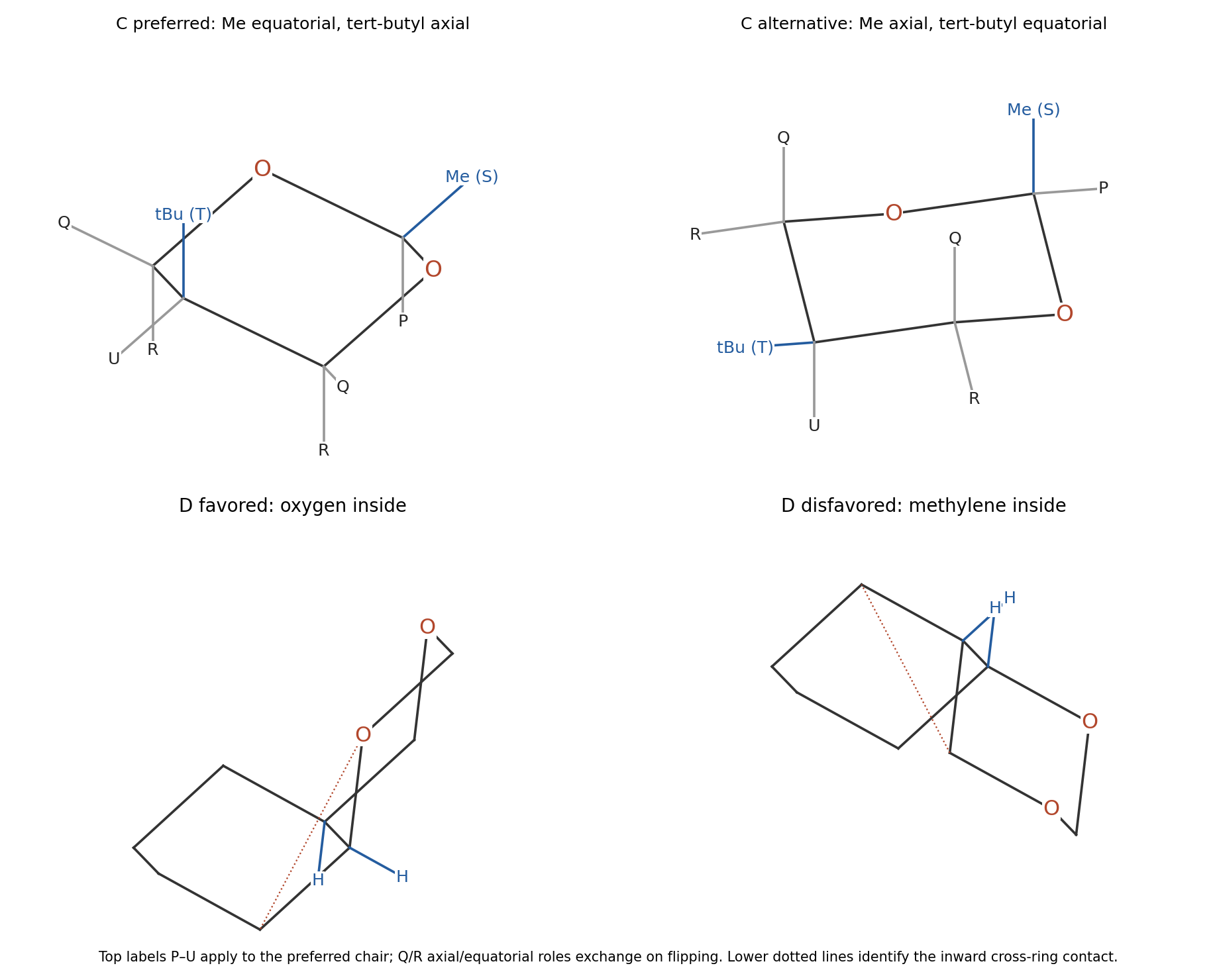

The axial penalties depend on the ring position. An axial methyl at C2 encounters the axial hydrogens on C4 and C6. The short C–O links and dioxane geometry make these 1,3-Diaxial interactions particularly unfavorable. In contrast, an axial substituent at C5 points toward ring oxygens O1 and O3 rather than toward axial C–H groups at those positions. Those oxygen sites present much less steric obstruction than axial hydrogens on carbon.
Avoiding the expensive axial C2 methyl outweighs the cost of axial tert-butyl at C5. Transferring cyclohexane tert-butyl preferences unchanged would therefore give the wrong answer. This is primarily a position-dependent steric comparison, not the usual anomeric preference for an axial electronegative substituent at an acetal carbon. Primary NMR work on substituted dioxanes documents this axial C5 tert-butyl conformer.[ref]
Carbon-13 magnetic resonance. Conformation in some tert-butyl-1,3-dioxanes by Alan J. Jones and others. 1971, pp. 4772–4777, discussion of cis-2-methyl-5-tert-butyl-1,3-dioxane
P is H2, the acetal methine between two oxygens; its only resolved coupling is to the attached methyl, giving the quartet. S is that C2 methyl, whose doublet has the same 6.9 Hz coupling. T is tert-butyl, integrating to nine equivalent hydrogens with no adjacent carbon-bound methine proton across its quaternary attachment.
U is equatorial H5, coupled to the four hydrogens at C4 and C6. The two equivalent equatorial methylene hydrogens are Q, each a doublet of doublets with a 12.3 Hz geminal coupling to its axial partner and a 1.3 Hz coupling to H5. The two equivalent axial methylene hydrogens are R, each with the same 12.3 Hz geminal coupling and a 3.7 Hz vicinal coupling to H5. Equivalence between C4 and C6 makes two pairs rather than four separately shifted methylene hydrogens.Coupling U to two equivalent R hydrogens and two equivalent Q hydrogens produces its triplet of triplets. The different small vicinal couplings are consistent with oblique H–C–C–H torsions for equatorial H5; the 12.3 Hz value is geminal and must not be mistaken for a large vicinal trans-diaxial coupling.
Articles by others on the same topic
There are currently no matching articles.