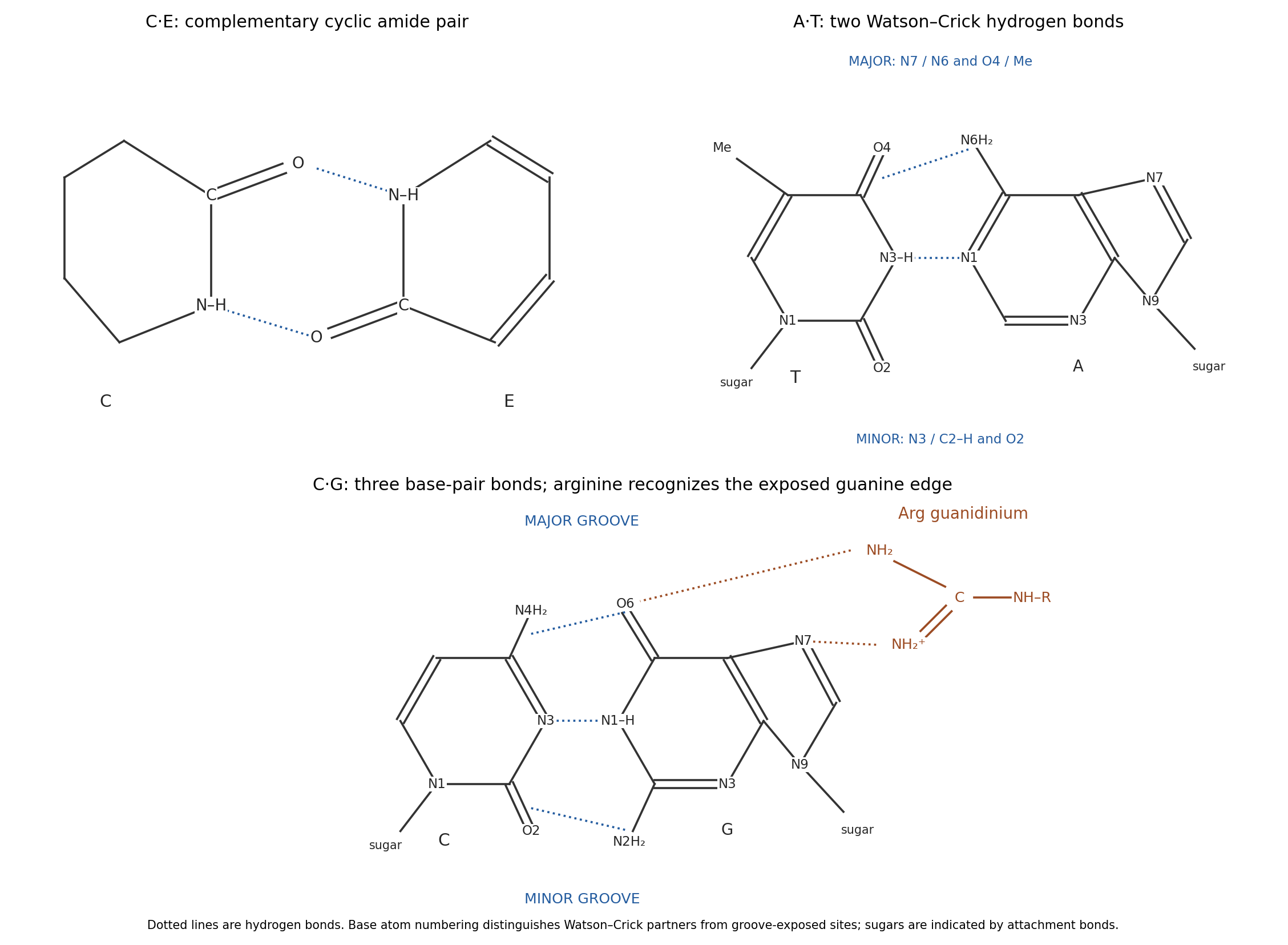
C is the best geometrical match for a strongly bound 1:1 complex with E. Both have an adjacent amide donor–acceptor edge. Arrange them head-to-tail so that the N–H of E donates to the carbonyl oxygen of C, and the N–H of C donates to the carbonyl oxygen of E. This closes the familiar two-hydrogen-bond cyclic amide motif, illustrated below.
C combines a strong acceptor with a useful donor in the correct spacing. B has a stronger individual donor, but its pyridine N and OH are separated around the ring and do not reproduce the compact adjacent amide edge of E. A lacks a matching donor, and D's N–H is weak and has the wrong geometry for the same amide–amide motif. Site strength and spatial complementarity must be considered together; multiplying two isolated probe constants is not a reliable prediction of the complete association equilibrium. Self-association of C or E can compete and must be included in a quantitative binding analysis.

Articles by others on the same topic
There are currently no matching articles.