A: aldehyde oxygen is the best acceptor; there is no conventional strong O–H or N–H donor. The N-methylpyrrole nitrogen contributes its lone pair to aromatic bonding and is not an ordinary amine acceptor. A formyl C–H or ring C–H can participate in weak contacts, but is not comparable to the donors in B and C.
B: pyridine nitrogen is the best acceptor and the phenolic OH is the best donor. Its oxygen can accept more weakly, but nitrogen provides the primary basic site in the depicted hydroxypyridine form.
C: lactam carbonyl oxygen is the best acceptor and the amide N–H is the donor. amide nitrogen is not a useful acceptor because its lone pair is delocalized toward the carbonyl.
D: the secondary amine nitrogen is the best acceptor, and its N–H is the only conventional donor, but a weak one here. Its ketone oxygen is also an acceptor, although weaker than the amine site in this comparison. These assignments distinguish functional-group identity and lone-pair availability, rather than counting heteroatoms.
4-Fluorophenol probes acceptor strength because it donates its OH hydrogen. The qualitative order is C D B A: the electron-rich lactam oxygen is the strongest acceptor here, the secondary amine is next, pyridine nitrogen is intermediate, and aldehyde oxygen is weakest. Resonance donation from amide nitrogen increases the lactam oxygen's basicity relative to an ordinary aldehyde or ketone oxygen. The N-methylpyrrole site in A does not add an independent amine-like acceptor.
N-Methylpyrrolidin-2-one is a carbonyl acceptor without N–H, so it instead probes the solute's donor ability. B C A and D: B's phenolic OH is a strong donor, the lactam N–H of C is appreciable, A lacks a conventional donor, and D's neutral secondary-amine N–H is weak. The amine can be a good acceptor and a poor donor at the same time; the two properties are not opposites on one scale.
These are association equilibria in cyclohexane, where solvent competition for hydrogen bonds is weak. The quoted constants should be compared within each probe series, not treated as solvent-independent measures. At 298 K, as an illustrative common temperature, a tenfold increase in corresponds to a binding free-energy advantage . This does not imply the experiment's temperature was specified, nor that every difference is the energy of one isolated hydrogen bond.
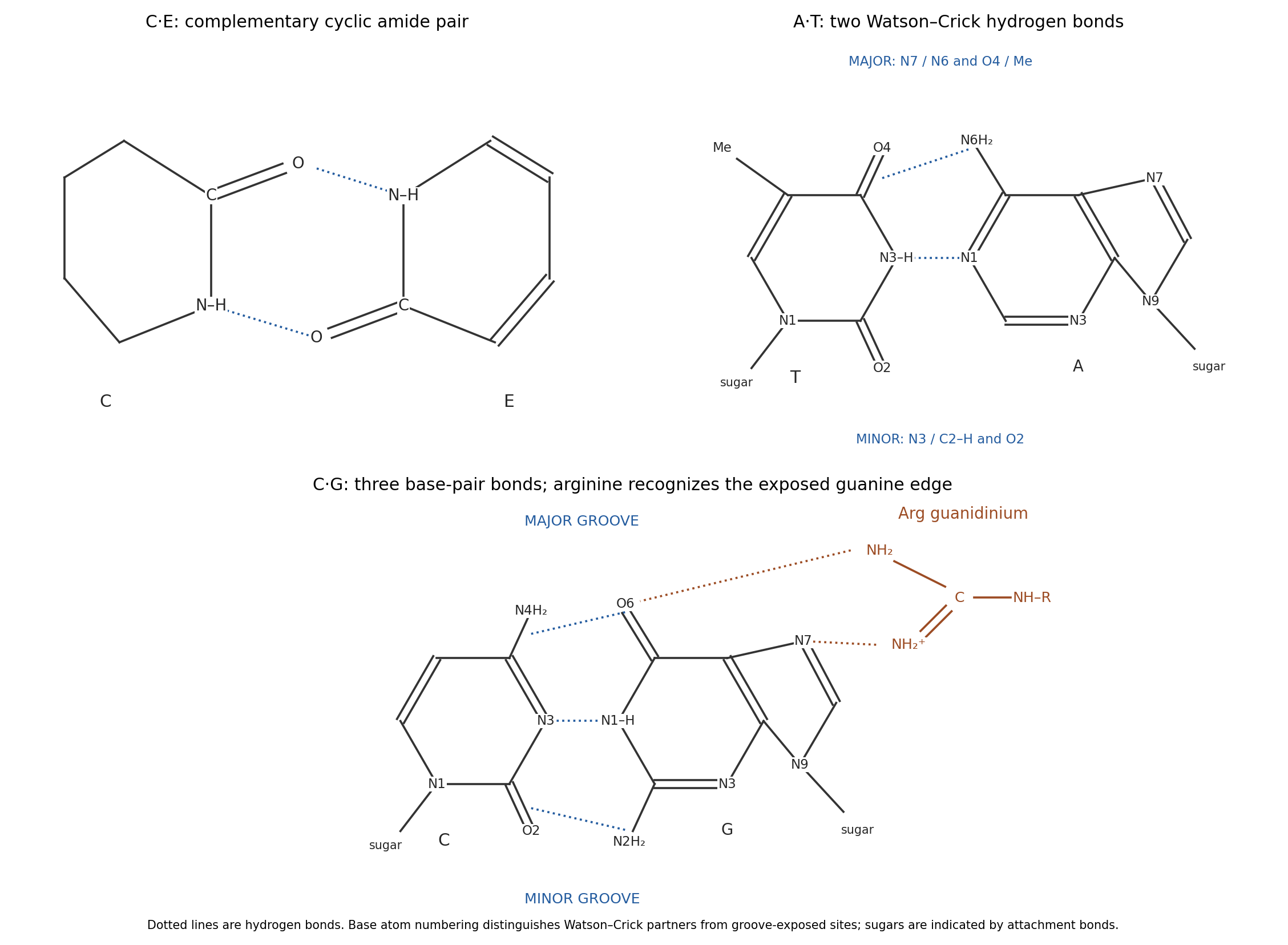
C is the best geometrical match for a strongly bound 1:1 complex with E. Both have an adjacent amide donor–acceptor edge. Arrange them head-to-tail so that the N–H of E donates to the carbonyl oxygen of C, and the N–H of C donates to the carbonyl oxygen of E. This closes the familiar two-hydrogen-bond cyclic amide motif, illustrated below.
C combines a strong acceptor with a useful donor in the correct spacing. B has a stronger individual donor, but its pyridine N and OH are separated around the ring and do not reproduce the compact adjacent amide edge of E. A lacks a matching donor, and D's N–H is weak and has the wrong geometry for the same amide–amide motif. Site strength and spatial complementarity must be considered together; multiplying two isolated probe constants is not a reliable prediction of the complete association equilibrium. Self-association of C or E can compete and must be included in a quantitative binding analysis.

Articles by others on the same topic
There are currently no matching articles.