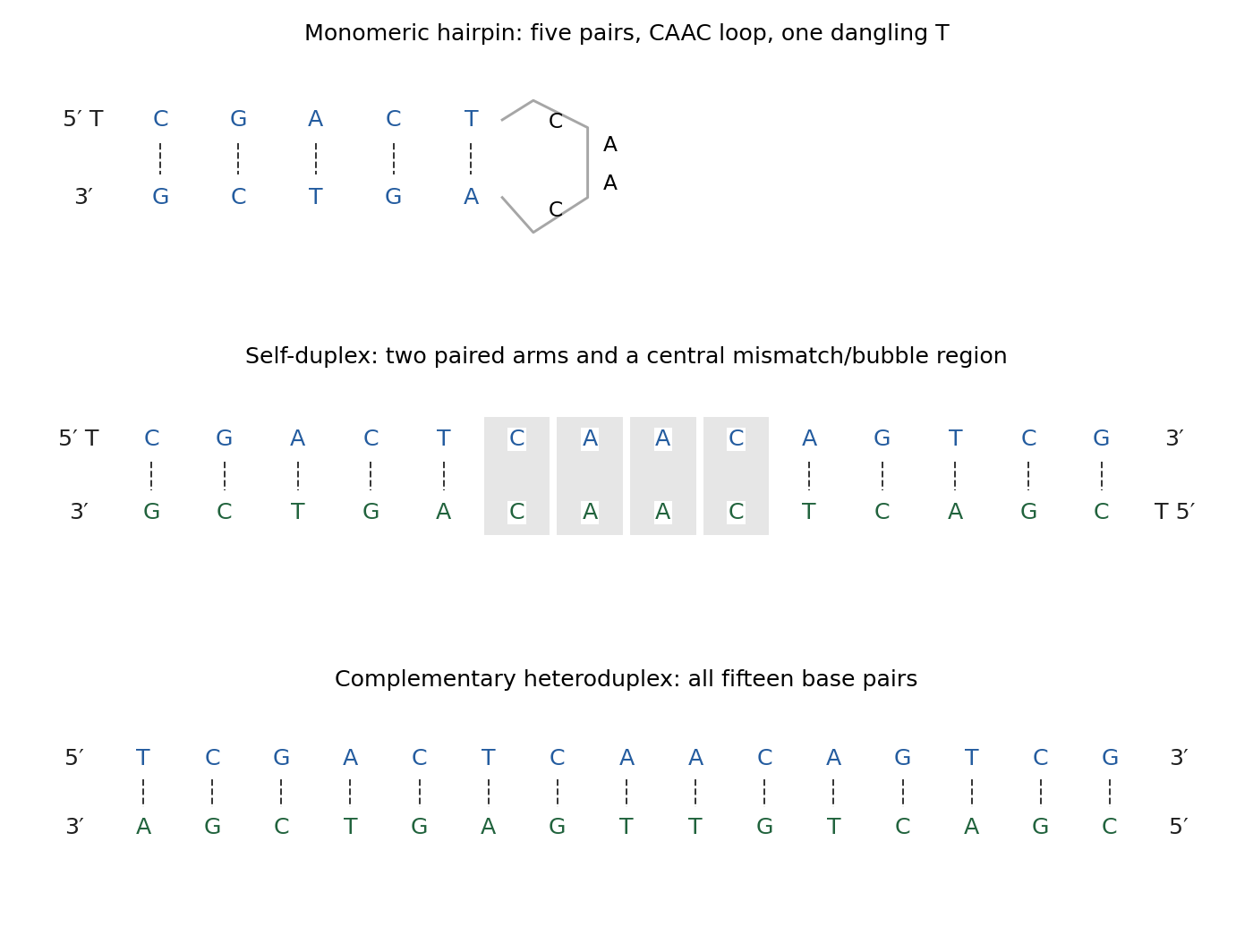
There are three natural states: an unfolded single strand, a monomeric DNA hairpin, and an intermolecular self-duplex. A useful parsing of the sequence is . The two five-base arms are reverse complements. They can form a hairpin with a five-base-pair stem, a four-base CAAC loop, and a dangling 5′ T.
Two copies can instead pair their arms intermolecularly. The self-duplex has two five-base-pair regions, a central noncomplementary internal region, and dangling T residues; it is not a perfectly paired 15-base-pair duplex. Low temperature favours pairing. At relatively low strand concentration, the unimolecular hairpin avoids the association-entropy cost of a dimer; at sufficiently high concentration, intermolecular pairing becomes more favourable. At high temperature, the unfolded state predominates. Actual crossover temperatures require salt conditions and sequence thermodynamics.

Articles by others on the same topic
There are currently no matching articles.