For hydrogen-bond acceptance, the three strongest groups are the terminal carboxylate, the Cys–CO–N(Pro) tertiary-amide carbonyl, and the Pro–CO–NH(Tyr) secondary-amide carbonyl, in that qualitative order. Negative charge makes carboxylate a particularly strong acceptor. Both amide oxygens accept strongly; greater nitrogen alkyl donation generally makes a tertiary amide oxygen more basic than the comparable secondary-amide oxygen. This last ordering is a functional-group estimate, not a precise calculation of a folded tripeptide's site parameters.
For donation, the order is terminal ammonium tyrosine phenolic OH the peptide NH between Pro and Tyr. The thiol is a weaker donor. Protonated ammonium has no available lone pair to accept; the proline amide nitrogen has no N–H bond to donate, and amide nitrogen lone pairs are delocalized into carbonyl groups. The carboxylate has no O–H donor in the drawn protonation state.
The functional group interaction profile compares donor strength and acceptor strength . In water, strong–strong contacts compensate for desolvation, giving the upper-right black region. Strong–weak contacts lose favourable solvent interactions without adequate replacement, giving the two grey regions. Weak–weak association gives the lower-left black region through the hydrophobic effect.
Ethanol's ethyl groups preferentially solvate weakly polar sites, removing this incentive for their association: the lower-left region becomes approximately neutral. Its hydroxyl group retains competition for hydrogen bonds elsewhere in the profile.[ref]
There are three natural states: an unfolded single strand, a monomeric DNA hairpin, and an intermolecular self-duplex. A useful parsing of the sequence is . The two five-base arms are reverse complements. They can form a hairpin with a five-base-pair stem, a four-base CAAC loop, and a dangling 5′ T.
Two copies can instead pair their arms intermolecularly. The self-duplex has two five-base-pair regions, a central noncomplementary internal region, and dangling T residues; it is not a perfectly paired 15-base-pair duplex. Low temperature favours pairing. At relatively low strand concentration, the unimolecular hairpin avoids the association-entropy cost of a dimer; at sufficiently high concentration, intermolecular pairing becomes more favourable. At high temperature, the unfolded state predominates. Actual crossover temperatures require salt conditions and sequence thermodynamics.
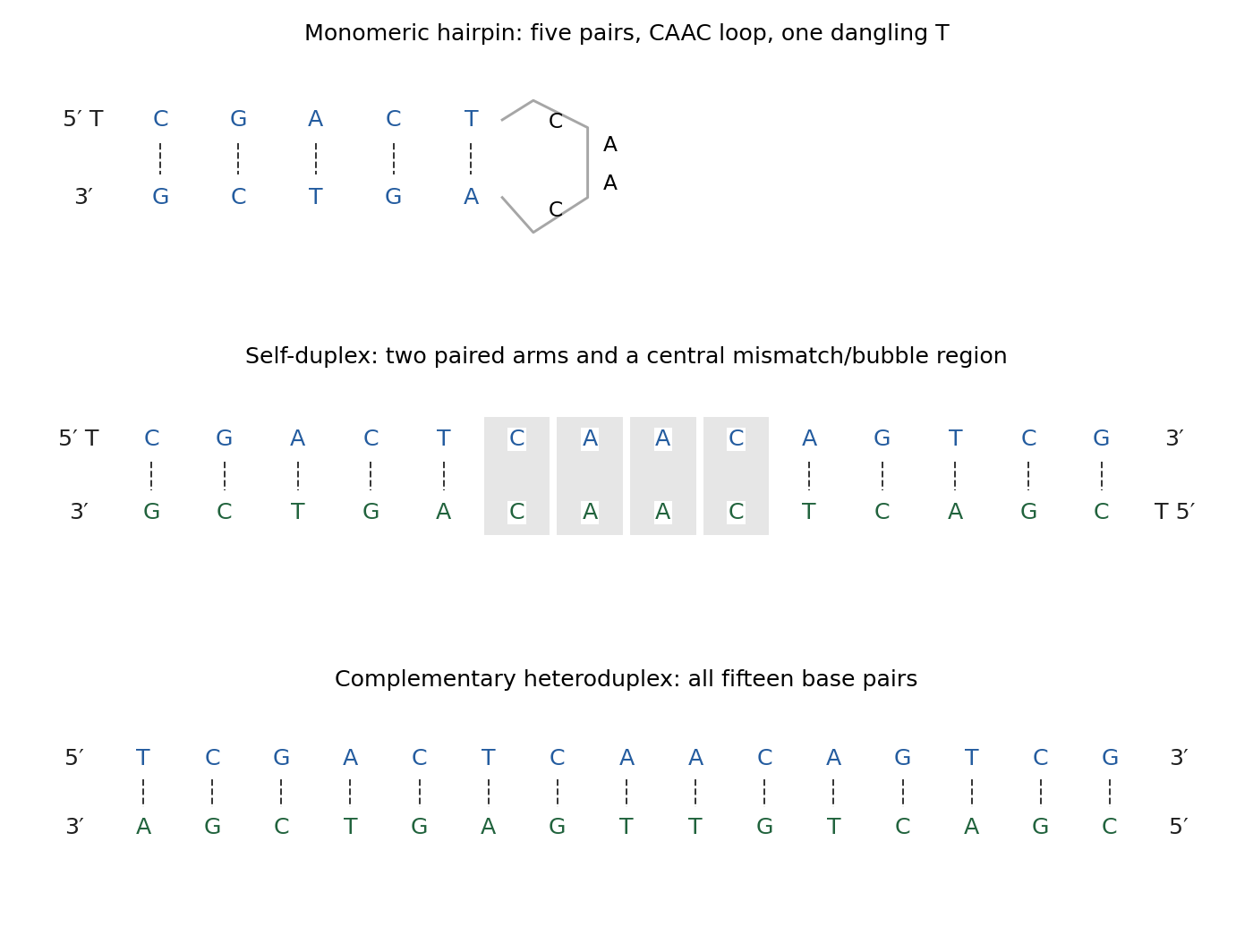
The second strand is the complete reverse complement of the first. They can therefore form a fully matched antiparallel 15-base-pair heteroduplex, replacing the less fully paired hairpin/self-duplex states under conditions supporting hybridization:The lower line is written antiparallel; read it from its own 5′ end to recover the added oligomer.
- : a very small four-membered hydrogen-bonded loop, incompatible with a favourable repeating peptide-backbone geometry.
- : a seven-membered loop associated with a gamma turn; a long regular two-residue-per-turn structure is strongly constrained.
- : the ten-membered hydrogen-bonded rings of a 3-10 helix, with about three residues per turn.
- : the thirteen-membered rings of an alpha helix, with about 3.6 residues per turn.
- : the sixteen-membered rings of a pi helix, with about 4.4 residues per turn.
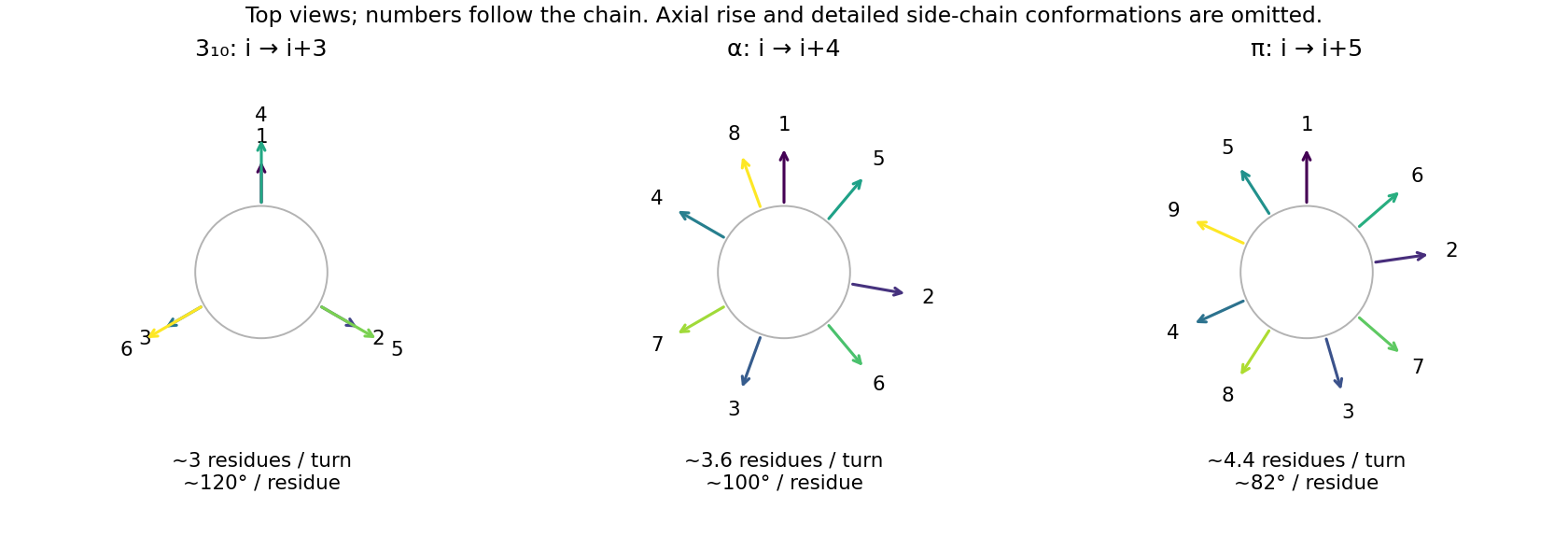


The alpha helix provides a favourable combination of allowed backbone torsions, reasonably linear hydrogen bonds, and side-chain packing. Its successive side chains advance by about , rather than lining up in the three columns of the narrower 3-10 helix. Smaller repeating rings impose more severe backbone constraints; the wider pi helix gives a different, generally less favourable packing arrangement. Short 3-10 and pi-helical segments can still occur in proteins, so this is a preference for a common extended secondary structure, not a prohibition of the alternatives. Proline and sequence-specific interactions can disrupt the idealized backbone donor pattern.
Articles by others on the same topic
There are currently no matching articles.