A carbonyl ligand binds through carbon, whose occupied molecular orbital has a substantial outward-facing carbon lobe. Overlap with an empty metal orbital along the M–C axis gives ligand-to-metal sigma donation. Conversely, an occupied metal orbital overlaps sideways with an empty CO antibonding molecular orbital, giving metal-to-ligand pi backbonding. There are two mutually perpendicular pi channels. The original orbital schematic below shows one of them; and denote orbital phase, not electric charge.
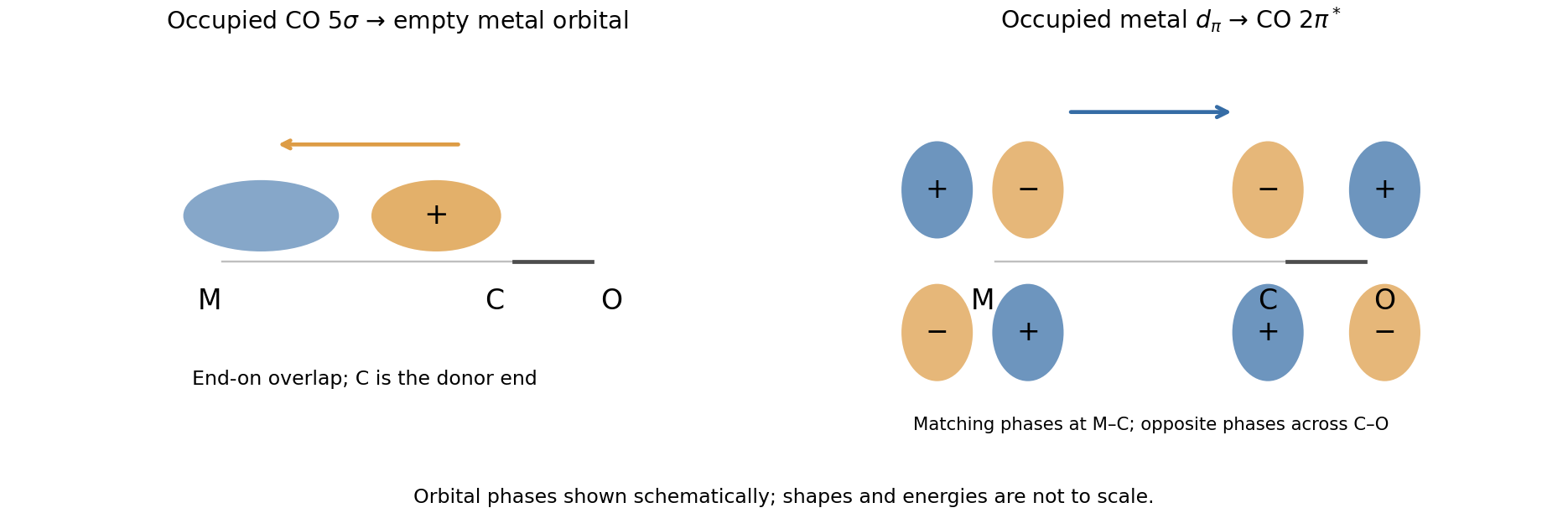
Carbonyl sigma donation and one pi-backbonding channel
. Details. 
The interactions are synergic: donation makes electron density available at the metal, and backbonding helps accommodate it while strengthening the metal–carbon interaction. Occupying CO reduces the C–O bond order, lengthens that bond and lowers its bond force constant. Therefore stronger pi backbonding generally lowers the carbonyl stretching spectroscopic wavenumber even while strengthening the M–C attachment.
Articles by others on the same topic
There are currently no matching articles.