A carbonyl ligand binds through carbon, whose occupied molecular orbital has a substantial outward-facing carbon lobe. Overlap with an empty metal orbital along the M–C axis gives ligand-to-metal sigma donation. Conversely, an occupied metal orbital overlaps sideways with an empty CO antibonding molecular orbital, giving metal-to-ligand pi backbonding. There are two mutually perpendicular pi channels. The original orbital schematic below shows one of them; and denote orbital phase, not electric charge.
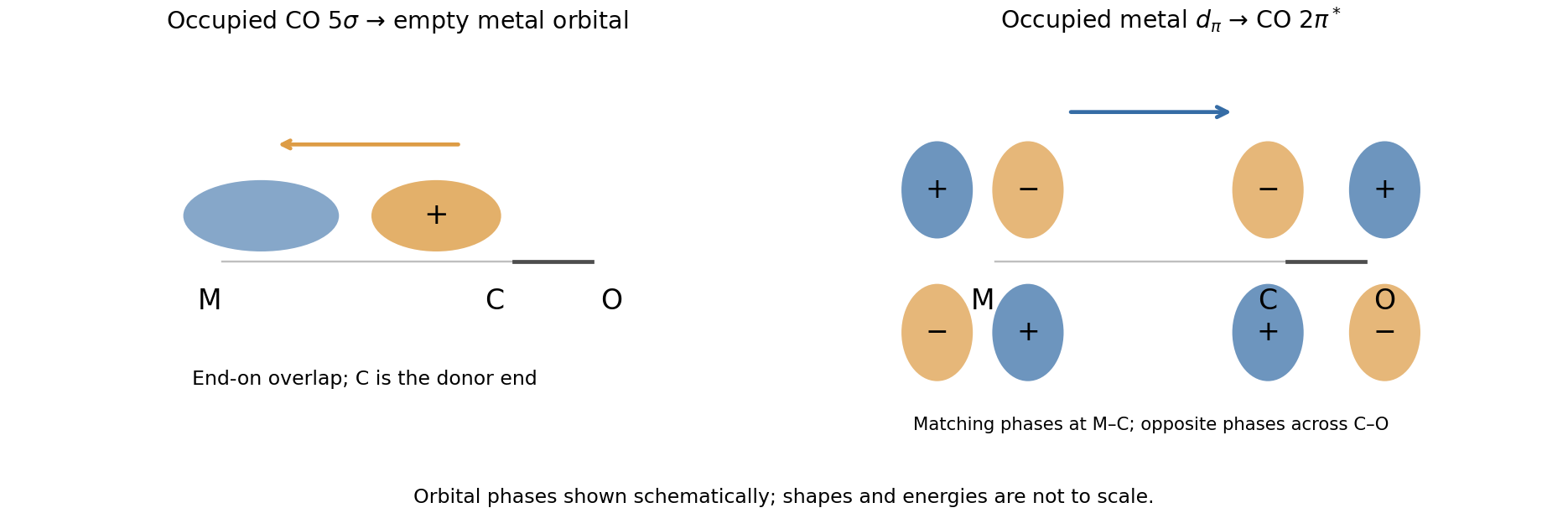
Carbonyl sigma donation and one pi-backbonding channel
. Details. 
The interactions are synergic: donation makes electron density available at the metal, and backbonding helps accommodate it while strengthening the metal–carbon interaction. Occupying CO reduces the C–O bond order, lengthens that bond and lowers its bond force constant. Therefore stronger pi backbonding generally lowers the carbonyl stretching spectroscopic wavenumber even while strengthening the M–C attachment.
For the same pair of atoms, the harmonic approximation gives , where is the bond force constant and the reduced mass. The large shifts mainly reflect changes in from CO pi backbonding; the complexes are not distinguished simply by their total number of valence electrons.
has stronger net backbonding than . Both are group-6 M(0), , 18-electron complexes. The more spatially extended tungsten orbitals provide effective overlap with CO , consistent with the lower stretching frequency. As a simple same-mode force-constant comparison, , about a 2.3% reduction.
has appreciable but less C–O weakening than those hexacarbonyls. Ni(0) is and the complex is also 18-electron. The more contracted, lower-energy late-3d occupied orbitals give less effective donation into CO than the group-6 carbonyls in this comparison. Trimethylphosphine donates electron density and increases backbonding relative to an otherwise comparable less-donating nickel complex; that effect does not force its frequency below chromium's. Comparing different metals requires both orbital energies and overlap.
has very weak backbonding and a frequency above free CO. Cu(I) is and 18-electron here, but positive charge lowers its occupied orbital energies and suppresses backdonation. Sigma donation and the cation's electrostatic polarization can strengthen the internal C–O bond. Consequently the usual free-CO reference, about , lies below this cation's band. A blue shift is compatible with carbon coordination; it does not imply absence of a metal–CO bond. Coupled normal modes and measurement conditions limit literal extraction of a local bond force constant from one band.
Articles by others on the same topic
There are currently no matching articles.