For electron counting, use the ionic method: subtract the metal oxidation state from its group number, then add two electrons for each neutral phosphine ligand or carbonyl ligand and two for each chloride ligand.
is Ni(0), , 18-electron and tetrahedral. The count is . With only one distinct ligand in an tetrahedral molecular geometry, there is only one geometrical arrangement.
is Rh(I), , 16-electron and square planar, with the two phosphines trans. Its count is . A square planar molecular geometry is characteristic of this low-spin configuration. Opposite triphenylphosphine groups avoid their largest mutual steric hindrance; CO and chloride occupy the other trans pair.
is Pd(II), , 16-electron and square planar, with the bulky phosphines trans. Its count is likewise . The two di-tert-butylphenylphosphine groups are particularly crowded if cis. These predictions concern the favored intact four-coordinate species; ligand dissociation can occur under other conditions.
The usual qualitative order of increasing ligand field isA chloride ligand is a sigma-donor ligand and pi-donor ligand; its occupied pi orbitals raise the metal -derived levels and reduce the splitting. A carbonyl ligand is a particularly effective pi-acceptor ligand, lowering those levels and producing a large splitting. Both phosphine ligands are sigma donors with acceptor orbitals of mainly P–C antibonding molecular orbital character. Replacing phenyl groups by electron-releasing tert-butyl groups increases sigma basicity but generally weakens pi acceptance, so the alkyl-rich phosphine is placed below triphenylphosphine in this qualitative pi-bonding comparison. It would be wrong to equate a stronger sigma donor automatically with a stronger-field ligand, or to invoke empty phosphorus orbitals as the essential acceptors.[ref]
Metal-phosphine bonding revisited. σ-Basicity, π-acidity, and the role of phosphorus d orbitals in zerovalent metal-phosphine complexes by Gianfranco Pacchioni and Paul S. Bagus. 1992, pp. 4391–4398, sigma basicity, pi acidity and phosphorus orbital participation
This is a qualitative spectrochemical series prediction, not a universal numerical ranking for all metals and geometries. The opposing sigma and pi trends mean that precise comparisons require matched complexes and measured splittings; a Tolman electronic parameter measures net effects on CO backbonding and is not itself a ligand-field splitting.
A carbonyl ligand binds through carbon, whose occupied molecular orbital has a substantial outward-facing carbon lobe. Overlap with an empty metal orbital along the M–C axis gives ligand-to-metal sigma donation. Conversely, an occupied metal orbital overlaps sideways with an empty CO antibonding molecular orbital, giving metal-to-ligand pi backbonding. There are two mutually perpendicular pi channels. The original orbital schematic below shows one of them; and denote orbital phase, not electric charge.
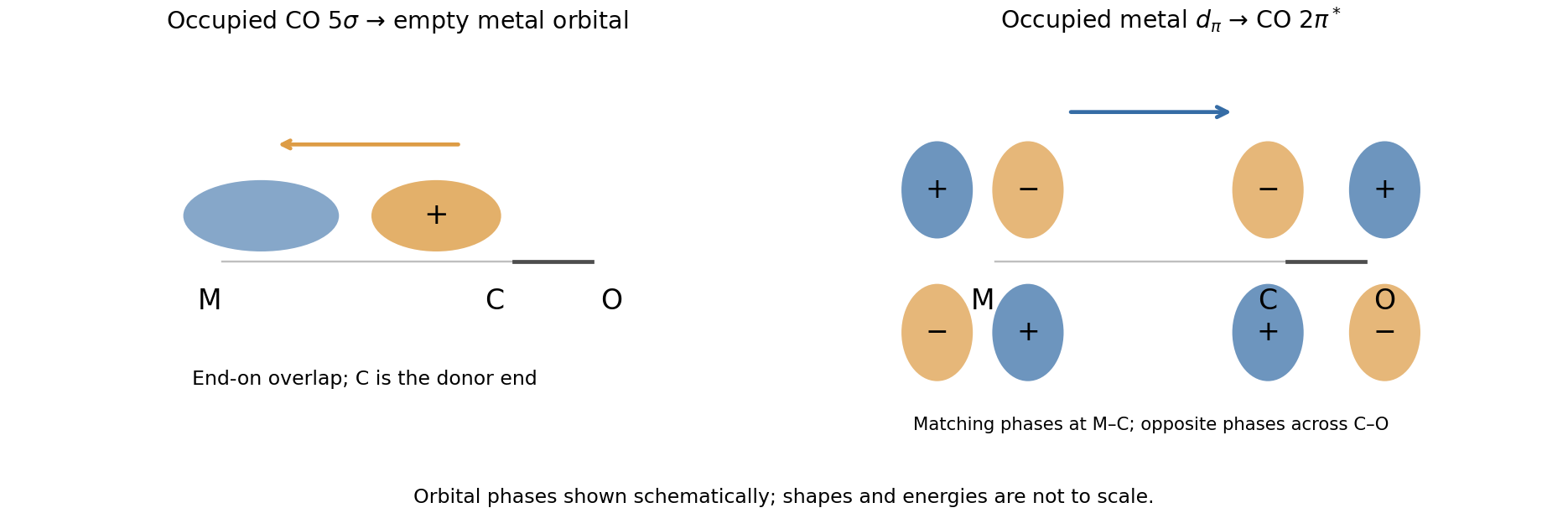
Carbonyl sigma donation and one pi-backbonding channel
. Details. 
The interactions are synergic: donation makes electron density available at the metal, and backbonding helps accommodate it while strengthening the metal–carbon interaction. Occupying CO reduces the C–O bond order, lengthens that bond and lowers its bond force constant. Therefore stronger pi backbonding generally lowers the carbonyl stretching spectroscopic wavenumber even while strengthening the M–C attachment.
For the same pair of atoms, the harmonic approximation gives , where is the bond force constant and the reduced mass. The large shifts mainly reflect changes in from CO pi backbonding; the complexes are not distinguished simply by their total number of valence electrons.
has stronger net backbonding than . Both are group-6 M(0), , 18-electron complexes. The more spatially extended tungsten orbitals provide effective overlap with CO , consistent with the lower stretching frequency. As a simple same-mode force-constant comparison, , about a 2.3% reduction.
has appreciable but less C–O weakening than those hexacarbonyls. Ni(0) is and the complex is also 18-electron. The more contracted, lower-energy late-3d occupied orbitals give less effective donation into CO than the group-6 carbonyls in this comparison. Trimethylphosphine donates electron density and increases backbonding relative to an otherwise comparable less-donating nickel complex; that effect does not force its frequency below chromium's. Comparing different metals requires both orbital energies and overlap.
has very weak backbonding and a frequency above free CO. Cu(I) is and 18-electron here, but positive charge lowers its occupied orbital energies and suppresses backdonation. Sigma donation and the cation's electrostatic polarization can strengthen the internal C–O bond. Consequently the usual free-CO reference, about , lies below this cation's band. A blue shift is compatible with carbon coordination; it does not imply absence of a metal–CO bond. Coupled normal modes and measurement conditions limit literal extraction of a local bond force constant from one band.
A dissociative substitution begins with slow CO loss,followed by capture of the incoming ligand in coordination chemistry. A more electron-releasing increases metal-to-CO pi backbonding in the six-coordinate reactant, stabilizing it and strengthening its M–CO attachments. Removing CO sacrifices a useful pi acceptor from that electron-rich center. Thus the activation free energy for CO dissociation often rises and the substitution slows. Within an otherwise matched series, captures this sensitivity. The rate depends on the relative energies of reactant and dissociation transition state, so the trend is conditional: large changes in steric hindrance, geometry or mechanism can override the electronic effect.
The CO trans to a phosphine ligand competes for metal pi donation with a weaker pi acceptor than CO itself, whereas a cis CO has another CO trans to it. The trans-to-phosphine carbonyl can therefore benefit from stronger M–CO pi backbonding; loss of one of the four cis carbonyls is commonly favored. Capture of the incoming phosphine at that vacancy gives the cis bis(phosphine) product. The fourfold statistical availability of cis sites reinforces an electronic preference but does not establish it by itself.
This is the carbonyl cis effect, rather than the square-planar trans effect applied without qualification. A fuller explanation compares the five-coordinate dissociation transition states and their ligand site preferences. Product geometry alone cannot prove which CO first departed, because the intermediate can rearrange before capture. Isotopically labeled CO exchange is a more discriminating experiment; the classic studies explicitly separate this issue from product stereochemistry.[ref]
Cis labilization of ligand dissociation. 3. Survey of group 6 and 7 six-coordinate carbonyl compounds. The site preference model for ligand labilization effects by Jim D. Atwood and Theodore L. Brown. 1976, pp. 3160–3161, isotope exchange, intermediate rearrangement and limitations of inferring dissociation sites from substitution products
Articles by others on the same topic
There are currently no matching articles.