A has a strong ester C=O band at roughly –, lowered by conjugation with C=C. B's unconjugated ester carbonyl is nearer –; it also has terminal-alkene features, including the approximately pair.
C has no carbonyl band. Its terminal alkyne gives a relatively sharp sp C-H stretch near and a usually weaker C≡C feature near –. C-O stretching alone is less diagnostic because esters and the acetal all contain C-O bonds. The numbers are characteristic ranges, not exact frequencies inferred from an unprinted IR trace.
Carbon-13 NMR spectra: 1 = C, 2 = A, 3 = B. Approximate shifts, read from the printed axes, are shown in the annotated structures.
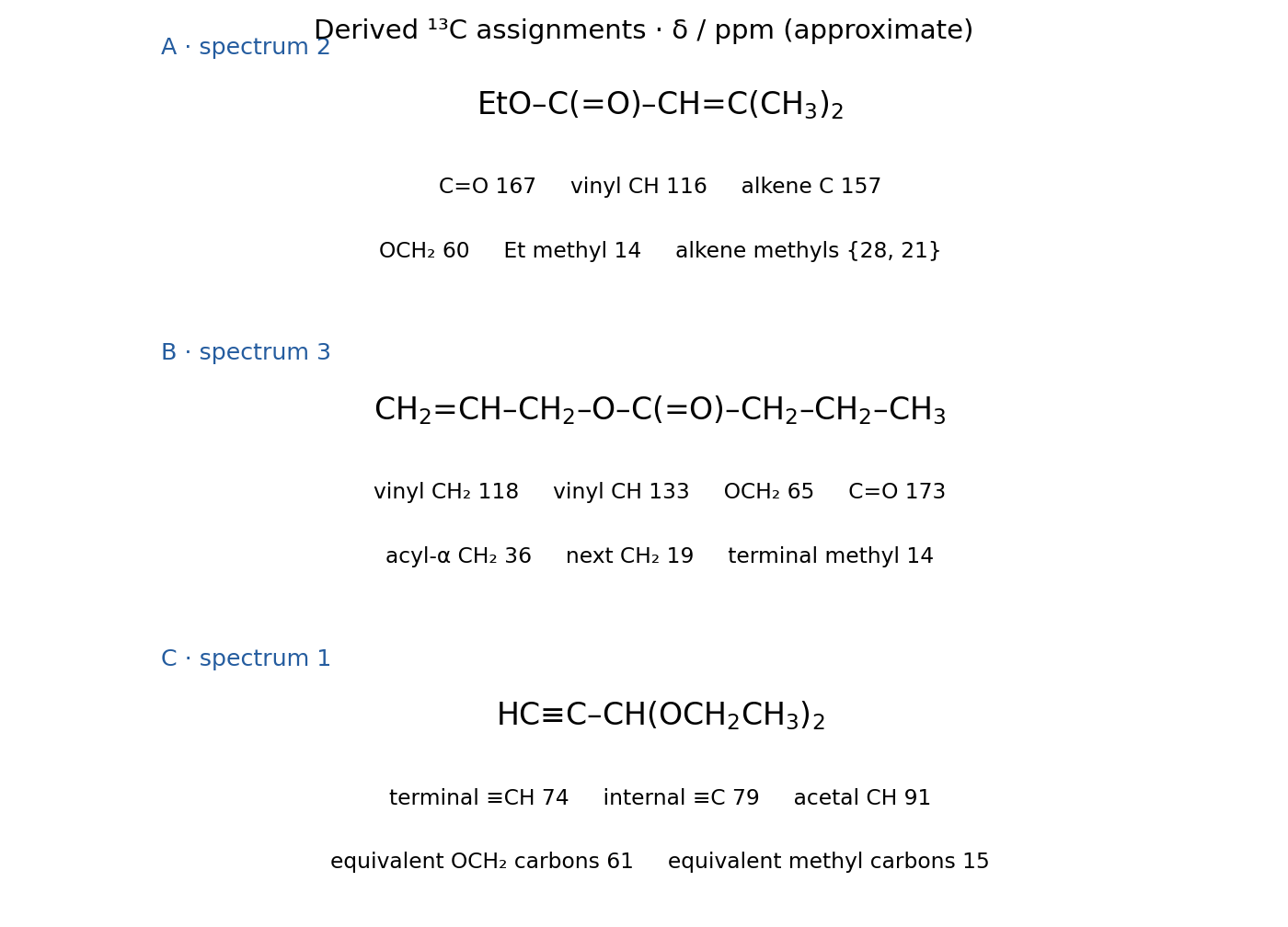
- C: has five carbon environments: acetal CH near ; substituted/terminal alkyne carbons near and ; OCH near ; and methyl near . One alkyne signal is close to the CDCl solvent region, which must not be counted as a new molecular environment.
- A: has ester carbonyl near , substituted alkene C near , vinyl CH near , OCH near , two nonequivalent alkene methyls near and , and ethoxy methyl near .
- B: has carbonyl near , vinyl CH near , terminal vinyl CH near , OCH near , acyl-alpha CH near , the next CH near , and terminal methyl near .
The two methyls in A are chemically distinct because one is cis and the other trans to each substituent at the other alkene carbon. Their two measured shifts are secure; assigning an individual methyl to a particular side of the drawn double bond requires an additional stereospecific shift argument or experiment, so their spatial interchange is left explicit.
Spectrum 4 has one vinyl proton, two alkene-methyl groups and an ethoxy group. Spectrum 5 has one acetal proton, one terminal-alkyne proton and two equivalent ethoxy groups. Spectrum 6 has the three-proton terminal-alkene pattern and the allylic OCH group, together with the butanoate chain.
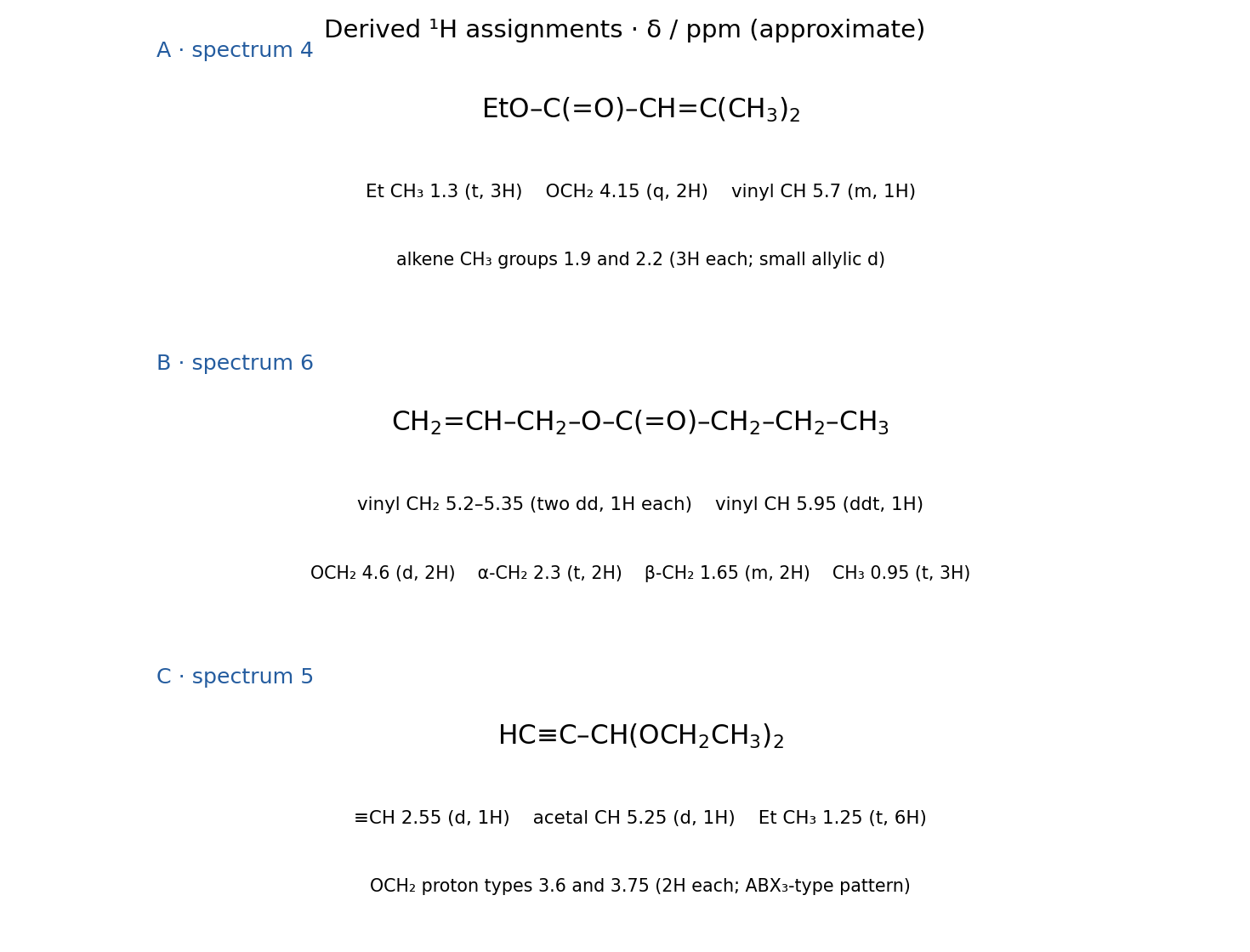


A, spectrum 4: ethoxy CH at about is a NMR triplet, and OCH at about is a NMR quartet. The two alkene methyls at about and each integrate to three protons; they are apparent NMR singlets on the overview but have small allylic NMR doublet splitting. The vinyl CH at about is correspondingly a narrow NMR multiplet, formally a quartet of quartets when its two methyl couplings are unequal, or approximately a NMR septet if they coincide. A broadened overview must not be used to declare all those small couplings exactly zero.
C, spectrum 5: the acetal CH at about and terminal C≡CH at about each integrate to one proton and show their small mutual long-range NMR doublet splitting. The ethoxy methyls give a six-proton NMR triplet near . The OCH region has two sets near and , each integrating to two protons. These are an ABX3 spin system: geminal coupling and coupling to CH produce approximately one doublet of quartets for each proton type, with second-order distortion in the expanded trace. Treating the whole region as one ideal four-proton NMR quartet misses the printed structure.
B, spectrum 6: the internal alkene CH near is a doublet of doublets of triplets from trans/cis coupling to CH and vicinal coupling to OCH. The two terminal alkene protons near – are distinct doublet of doublets-type signals, with possible additional small allylic splitting. OCH near is principally a NMR doublet. The acyl-alpha CH near is a NMR triplet, the middle CH near an approximate NMR sextet or overlapping NMR triplet of quartets, and the terminal methyl near a NMR triplet.
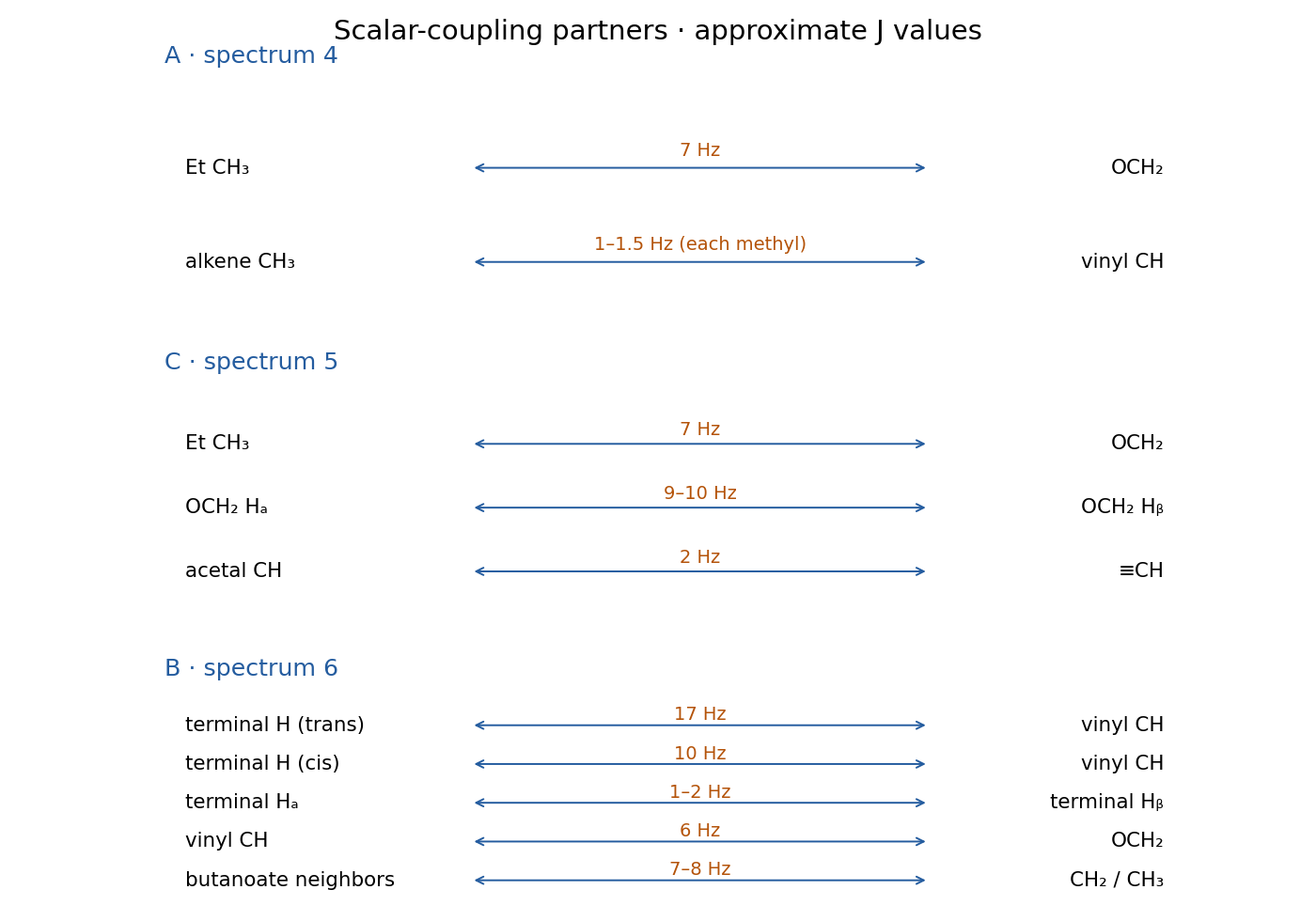
Coupling partners and approximate coupling constants, with line separations converted using 300 Hz per ppm
. Details. 
C: ethoxy CH ↔ CH, about ; the two OCH proton types have a geminal coupling of about –; acetal CH ↔ C≡CH has .
B: internal vinyl CH ↔ trans terminal H, about ; ↔ cis terminal H, about ; terminal CH geminal coupling about –. Vinyl CH ↔ OCH is about . Both vicinal links along the butanoate alkyl chain are about –.
Use when a separation is measured in ppm. Thus corresponds to about , whereas corresponds to about . These are approximate readings, not a fitted spin simulation.
The small four-bond splittings illustrate allylic scalar coupling and acetal-alkyne long-range coupling.
Articles by others on the same topic
There are currently no matching articles.