Student suggested answers are advertised on Chemistry Moodle, but complete worked coverage of this exact 2021 paper remains unverified.[ref]
Part IA course guide 2026 by the University of Cambridge Department of Chemistry. Printed page 11, past-paper and suggested-answer archive
A has a strong ester C=O band at roughly –, lowered by conjugation with C=C. B's unconjugated ester carbonyl is nearer –; it also has terminal-alkene features, including the approximately pair.
C has no carbonyl band. Its terminal alkyne gives a relatively sharp sp C-H stretch near and a usually weaker C≡C feature near –. C-O stretching alone is less diagnostic because esters and the acetal all contain C-O bonds. The numbers are characteristic ranges, not exact frequencies inferred from an unprinted IR trace.
Carbon-13 NMR spectra: 1 = C, 2 = A, 3 = B. Approximate shifts, read from the printed axes, are shown in the annotated structures.
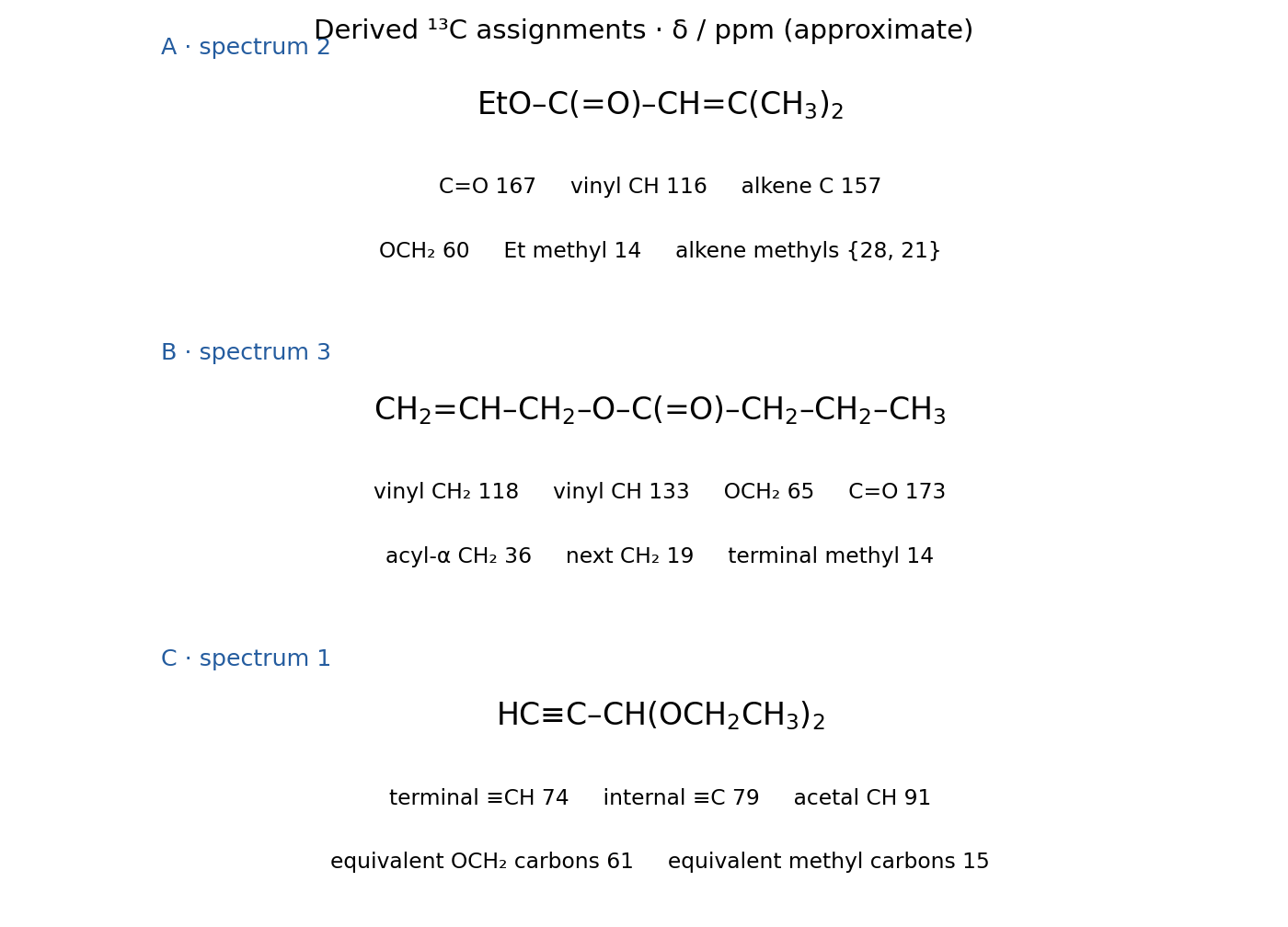
- C: has five carbon environments: acetal CH near ; substituted/terminal alkyne carbons near and ; OCH near ; and methyl near . One alkyne signal is close to the CDCl solvent region, which must not be counted as a new molecular environment.
- A: has ester carbonyl near , substituted alkene C near , vinyl CH near , OCH near , two nonequivalent alkene methyls near and , and ethoxy methyl near .
- B: has carbonyl near , vinyl CH near , terminal vinyl CH near , OCH near , acyl-alpha CH near , the next CH near , and terminal methyl near .
The two methyls in A are chemically distinct because one is cis and the other trans to each substituent at the other alkene carbon. Their two measured shifts are secure; assigning an individual methyl to a particular side of the drawn double bond requires an additional stereospecific shift argument or experiment, so their spatial interchange is left explicit.
Spectrum 4 has one vinyl proton, two alkene-methyl groups and an ethoxy group. Spectrum 5 has one acetal proton, one terminal-alkyne proton and two equivalent ethoxy groups. Spectrum 6 has the three-proton terminal-alkene pattern and the allylic OCH group, together with the butanoate chain.
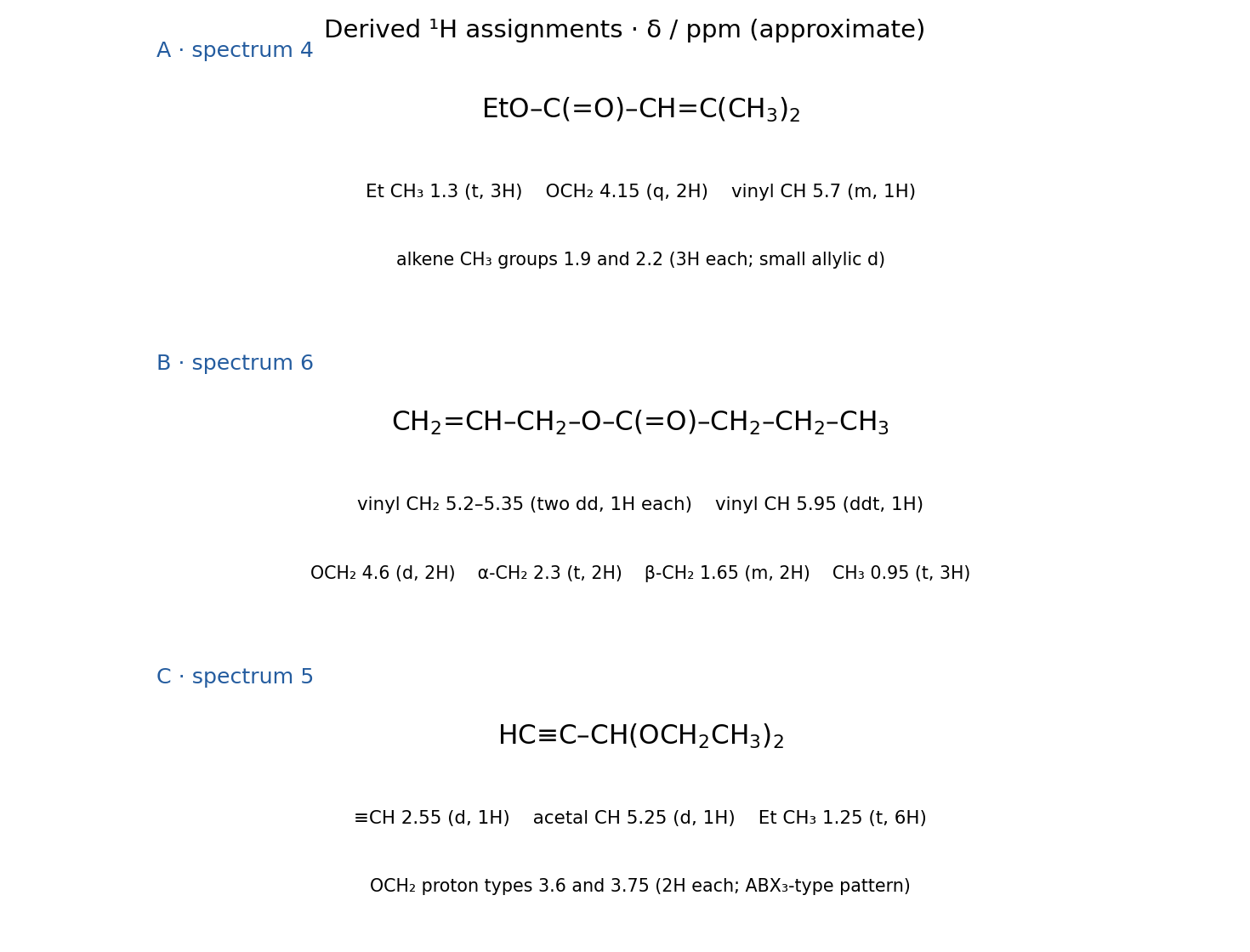
A, spectrum 4: ethoxy CH at about is a NMR triplet, and OCH at about is a NMR quartet. The two alkene methyls at about and each integrate to three protons; they are apparent NMR singlets on the overview but have small allylic NMR doublet splitting. The vinyl CH at about is correspondingly a narrow NMR multiplet, formally a quartet of quartets when its two methyl couplings are unequal, or approximately a NMR septet if they coincide. A broadened overview must not be used to declare all those small couplings exactly zero.
C, spectrum 5: the acetal CH at about and terminal C≡CH at about each integrate to one proton and show their small mutual long-range NMR doublet splitting. The ethoxy methyls give a six-proton NMR triplet near . The OCH region has two sets near and , each integrating to two protons. These are an ABX3 spin system: geminal coupling and coupling to CH produce approximately one doublet of quartets for each proton type, with second-order distortion in the expanded trace. Treating the whole region as one ideal four-proton NMR quartet misses the printed structure.
B, spectrum 6: the internal alkene CH near is a doublet of doublets of triplets from trans/cis coupling to CH and vicinal coupling to OCH. The two terminal alkene protons near – are distinct doublet of doublets-type signals, with possible additional small allylic splitting. OCH near is principally a NMR doublet. The acyl-alpha CH near is a NMR triplet, the middle CH near an approximate NMR sextet or overlapping NMR triplet of quartets, and the terminal methyl near a NMR triplet.
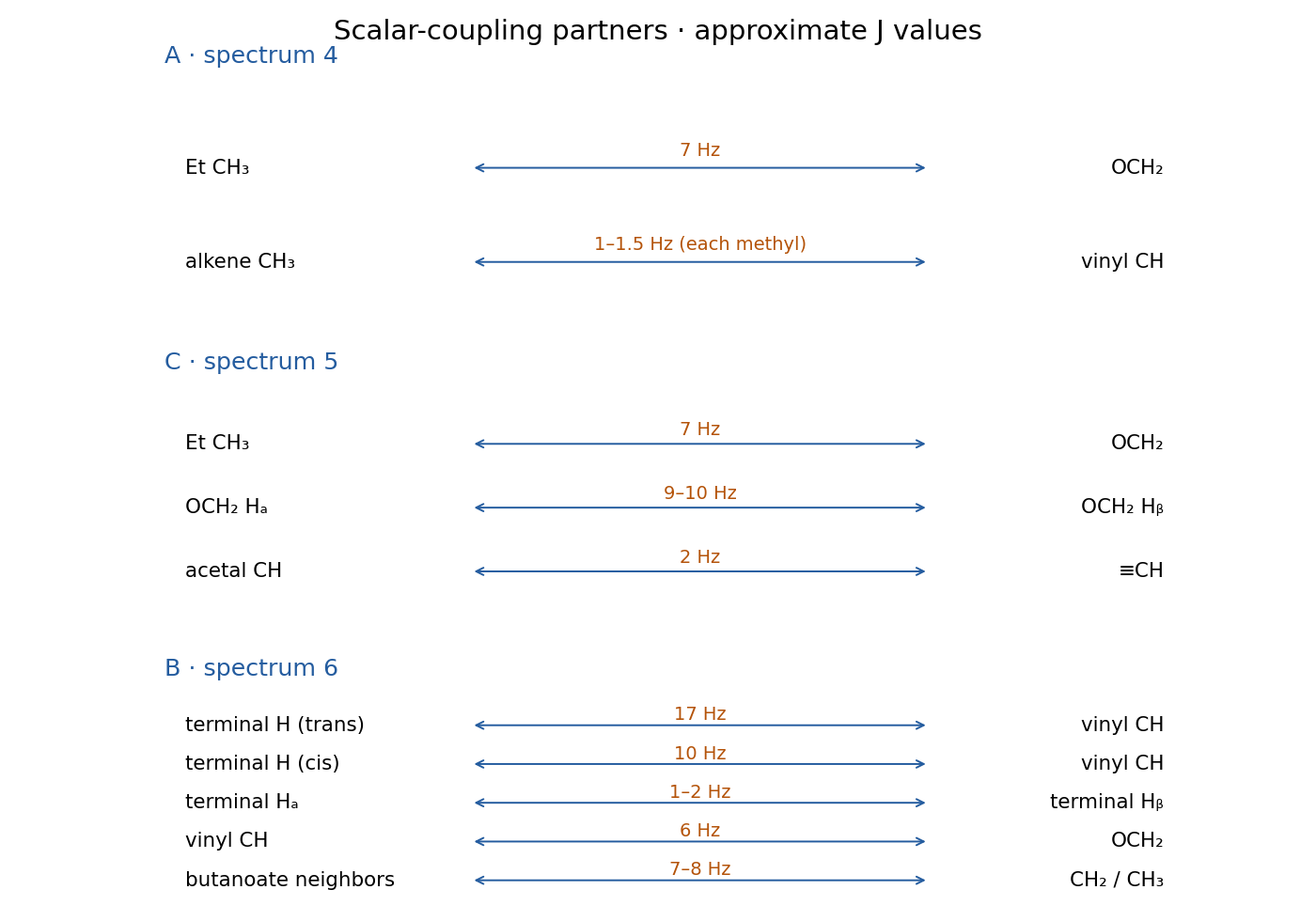
Coupling partners and approximate coupling constants, with line separations converted using 300 Hz per ppm
. Details. C: ethoxy CH ↔ CH, about ; the two OCH proton types have a geminal coupling of about –; acetal CH ↔ C≡CH has .
B: internal vinyl CH ↔ trans terminal H, about ; ↔ cis terminal H, about ; terminal CH geminal coupling about –. Vinyl CH ↔ OCH is about . Both vicinal links along the butanoate alkyl chain are about –.
Use when a separation is measured in ppm. Thus corresponds to about , whereas corresponds to about . These are approximate readings, not a fitted spin simulation.
The small four-bond splittings illustrate allylic scalar coupling and acetal-alkyne long-range coupling.
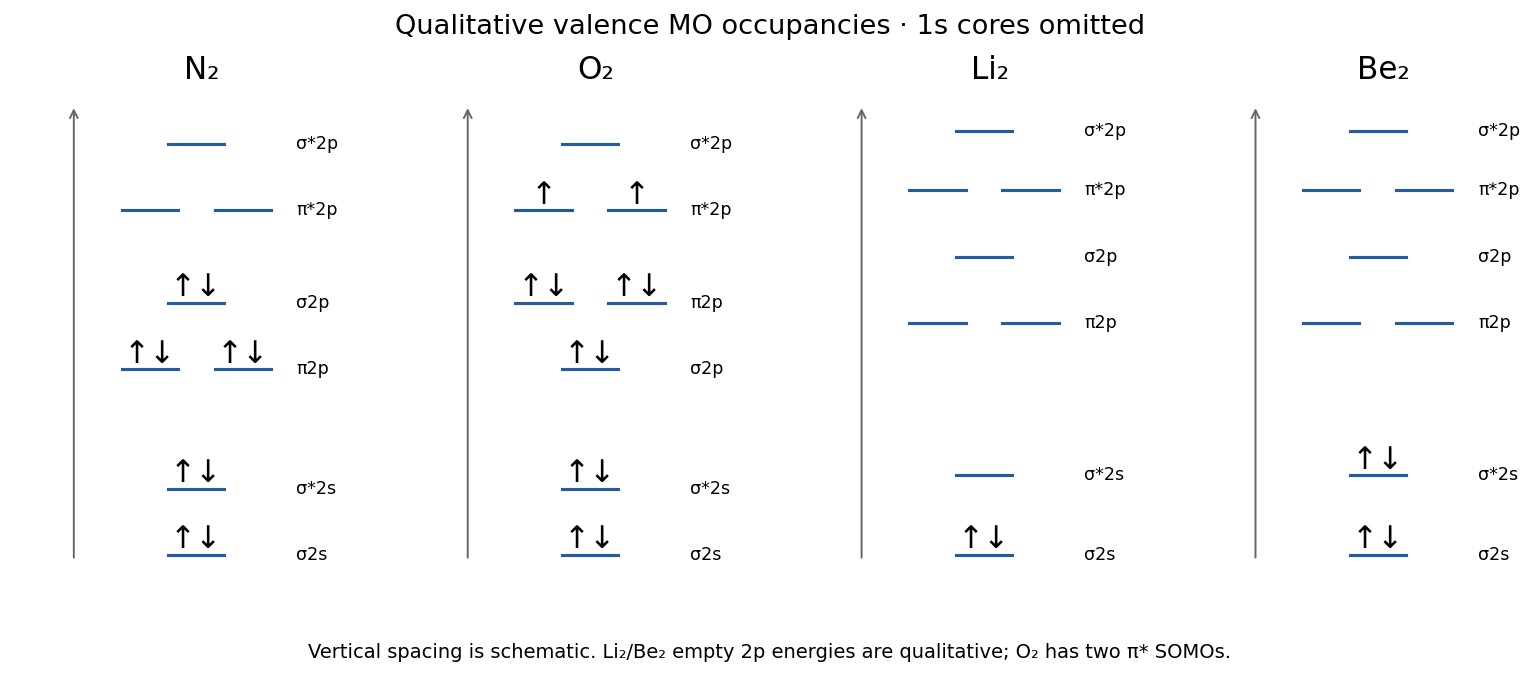
Qualitative valence molecular-orbital occupancies for nitrogen, oxygen, lithium and beryllium dimers
. Details. Suppress the filled 1s core pair, which contributes zero net bond order. For N, use the valence orderingand occupy it as .
For O, the ordering of the bonding 2p levels is reversed: . Occupancy is , with parallel spins in the two degenerate antibonding pi orbitals.
Li has ; Be has in the elementary valence description. Empty 2p-derived levels must also be included to discuss mixing and Be's weak bonding; their precise energies are not set by this qualitative diagram.
O: the two orbitals are the highest occupied, singly occupied spatial orbitals. The next completely empty spatial orbital is . An added electron can instead occupy the opposite-spin vacancy in a singly occupied pi-star orbital; this distinction matters if “LUMO” is being used for an electron-addition spin orbital.
Li: Homo ; next empty sigma orbital conventionally denoted in this elementary diagram. Be: Homo ; the low empty 2p manifold supplies the LUMO candidates, drawn as in the stated light-diatomic ordering. Mixing makes these labels descriptions of dominant atomic-orbital character, not strictly unmixed atomic functions.
This distinction is the open-shell frontier orbital convention.
Use :in the elementary configurations. The zero for Be is a limitation of this occupancy count, not proof that its measured interaction potential is everywhere repulsive.
Both Be's occupied bonding and antibonding 2s levels cancel in the simplest diagram. Beryllium's relatively accessible empty 2p orbitals allow mixing and correlated configurations to change that cancellation and produce a weak bond. An s-only single-configuration picture is therefore insufficient; spectroscopy and accurate correlated calculations establish its binding.[ref]
For He, similarly gives zero elementary covalent bond order, but the empty-shell excitation gap is much larger and there is no comparable low-energy 2s/2p near-degeneracy. Thus it has no ordinary stable covalent bond.
The literal claim that He does not exist needs qualification: an extraordinarily weak, cold van der Waals helium dimer has been observed. That does not contradict the zero covalent-bond-order diagram.[ref]
The beryllium dimer and helium dimer illustrate two physically different ways that the elementary bond-order picture can miss weak binding.
No ordinary covalent bond is expected. He's filled 1s orbital is very low in energy, whereas Be supplies another filled shell and much higher empty valence orbitals. Mixing the two occupied s combinations gives no net elementary bond-order gain, and their large energy mismatch limits useful shared covalent character. A very weak dispersion-bound encounter is a different possibility; the answer concerns a conventional covalent bond.
BeLi has three valence electrons: two occupy a bonding sigma orbital and the third its higher partner. The elementary bond order is therefore , with one unpaired electron: expect a relatively weak, paramagnetic, doublet diatomic molecule. Because Be attracts valence charge more strongly than Li, the bond is polar toward Be. This is a qualitative prediction, not a numerical dissociation energy.
This is the elementary picture of the lithium beryllium diatomic molecule.
The reacting Homo is the tertiary-amine nitrogen lone pair. The relevant LUMO is the C-I antibonding orbital, , of MeI. Backside lone-pair donation into that orbital forms N-C while weakening C-I. The neutral OH group is not first converted to an alkoxide in the stated reaction.
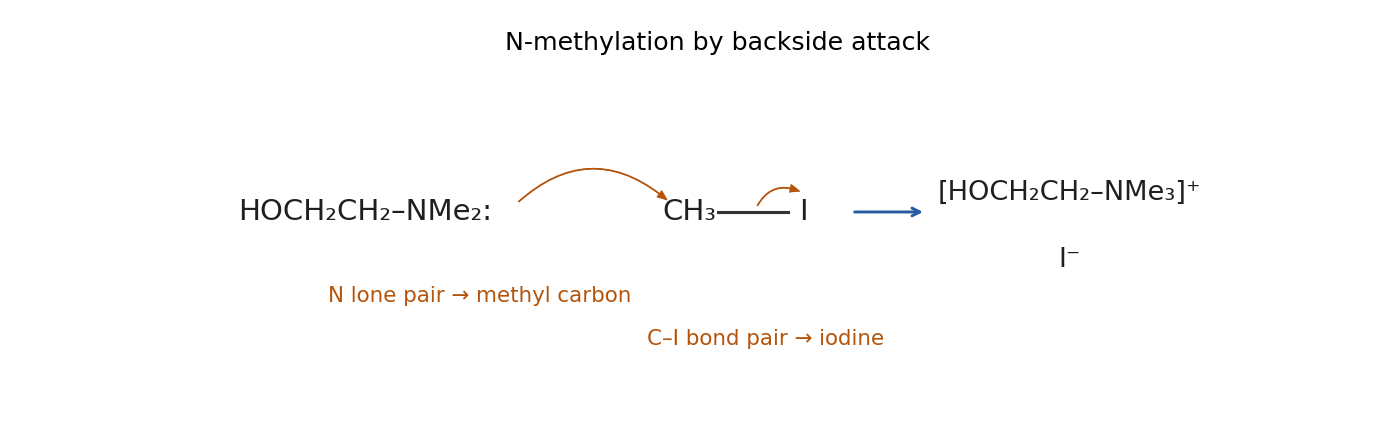
Draw a curly arrow from the nitrogen lone pair to methyl carbon, and a second from the C-I bond to I:This is concerted SN2 quaternization. The product is choline iodide; nitrogen has four carbon substituents and positive charge, while the alcohol remains OH.
Acetonitrile is suitable: it dissolves the organic reagents, is polar enough to stabilize the developing ionic products and is an aprotic, relatively unreactive medium. It does not strongly hydrogen-bond-solvate the amine lone pair or compete efficiently as the methylating nucleophile. Sufficient solubility and chemical compatibility matter as well as polarity.
A is dimethyl ether, , with NaCl as the corresponding salt byproduct. Backside methoxide attack on methyl chloride gives an SN2 substitution:The rate is bimolecular because both reactants participate in the elementary bond-forming/bond-breaking event.
All comparisons assume the same temperature and comparable reagent thermodynamic activities in methanol.
- Iodomethane: faster, because iodide is a better leaving group and the C-I bond is more readily broken than C-Cl.
- 1-Chloropropane: slower than methyl chloride for SN2, because its ethyl substituent crowds backside approach and raises the substitution barrier. It is still a primary substrate, so SN2 remains plausible.
- MeSNa: generally faster substitution with methanethiolate than methoxide in this protic solvent. Sulfur is more polarizable and its larger anion is less strongly hydrogen-bond-solvated, making it a better nucleophile here. This must not be inferred simply from basicity: methanethiolate is the weaker base.
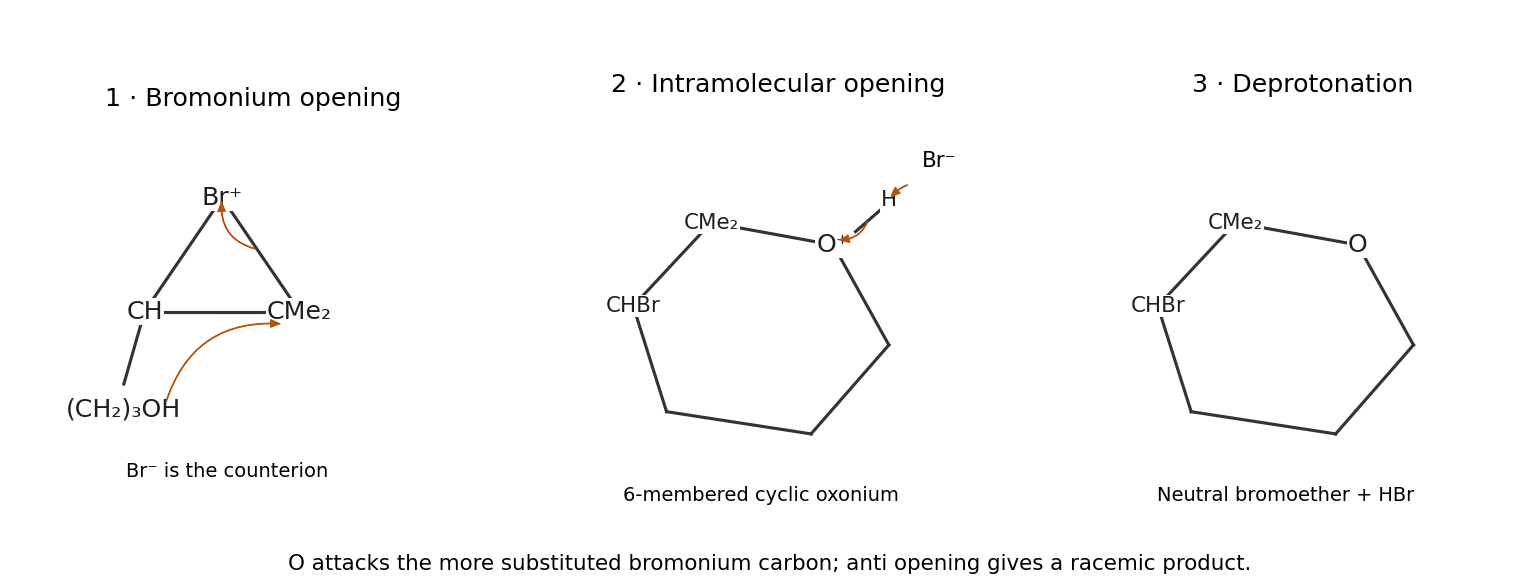
Bromonium formation and intramolecular opening give the six-membered cyclic bromoether
. Details. The alkene pi bond attacks Br as the Br-Br bond breaks to bromide, forming a bridged, unsymmetrical bromonium ion. The carbon bearing the two methyl groups has greater carbocation-like character.
The tethered alcohol oxygen attacks that carbon from the side opposite the bromine bridge. Its lone pair forms the new O-C bond while the attacked C-Br bridge bond opens, giving a six-membered cyclic oxonium ion. Bromide or solvent removes the O-H proton to give the neutral bromoether.
This explains why O becomes attached at the more substituted alkene carbon while Br remains at the other carbon. Polar solvent assists charge separation, and intramolecular capture competes effectively with external bromide attack. Opening is anti; attack on the two faces of the achiral starting material gives a racemic product at the newly formed CHBr stereocentre.
The ring-forming step is bromoetherification.
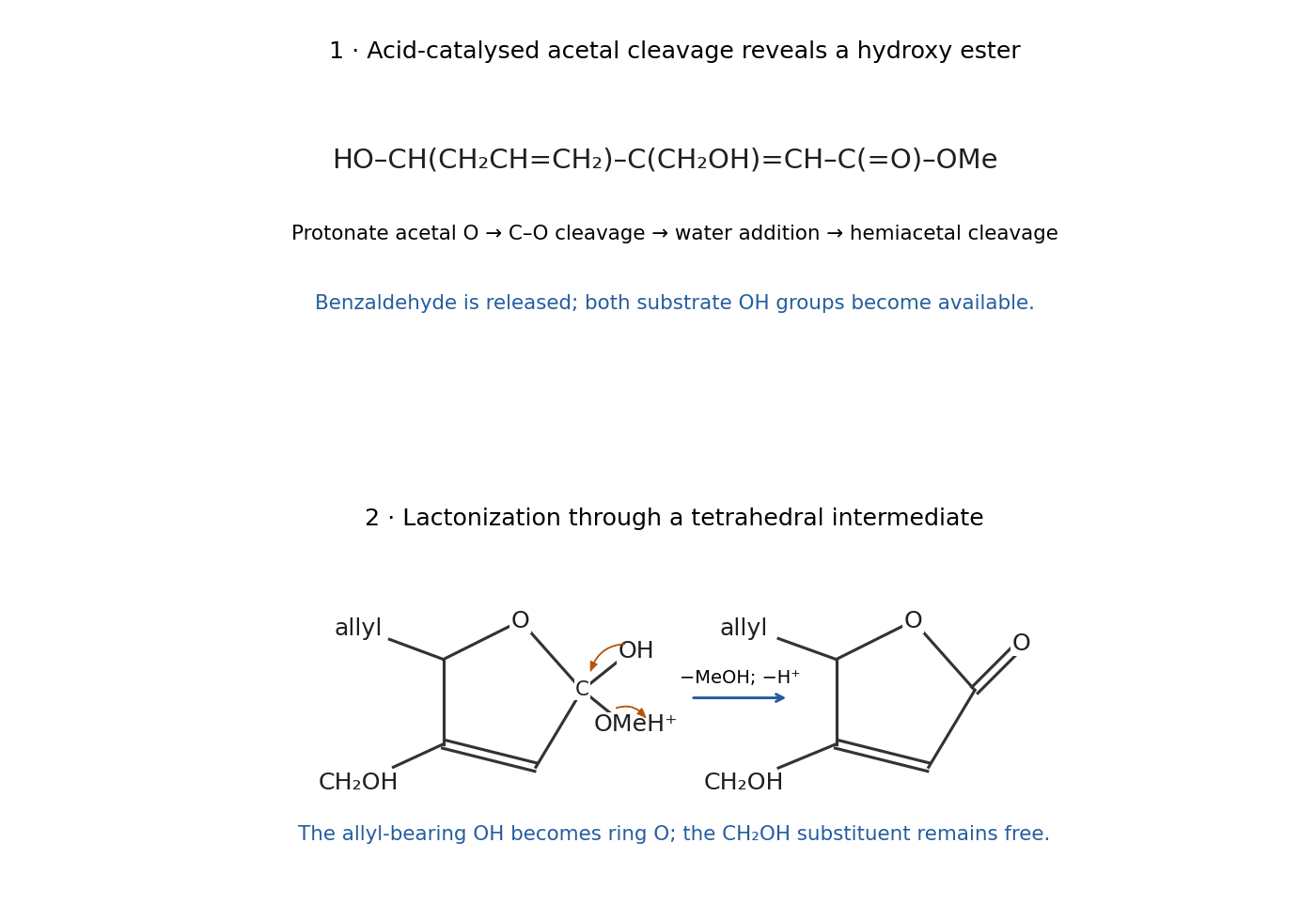
First hydrolyze the benzylidene acetal. Protonate one acetal oxygen and break its bond to the Ph-CH centre, giving one free alcohol and a benzylic oxocarbenium ion. Water attacks that centre; proton transfers give a hemiacetal. Protonate the remaining acetal-derived OR group and cleave it to release the second alcohol and benzaldehyde.
The resulting unsaturated hydroxy ester isThe OH on the allyl-substituted methine is gamma to the ester carbonyl. Protonation of that carbonyl enables intramolecular OH attack to give a five-membered tetrahedral intermediate. Proton transfer to methoxy and collapse expel methanol, followed by deprotonation to give the alpha,beta-unsaturated gamma-lactone.
The other liberated OH remains CHOH. Both C=C units survive: one is the allyl substituent and the other becomes the lactone's conjugated double bond. Hydrolysis to a hydroxy acid followed by lactonization is an alternative sequence under the aqueous acid; direct acid-catalysed intramolecular ester exchange gives the same atom mapping.
Let . One standard route is:where the last two carbons are joined through oxygen to form the epoxide shown in the product drawing.
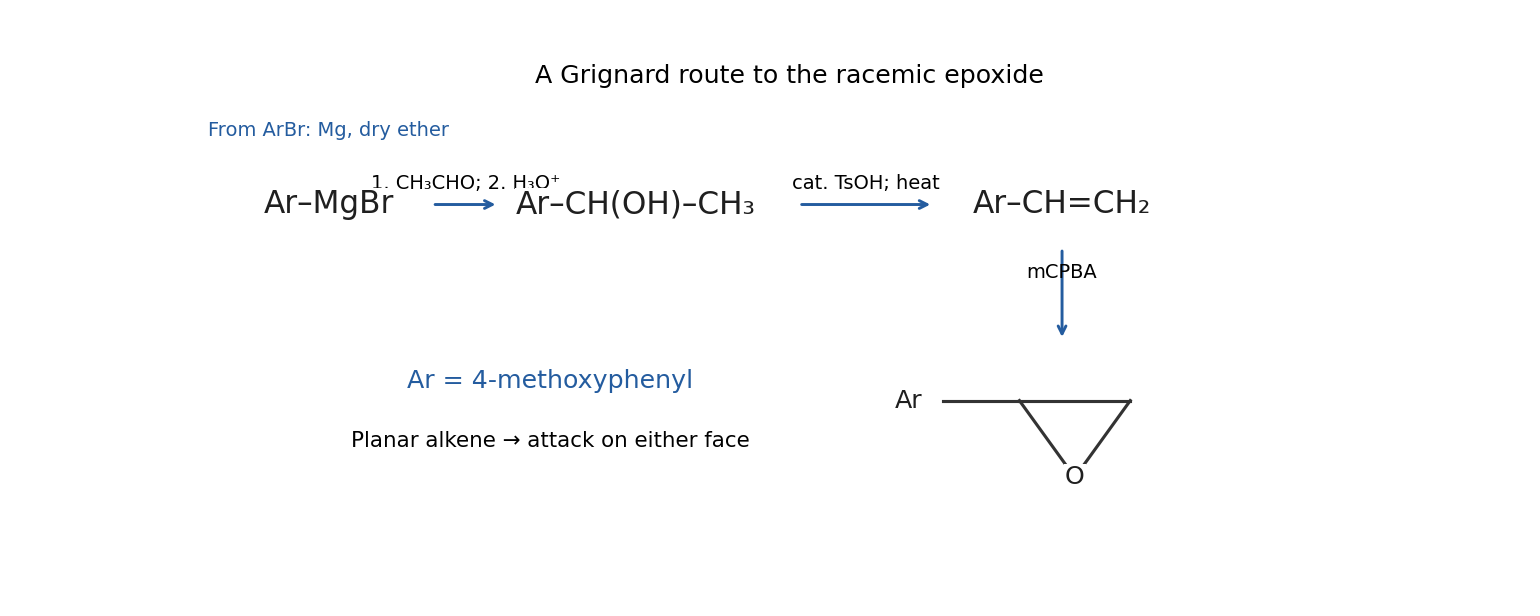


Use rigorously dry conditions for Grignard formation/addition; quench only after the aldehyde addition. Dehydration gives the styrene, and peracid oxidation transfers oxygen across its double bond. The methoxy substituent is compatible with this sequence. No asymmetric reagent is specified, so the target epoxide is racemic.
Write both electrode reactions first as reductions:The conventional cell reaction runs with oxidation on the left and reduction on the right. Reverse the first equation and multiply the second by four:Four electrons pass through the external circuit per reaction as written. This direction consumes the oxide; deposition requires the reverse electrolysis direction.
With ,Thus the conventional forward reaction is spontaneous under standard conditions, dissolving CeO while oxidizing ethanol. Oxide deposition is its reverse and needs external electrical work; its intention does not change the sign convention.
Measure the reversible cell potential at several temperatures while maintaining standard-state thermodynamic activities and the same phases. From and ,The sign of the slope gives the sign of the standard reaction entropy. Measuring a loaded cell voltage without correcting polarization would not give this reversible thermodynamic derivative.
Pure solid CeO and liquid water have unit thermodynamic activity in the stated approximation, soThe power 11 and the four-electron denominator follow from the balanced conventional reaction; using the deposition reaction without reversing the potential would give inconsistent signs.
The fixed nonproton thermodynamic activity ratio is . HenceUsing the supplied constants at ,At pH 7, . This is the formal fixed-thermodynamic activity calculation requested; actual cerium speciation and thermodynamic activities would need to remain compatible with the chosen pH to realize it experimentally.
Passivation by the oxide film is a likely cause. As poorly conducting CeO covers palladium and thickens, electron transport through the deposit becomes difficult and the interfacial resistance rises. Transport of ions/defects through the film can also become limiting.
Thus abundant cerium in bulk solution does not guarantee continued interfacial deposition. The film can block the electronic or ionic path required to grow more oxide.
This is an oxide-film transport limitation during cerium dioxide electrodeposition.
For the stated single elementary step and constant reaction volume,The equal magnitudes follow from the unit stoichiometric coefficients. In the buffered case this hydroxide consumption is balanced by buffer chemistry; the measured total hydroxide concentration can then remain constant.
At , in the usual dilute-solution thermodynamic activity approximation. Therefore A: ; B: ; C: . These are initial concentrations; only C is actively buffered at its stated value.
Let and .
- A: OH starts in 100-fold excess, so its consumption changes its concentration by at most about 1%. Set : , a pseudo-first-order reaction law.
- B: initially . Stoichiometry preserves while hydroxide dominates water autoionization, giving . It is not pseudo-first-order reaction merely because its initial pH equals C's.
- C: adequate buffer capacity keeps constant despite consumption: , again pseudo-first-order reaction. Assume buffer components do not react with MeX or change the effective rate constant appreciably.
B: integrate :For completeness, unbuffered unequal initial concentrations obey , , and the exact expression isIt approaches the equimolar second-order expression as and the excess-hydroxide exponential when depletion is negligible.
Set :The corresponding numerical concentration factors are approximately , and , each divided by . Thus A is about 100 times faster than C at this conversion, while B takes about times as long as C because its hydroxide is depleted.
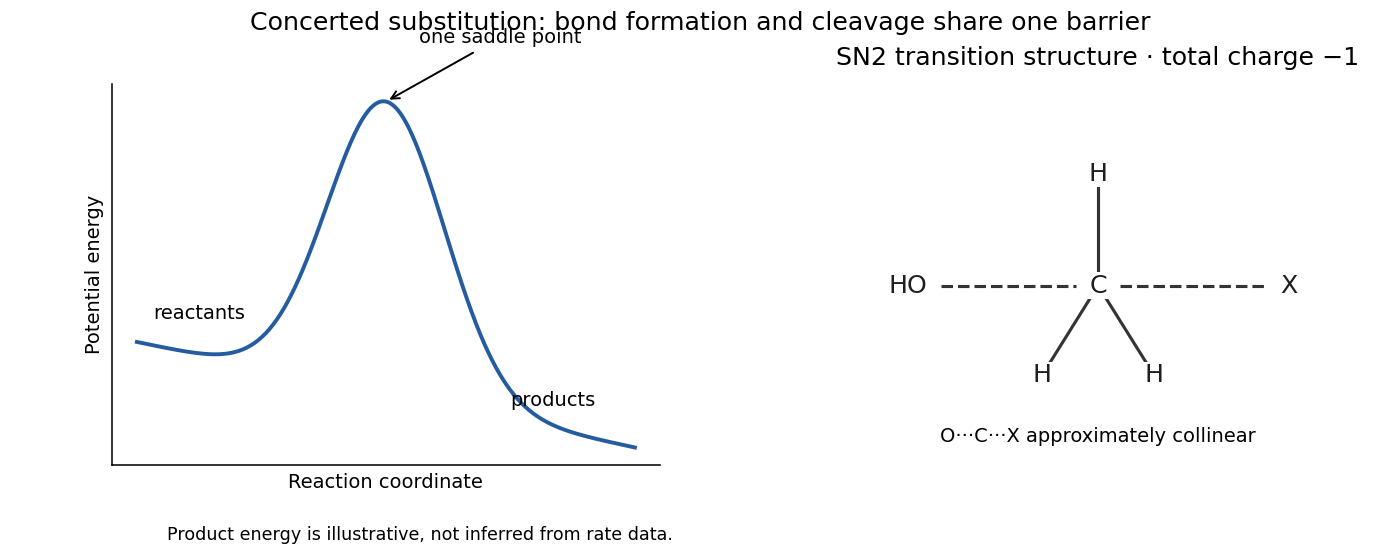
Single-barrier substitution profile and the trigonal-bipyramidal SN2 transition structure
. Details. 
Draw one maximum for the concerted SN2 reaction step, with no intermediate minimum. Its transition structure iswith O-C forming and C-X breaking, both shown as partial bonds. O-C-X is approximately linear, and the three C-H bonds lie in the equatorial plane. The overall charge is , distributed over the entering and leaving groups.
The sketch illustrates an exergonic case; the elementary-step description alone does not supply a numerical reaction energy or determine the product-reactant energy difference for every possible X.
A transition structure is a saddle point on the potential-energy surface: motion along the reaction coordinate lowers energy in either direction. It has one unstable vibrational direction and no intermediate residence basin.
An intermediate is a local minimum, separated from neighboring states by barriers, with a finite lifetime. It may be short-lived, but that does not make it a transition structure. The elementary SN2 reaction step has a transition structure and no distinct bonded intermediate.
C-C is strongest; N-N is much weaker despite nitrogen's smaller size. Carbon's effective nuclear attraction and good overlap of compact second-row valence orbitals favor a strong C-C sigma bond. The larger, more electron-deficient boron centres give less effective B-B bonding in the stated molecule, despite its relatively high-s-character trigonal bonding.
In hydrazine, the two neighboring nitrogen lone pairs strongly repel one another, destabilizing the N-N bond. Bond strength therefore cannot be predicted from atomic size alone; lone-pair repulsion explains the especially low N-N value.
This illustrates bonding trends in second-period single bonds.
B-F has a large favorable polar/ionic contribution because electron-deficient boron and fluorine have a large electronegativity difference. Fluorine lone-pair donation into boron's empty 2p orbital can additionally strengthen bonding in planar BF. C-F is a strong, polar second-row sigma bond, but tetrahedral CF has no equivalent empty carbon 2p acceptor for that pi donation.
N-F has less favorable bond polarity and substantial repulsion between nitrogen and fluorine lone pairs, making it weaker. Invoking occupied boron d orbitals is unnecessary and inappropriate for this second-row comparison.
Group 6: cohesion increases from chromium to molybdenum to tungsten. partially occupied d bands make a major contribution to metallic cohesion. Relative to localized 3d orbitals in Cr, more extended 4d/5d orbitals support stronger overlap and broader bonding bands. Strong 5d bonding and the compact dimensions associated with lanthanide/relativistic effects help make W especially cohesive.
Group 11: cohesion increases from silver to copper to gold. the filled d shell changes the balance from Group 6. Going from Cu to larger Ag weakens overlap and lowers cohesion. Gold reverses that simple size trend: relativistic 6s stabilization/contraction, changes in the 5d orbitals and stronger s-d participation enhance bonding. A size-only argument cannot explain Au exceeding both Ag and Cu.
Group 15, As > Sb > Bi: bonding in these elemental solids involves directional p-orbital interactions. Increasing size and longer separations weaken overlap down the group, reducing enthalpy of atomization. Changes in detailed solid structure and relativistic effects refine the numbers, but the underlying weakening of p-derived bonding explains the trend.
Enthalpy of atomization measures removal from the entire standard-state solid to gaseous ground-state atoms; it is not simply the dissociation energy of one selected diatomic bond.
Graphite: each carbon forms three strong in-plane sigma bonds in an sp honeycomb layer. The remaining p orbitals form delocalized pi bands, allowing electrical conduction especially along the layers. Much weaker interlayer attraction permits sliding, explaining softness without implying weak in-plane C-C bonds.
Carborundum is silicon carbide, SiC. A suitable structure is a three-dimensional, tetrahedrally coordinated covalent network: each Si has four C neighbors and each C four Si neighbors. Strong directional bonding in all directions resists slip and gives hardness. Its filled bonding states are separated from empty states by a substantial band gap, giving low conductivity when pure and undoped.
“Non-conductor” is the intended contrast with graphite; SiC is more precisely a wide-bandgap semiconductor, whose conductivity can change with doping and temperature.
Potassium intercalates between graphite layers and donates electron density to the graphitic pi system. Occupation of formerly less populated electronic states raises the mobile-carrier density, increasing electrical conductivity under the stated comparison.
Articles by others on the same topic
There are currently no matching articles.