Carbon-13 NMR spectra: 1 = C, 2 = A, 3 = B. Approximate shifts, read from the printed axes, are shown in the annotated structures.
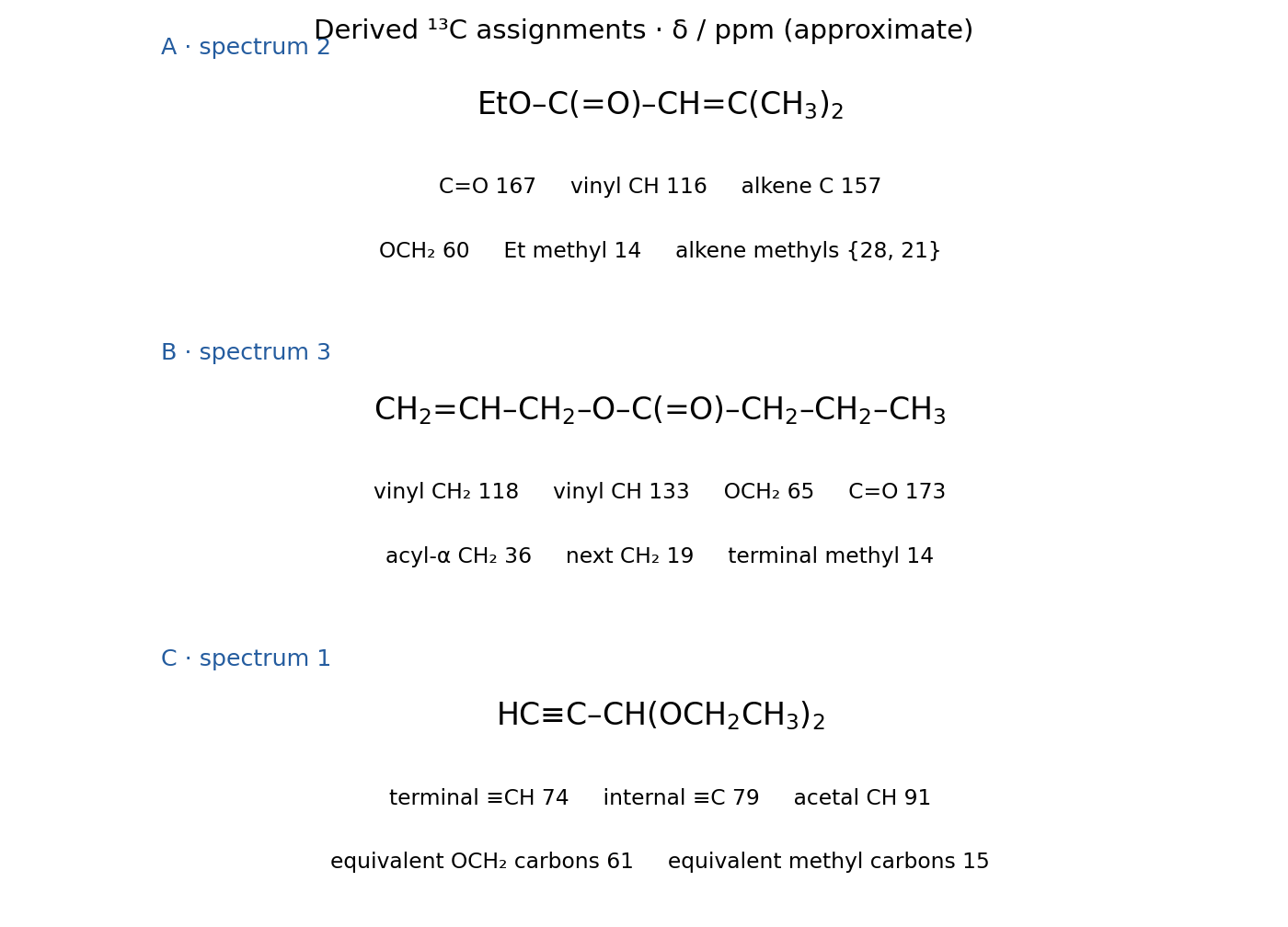

- C: has five carbon environments: acetal CH near ; substituted/terminal alkyne carbons near and ; OCH near ; and methyl near . One alkyne signal is close to the CDCl solvent region, which must not be counted as a new molecular environment.
- A: has ester carbonyl near , substituted alkene C near , vinyl CH near , OCH near , two nonequivalent alkene methyls near and , and ethoxy methyl near .
- B: has carbonyl near , vinyl CH near , terminal vinyl CH near , OCH near , acyl-alpha CH near , the next CH near , and terminal methyl near .
The two methyls in A are chemically distinct because one is cis and the other trans to each substituent at the other alkene carbon. Their two measured shifts are secure; assigning an individual methyl to a particular side of the drawn double bond requires an additional stereospecific shift argument or experiment, so their spatial interchange is left explicit.
Articles by others on the same topic
There are currently no matching articles.