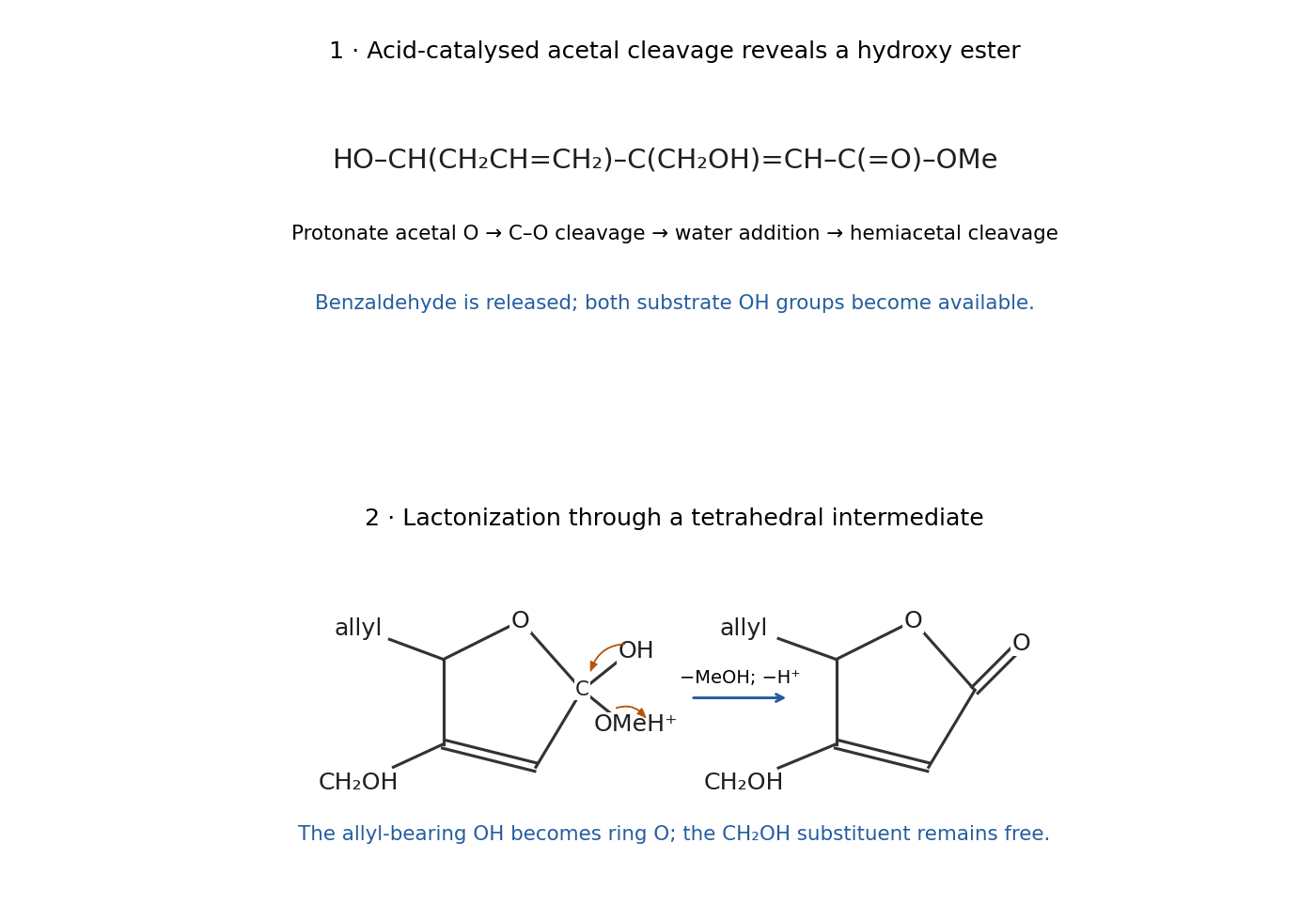

First hydrolyze the benzylidene acetal. Protonate one acetal oxygen and break its bond to the Ph-CH centre, giving one free alcohol and a benzylic oxocarbenium ion. Water attacks that centre; proton transfers give a hemiacetal. Protonate the remaining acetal-derived OR group and cleave it to release the second alcohol and benzaldehyde.
The resulting unsaturated hydroxy ester isThe OH on the allyl-substituted methine is gamma to the ester carbonyl. Protonation of that carbonyl enables intramolecular OH attack to give a five-membered tetrahedral intermediate. Proton transfer to methoxy and collapse expel methanol, followed by deprotonation to give the alpha,beta-unsaturated gamma-lactone.
The other liberated OH remains CHOH. Both C=C units survive: one is the allyl substituent and the other becomes the lactone's conjugated double bond. Hydrolysis to a hydroxy acid followed by lactonization is an alternative sequence under the aqueous acid; direct acid-catalysed intramolecular ester exchange gives the same atom mapping.
Articles by others on the same topic
There are currently no matching articles.