A is dimethyl ether, , with NaCl as the corresponding salt byproduct. Backside methoxide attack on methyl chloride gives an SN2 substitution:The rate is bimolecular because both reactants participate in the elementary bond-forming/bond-breaking event.
All comparisons assume the same temperature and comparable reagent thermodynamic activities in methanol.
- Iodomethane: faster, because iodide is a better leaving group and the C-I bond is more readily broken than C-Cl.
- 1-Chloropropane: slower than methyl chloride for SN2, because its ethyl substituent crowds backside approach and raises the substitution barrier. It is still a primary substrate, so SN2 remains plausible.
- MeSNa: generally faster substitution with methanethiolate than methoxide in this protic solvent. Sulfur is more polarizable and its larger anion is less strongly hydrogen-bond-solvated, making it a better nucleophile here. This must not be inferred simply from basicity: methanethiolate is the weaker base.
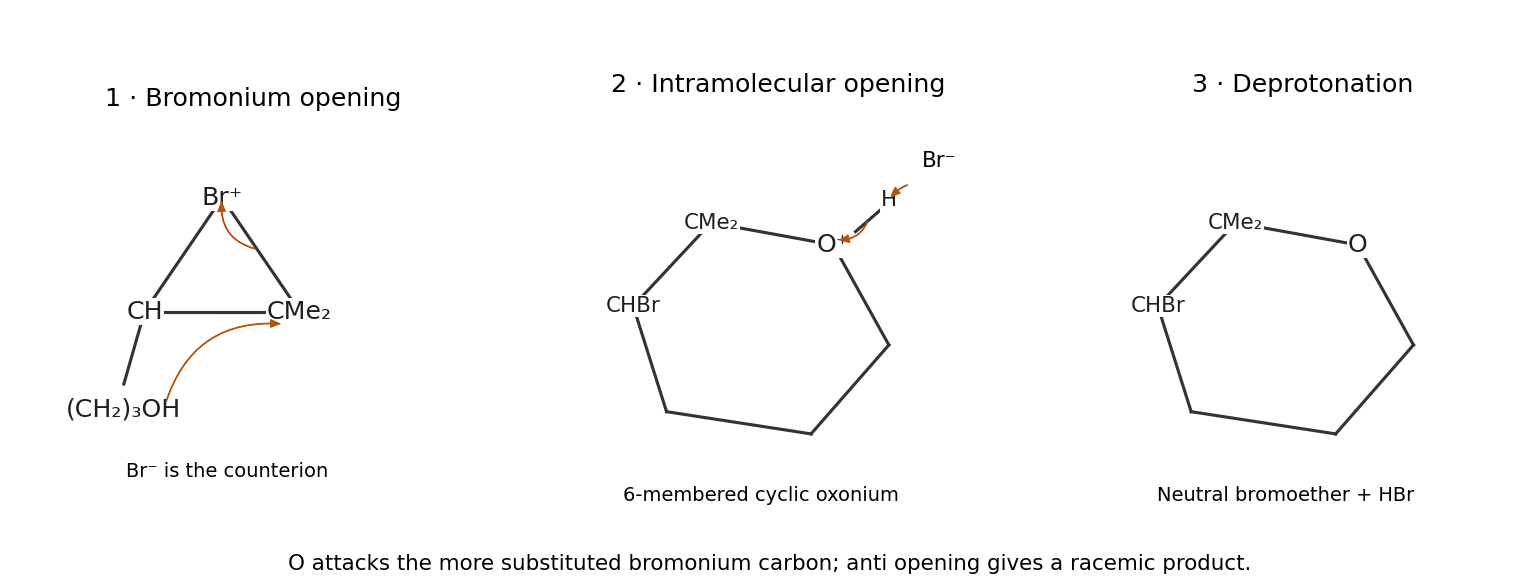
Bromonium formation and intramolecular opening give the six-membered cyclic bromoether
. Details. The alkene pi bond attacks Br as the Br-Br bond breaks to bromide, forming a bridged, unsymmetrical bromonium ion. The carbon bearing the two methyl groups has greater carbocation-like character.
The tethered alcohol oxygen attacks that carbon from the side opposite the bromine bridge. Its lone pair forms the new O-C bond while the attacked C-Br bridge bond opens, giving a six-membered cyclic oxonium ion. Bromide or solvent removes the O-H proton to give the neutral bromoether.
This explains why O becomes attached at the more substituted alkene carbon while Br remains at the other carbon. Polar solvent assists charge separation, and intramolecular capture competes effectively with external bromide attack. Opening is anti; attack on the two faces of the achiral starting material gives a racemic product at the newly formed CHBr stereocentre.
The ring-forming step is bromoetherification.
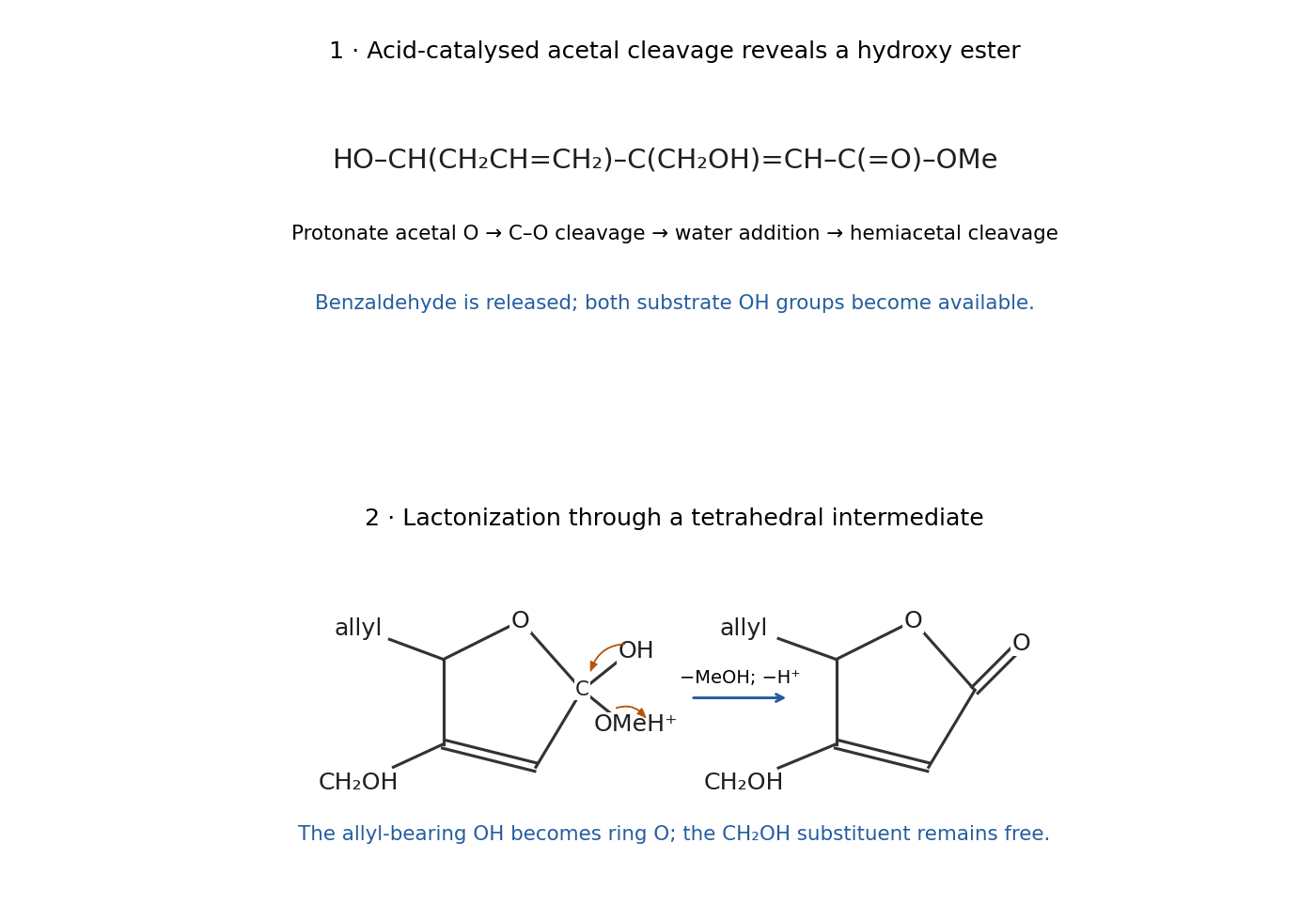
First hydrolyze the benzylidene acetal. Protonate one acetal oxygen and break its bond to the Ph-CH centre, giving one free alcohol and a benzylic oxocarbenium ion. Water attacks that centre; proton transfers give a hemiacetal. Protonate the remaining acetal-derived OR group and cleave it to release the second alcohol and benzaldehyde.
The resulting unsaturated hydroxy ester isThe OH on the allyl-substituted methine is gamma to the ester carbonyl. Protonation of that carbonyl enables intramolecular OH attack to give a five-membered tetrahedral intermediate. Proton transfer to methoxy and collapse expel methanol, followed by deprotonation to give the alpha,beta-unsaturated gamma-lactone.
The other liberated OH remains CHOH. Both C=C units survive: one is the allyl substituent and the other becomes the lactone's conjugated double bond. Hydrolysis to a hydroxy acid followed by lactonization is an alternative sequence under the aqueous acid; direct acid-catalysed intramolecular ester exchange gives the same atom mapping.
Let . One standard route is:where the last two carbons are joined through oxygen to form the epoxide shown in the product drawing.
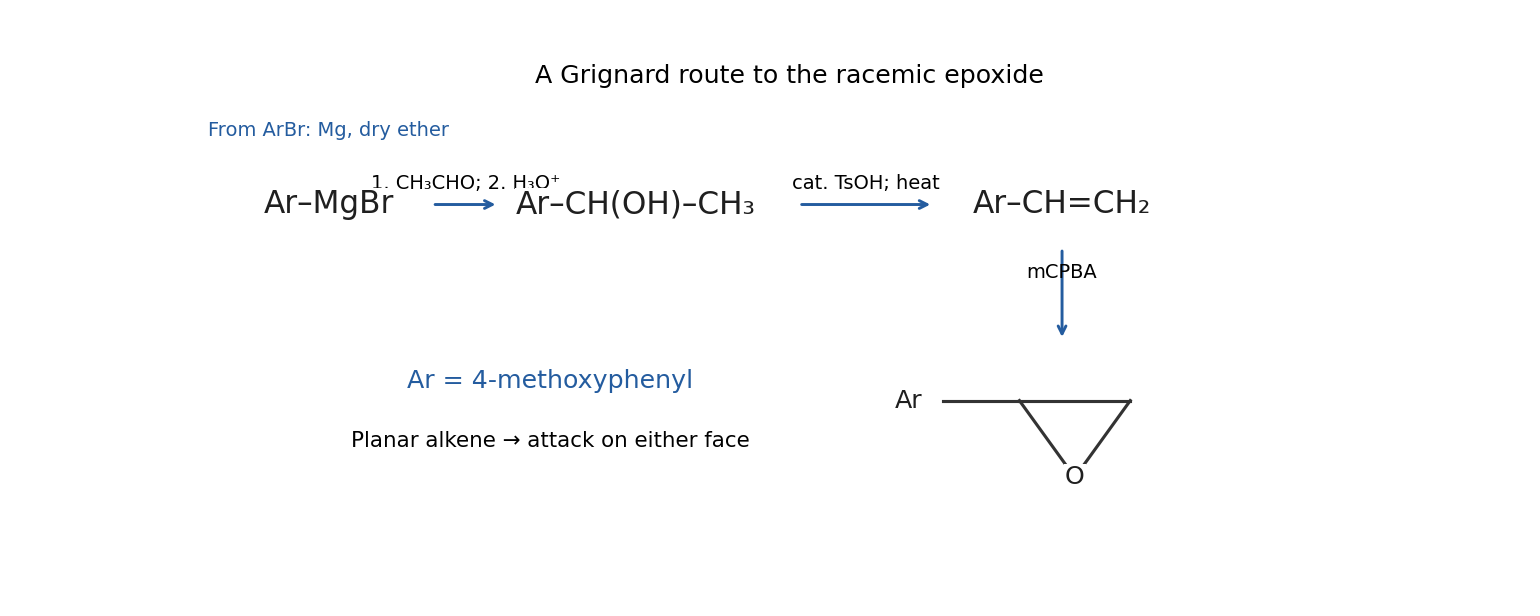


Use rigorously dry conditions for Grignard formation/addition; quench only after the aldehyde addition. Dehydration gives the styrene, and peracid oxidation transfers oxygen across its double bond. The methoxy substituent is compatible with this sequence. No asymmetric reagent is specified, so the target epoxide is racemic.
Articles by others on the same topic
There are currently no matching articles.