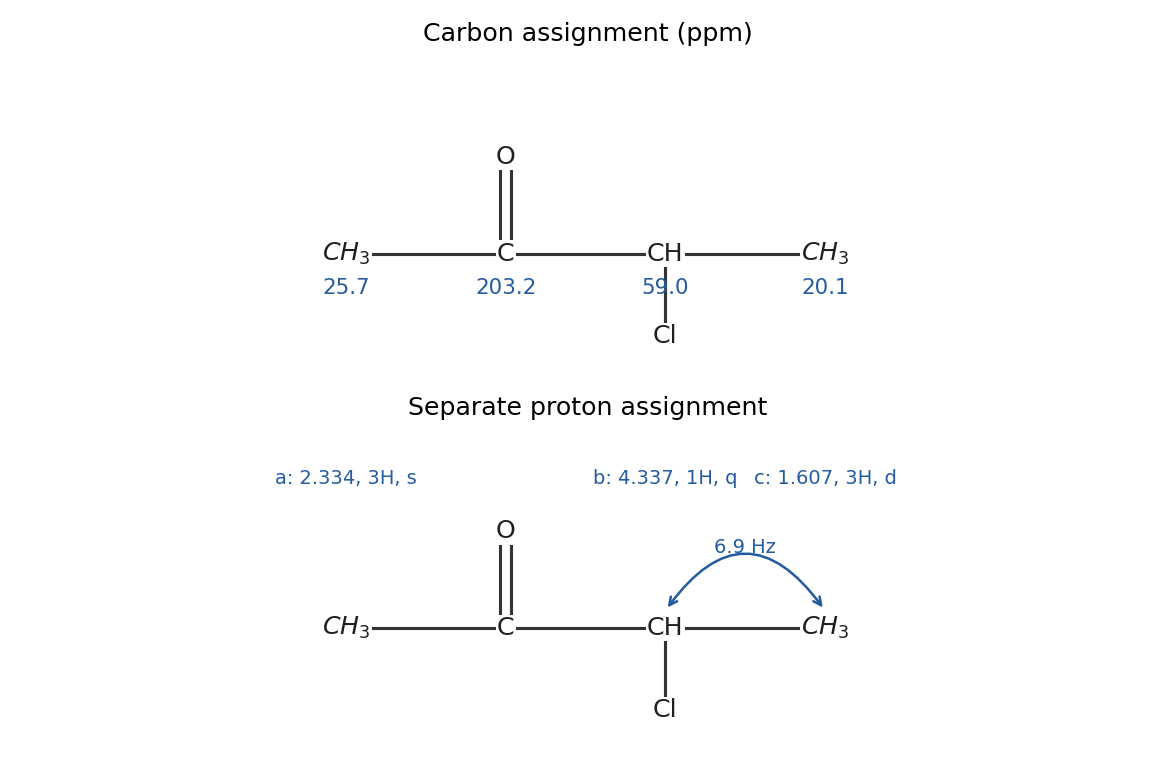
A is 3-Chlorobutan-2-one, . Counting chlorine as one hydrogen in the index of index of hydrogen deficiency gives . A single carbonyl accounts for that unsaturation; the resonance at ppm identifies a ketone, while the ppm methine bears chlorine.
The carbon-13 NMR assignments are for , for , for and ppm for . The four distinct carbon environments agree with the unsymmetrical structure. The small signal near 77 ppm belongs to the usual deuterated chloroform solvent, rather than to a fifth carbon of A.
The strong absorption is the carbonyl stretching vibration of a saturated ketone. Its exact wavenumber depends on substitution and measurement conditions; the important discrimination is that it is far below the high-frequency acyl chloride band in B and is accompanied by a carbonyl carbon-13 NMR resonance near 200 ppm.
Write the proton-labelled structure as . The assignments areThe NMR quartet is centred at ppm; each adjacent line differs by ppm. The NMR doublet has the same spacing, ppm. At 300 MHz,Three equivalent methyl protons split into a NMR quartet; the single methine proton splits into a NMR doublet. No resolved long-range scalar coupling splits the acetyl methyl, giving its NMR singlet. The integrals total seven protons.

Articles by others on the same topic
There are currently no matching articles.