C is 2-Chloroethyl vinyl ether, . There is one alkene and no carbonyl. Assign the carbon-13 NMR resonances asThe strongly differentiated pair of alkene shifts is characteristic of a vinyl ether; interpreting ppm as a carbonyl would leave the unusually shielded unsaturated ppm carbon and the three distinct vinylic protons unexplained.
The absorption is predominantly the carbon–carbon double-bond stretching vibration of the electron-rich vinyl ether. resonance donation from an oxygen lone pair changes both its frequency and its electric dipole moment variation during stretching. There is no carbonyl in the assigned structure, consistent with the absence of a carbon-13 NMR signal in the usual ketone or acyl chloride region.
Let be the internal vinylic proton, the terminal proton trans to , the terminal proton cis to , the oxygen-bound methylene and the chlorine-bound methylene. The assignments areFor the doublet of doublets, pairing corresponding lines gives Hz and Hz. The larger value identifies trans vinylic coupling; the smaller identifies cis vinylic coupling. The resonance confirms the large splitting, approximately Hz, and has a small geminal coupling to .
The small spacings are not perfectly reciprocal if treated as exact First-order NMR multiplets: the lines imply Hz, whereas the lines imply Hz and Hz. Thus report Hz, Hz and – Hz, rather than asserting incompatible exact constants. Printed precision and departures from a simple first-order pattern limit this line-picking estimate; a full spin-system fit would be needed for refined values. Splittings alone do not establish the signs of these couplings.
The two methylene groups split one another into approximate NMR triplets, with Hz; the oxygen-bound triplet gives approximately the same value from its rounded line labels. The three vinylic protons plus two methylenes give the required seven-proton integral. The terminal vinylic protons are diastereotopic, because replacing one or the other creates different alkene geometries.
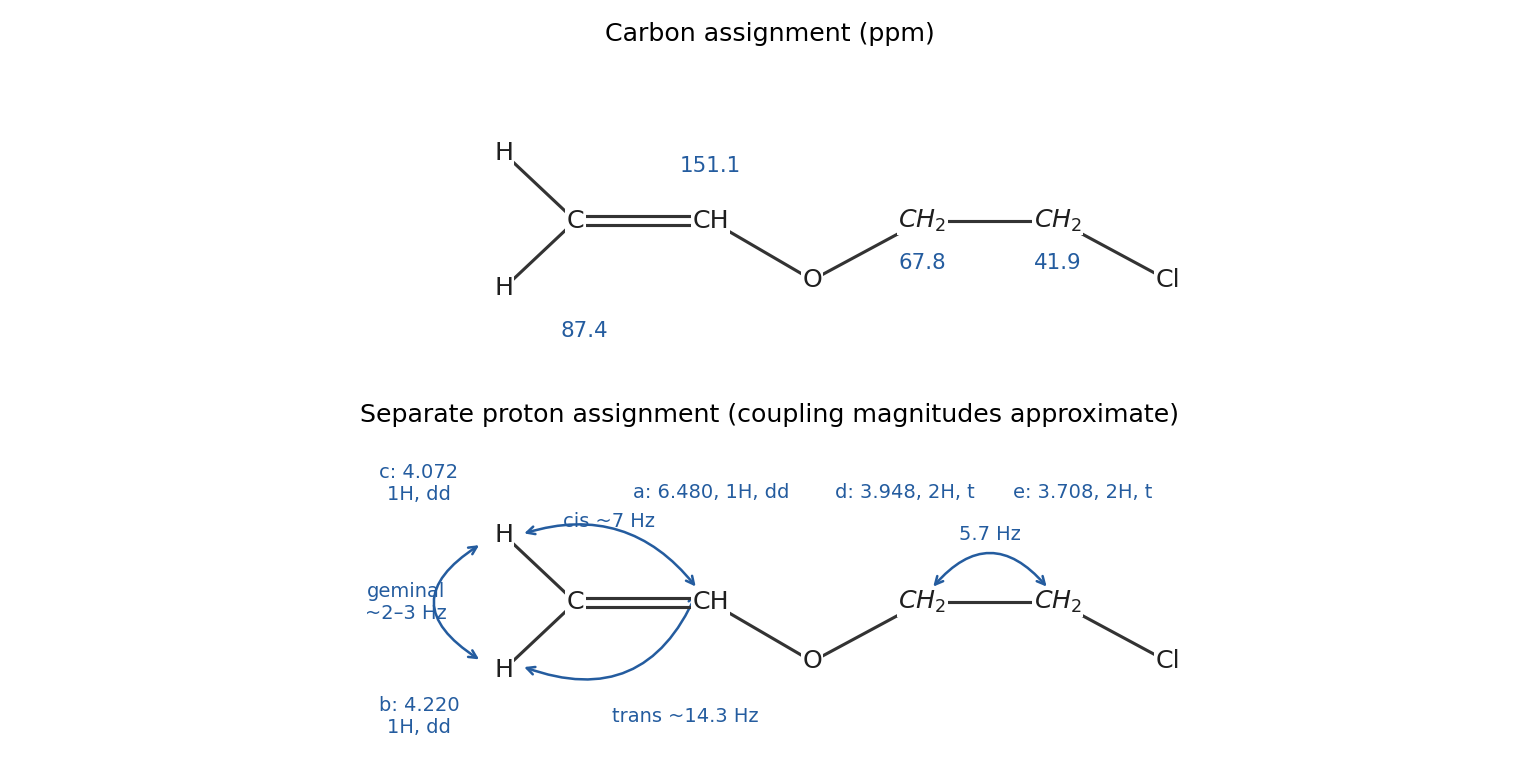
Original carbon and separate proton assignments for C, including trans, cis, geminal and methylene coupling paths
. Details. 
The vinyl ether has an important resonance contributorDonation from oxygen into the conjugated system increases electron density at the terminal unsaturated carbon, helping explain its unusually shielded ppm and its terminal protons near 4.1–4.2 ppm. The directly oxygen-bound unsaturated carbon is strongly deshielded at ppm; its proton at ppm also experiences the oxygen substituent and alkene magnetic anisotropy. These trends are consistent with the whole delocalized electronic structure; a chemical shift is not simply a meter for an atom's partial atomic charge.
For the saturated part, the stronger local deshielding by oxygen places at , , while lies at and ppm. The two terminal vinylic protons have different geometrical relationships to the oxygen substituent and therefore different chemical shifts as well as different vicinal couplings.
Articles by others on the same topic
There are currently no matching articles.