The four sigma bonds are the two C–H connections, C–N and N–N, containing eight electrons. A terminal-nitrogen axial lone pair contains two more. Of the remaining six electrons, two occupy an N–N pi bond lying in the molecular plane, while four occupy a perpendicular three-centre four-electron pi bond extending over C–N–N. There are therefore 16 valence electrons in total.
For orientation, a three-site model with equal on-site energy and adjacent interaction gives perpendicular pi levels at , , and . The lower two are doubly occupied and the upper is empty. The middle level has a terminal-end combination with little central-atom amplitude; unequal C and N orbital energies change its coefficients and make it only approximately nonbonding.
The highest occupied molecular orbital is the upper occupied perpendicular pi orbital, with substantial carbon amplitude, broadly above the strongly bonding sigma framework and the lower occupied pi orbitals. It is not the terminal axial nitrogen lone pair. Real diazomethane has C–N bonding and N–N antibonding character in this frontier orbital, rather than being an exactly nonbonding equal-site model. Photoelectron and Rydberg-state experiments support this assignment.[ref]
Vibronic structure and ion core interactions in Rydberg states of diazomethane: an experimental and theoretical investigation by Igor Fedorov and others. Abstract and discussion of ionization: removal from a C–N-bonding, N–N-antibonding pi orbital
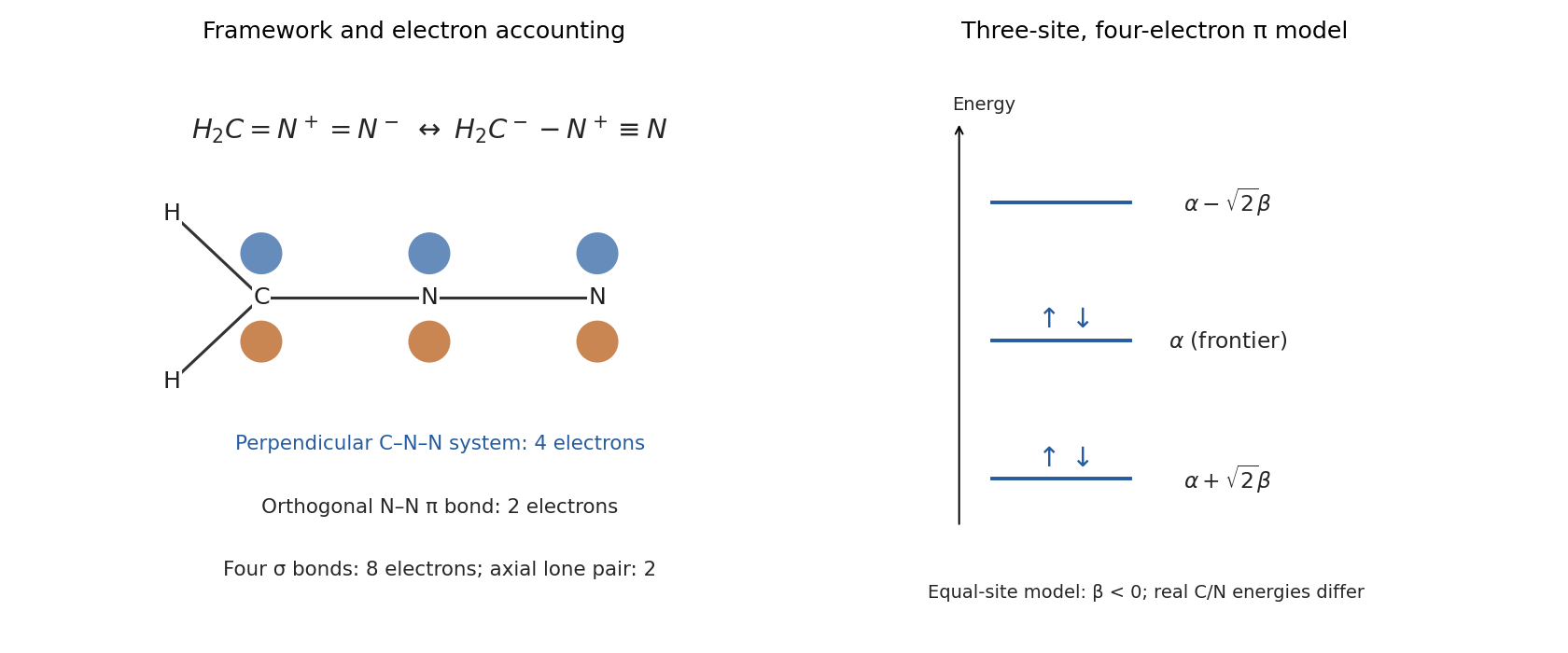
Original qualitative decomposition of diazomethane into four sigma bonds, an axial lone pair and two perpendicular pi systems
. Details. 
Articles by others on the same topic
There are currently no matching articles.