B gives spectrum 4. Number the unsaturated acyl chain from its carbonyl carbon. For , the assignments areThe strongly deshielded beta carbon and relatively shielded alpha carbon reflect polarization of the conjugated ester. All four protonated carbons here are CH or methyl environments and share one attached proton test phase, whereas the carbonyl has the opposite phase. The methoxy resonance is decisive: B has an O-bound methyl, not an O-bound methylene.
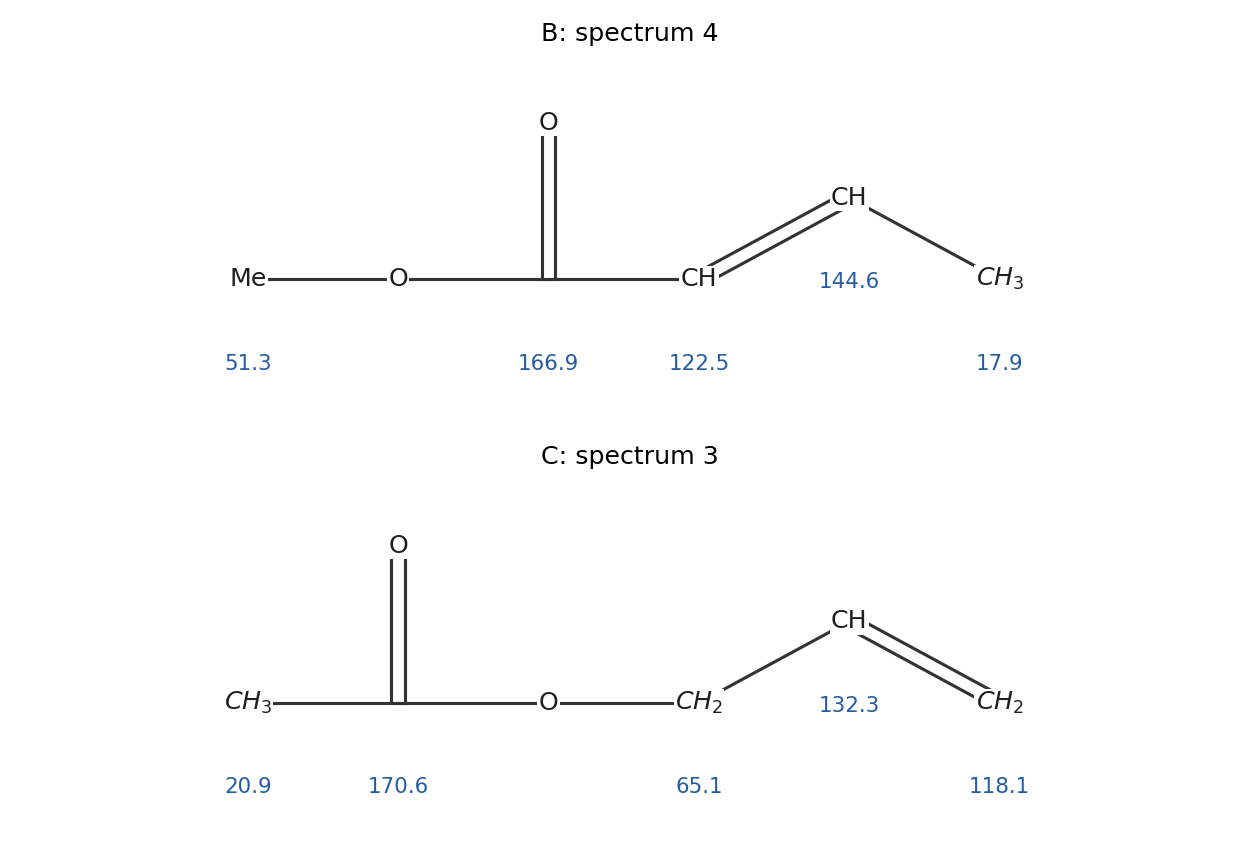
Original carbon-assignment structures for B and C, showing the distinction between a conjugated acyl group and an allyl alcohol-derived group
. Details. 
C gives spectrum 3. For allyl acetate, , assignThe 65.1-ppm resonance is the oxygen-bound methylene. Its attached proton test phase matches the terminal alkene methylene and the nonprotonated carbonyl, while the alkene CH and acetyl methyl have the opposite phase. The carbonyl is not conjugated with the alkene because oxygen and a saturated methylene interrupt the carbon–carbon conjugated path. This explains its higher carbonyl shift relative to B without requiring the two esters to have identical electronic environments.
B should have a lower carbonyl stretching frequency because its ester carbonyl is conjugated with a C=C bond. A typical diagnostic comparison is a conjugated ester carbonyl around – for B versus a nonconjugated ester carbonyl around – for C; the precise positions depend on the measurement conditions. conjugation distributes the pi bonding over the acyl fragment and lowers the effective carbonyl bond force constant.
C also has a terminal alkene, giving characteristic out-of-plane C–H bending features near 990 and . B has an internal, trans-disubstituted alkene, for which a band near is useful. Both compounds contain ester C–O bonds and alkene C–H bonds, so merely observing those general features would not distinguish them. The carbonyl comparison plus the alkene substitution pattern is the stronger identification.
Articles by others on the same topic
There are currently no matching articles.