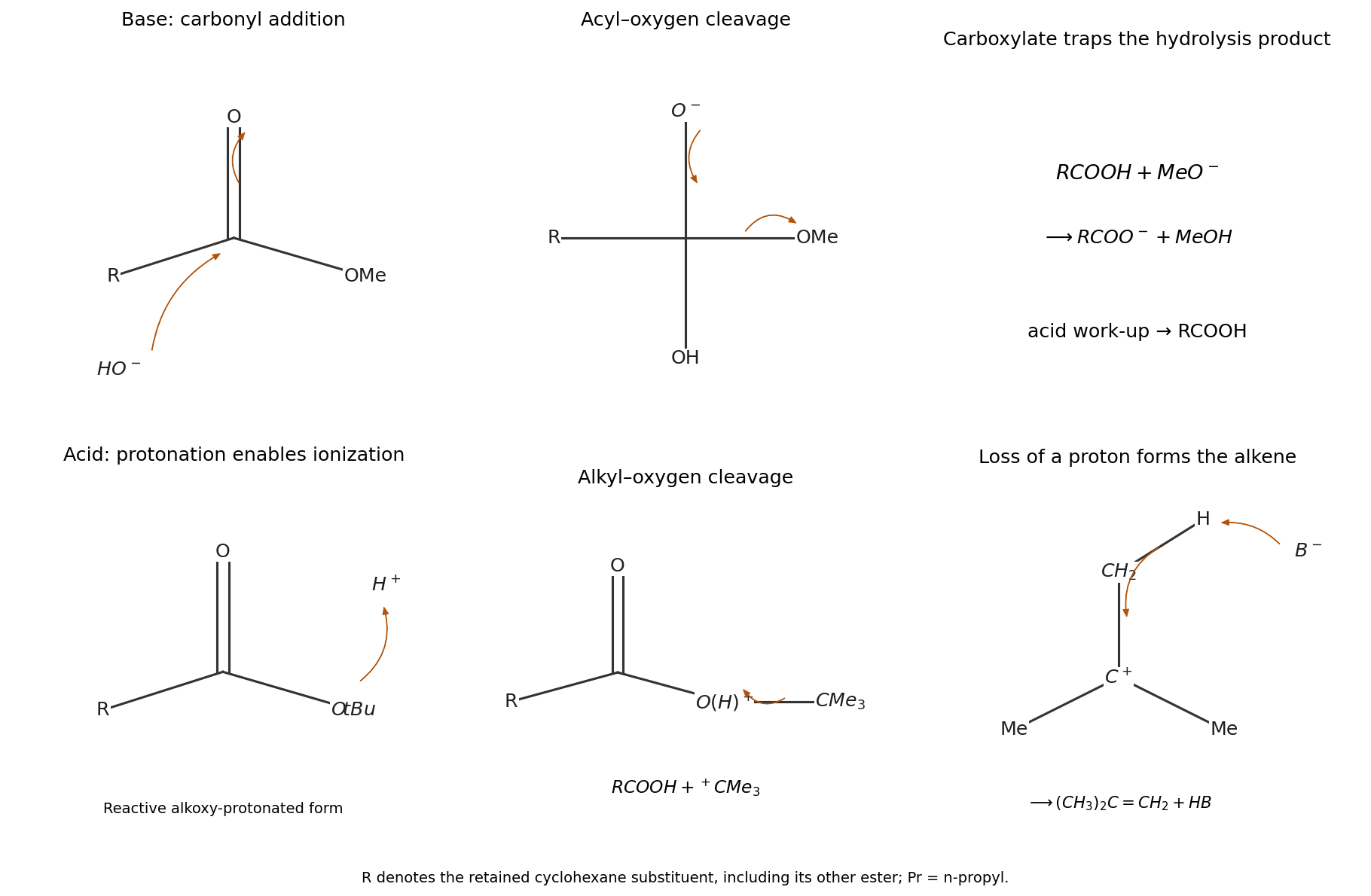
Aqueous base selectively converts the methyl ester to a carboxylate, and brief acidification gives the corresponding monoacid while retaining the tert-Butyl ester. At the methyl-ester end, a hydroxide lone pair attacks the acyl carbon and the carbonyl pi pair moves to oxygen. The tetrahedral intermediate collapses as the oxygen anion reforms C=O and the acyl C–OMe bond breaks to methoxide. proton transfer then gives the carboxylate and methanol. carboxylate formation makes the net saponification effectively irreversible under the basic conditions; protonation protonates that carboxylate.
The tert-Butyl ester reacts more slowly under these conditions because its bulky alkoxy group hinders acyl attack, and tert-butoxide is a stronger base and poorer leaving group than methoxide. The selectivity is kinetic, not an assertion that tert-butyl esters can never undergo base hydrolysis. The work-up should be sufficiently mild and brief to avoid the separate acid-labile pathway.
Anhydrous trifluoroacetic acid instead removes the tert-butyl group, leaving the methyl ester. protonation activates the ester; in a useful reactive protonation form the alkoxy oxygen bears the proton. The O–C(tert-butyl) bond then cleaves with its electron pair going to oxygen, producing the carboxylic acid and a tert-butyl-cation-like fragment. Loss of a methyl proton gives 2-methylpropene and regenerates the acid catalyst. Carbonyl-oxygen protonation and charge delocalization can precede cleavage; drawing alkoxy-oxygen protonation is a transparent way of tracking the bonds broken. The key distinction is alkyl–oxygen cleavage here versus acyl–oxygen cleavage in the base reaction. Methyl-cation formation is strongly unfavourable, and without water ordinary acid-catalysed methyl-ester hydrolysis is not available. No water is required to account for the tert-butyl deprotection or its alkene by-product.

Articles by others on the same topic
There are currently no matching articles.