The assignments are A → spectrum 3, B → spectrum 4, C → spectrum 1, and D → spectrum 2. The useful infrared spectroscopy evidence is the combination of functional-group absorptions, rather than every feature of the fingerprint region.
A is a saturated diketone: spectrum 3 has a strong ketone C=O band near without the very broad acid O–H absorption. Its two symmetry-related carbonyls do not require two well-separated diagnostic bands.
B is a conjugated dienoic acid: spectrum 4 combines a broad carboxylic acid O–H envelope, approximately –, with a conjugated C=O band near – and C=C absorptions around –.
C is an alkynoic acid: spectrum 1 contains the broad acid O–H absorption, a carbonyl near , and a conspicuous C≡C stretch near . Its alkyne is internal, so no terminal ≡C–H stretch is expected.
D is a conjugated vinyl ester: spectrum 2 has a strong ester C=O absorption around –, alkene features near , and strong C–O fingerprint absorptions, but no broad acid O–H envelope. These are approximate readings of the original axes, not exact assignments of every vibrational mode.
The carbon spectra are A → 5, B → 8, C → 6, and D → 7. Number each acyclic acid or ester chain from its carbonyl carbon. The assignments below account for every carbon-13 NMR environment.
For A, both ketone carbonyl carbons have ppm and all four methylene carbons have ppm. Molecular symmetry and rapid conformational averaging explain why six carbons give only two resonances.
For B, written , assign , , , , , and ppm. The alternation among vinylic chemical shifts reflects polarization of the conjugated chain, especially the deshielded carbon beta to the carboxyl group.
For C, written , assign the carbonyl at , the adjacent sp carbon at , the other sp carbon at , and the terminal methyl at ppm. The two methylene resonances are and ppm. A plausible assignment is and ppm, but their ordering is tentative from the supplied shift list alone; a correlation experiment would resolve it.
For D, written , the carbonyl is at ppm. The crotonyl beta-CH, alpha-CH and methyl carbons are at , and ppm, respectively. The O-bound vinyl CH is at ppm and its terminal is at ppm. The two sides of the ester oxygen therefore produce quite different vinylic environments.
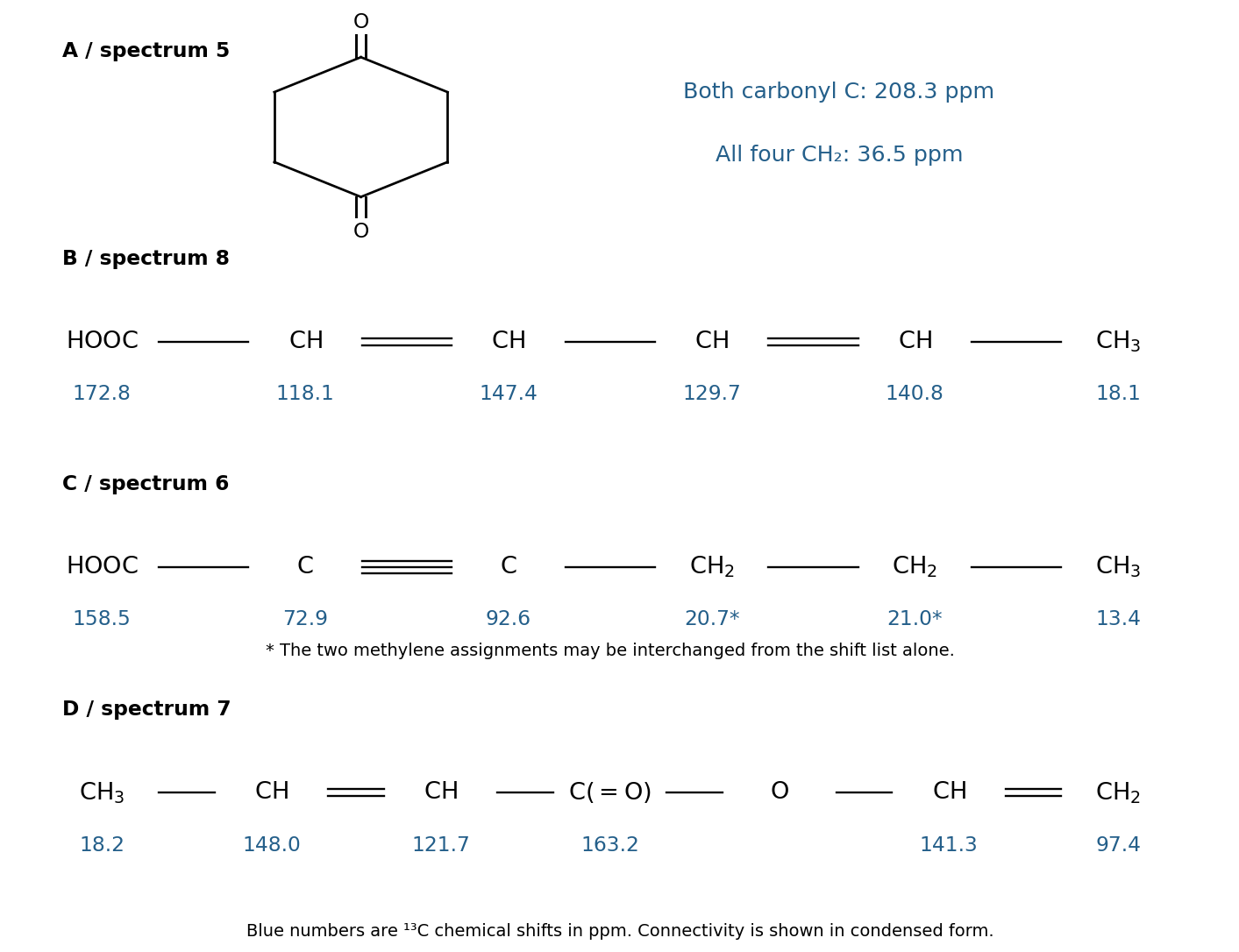
Original structural maps of all supplied carbon-13 NMR assignments
. Details. 
Use the proton labels in the original drawing below. Let denote the three methyl hydrogens, the crotonyl beta-CH, the crotonyl alpha-CH, the O-bound vinyl CH, and the terminal vinyl hydrogens trans and cis to , respectively.The integrals sum to eight hydrogens. Multiplet centres give the chemical shifts; a peak label at one edge of a multiplet is not its centre. The terminal vinyl hydrogens are chemically nonequivalent because one is cis and the other trans to the O-bound vinyl hydrogen. Each crotonyl CH couples to the other and to the methyl group; the resolved long-range interaction makes the methyl a doublet of doublets rather than a simple doublet.
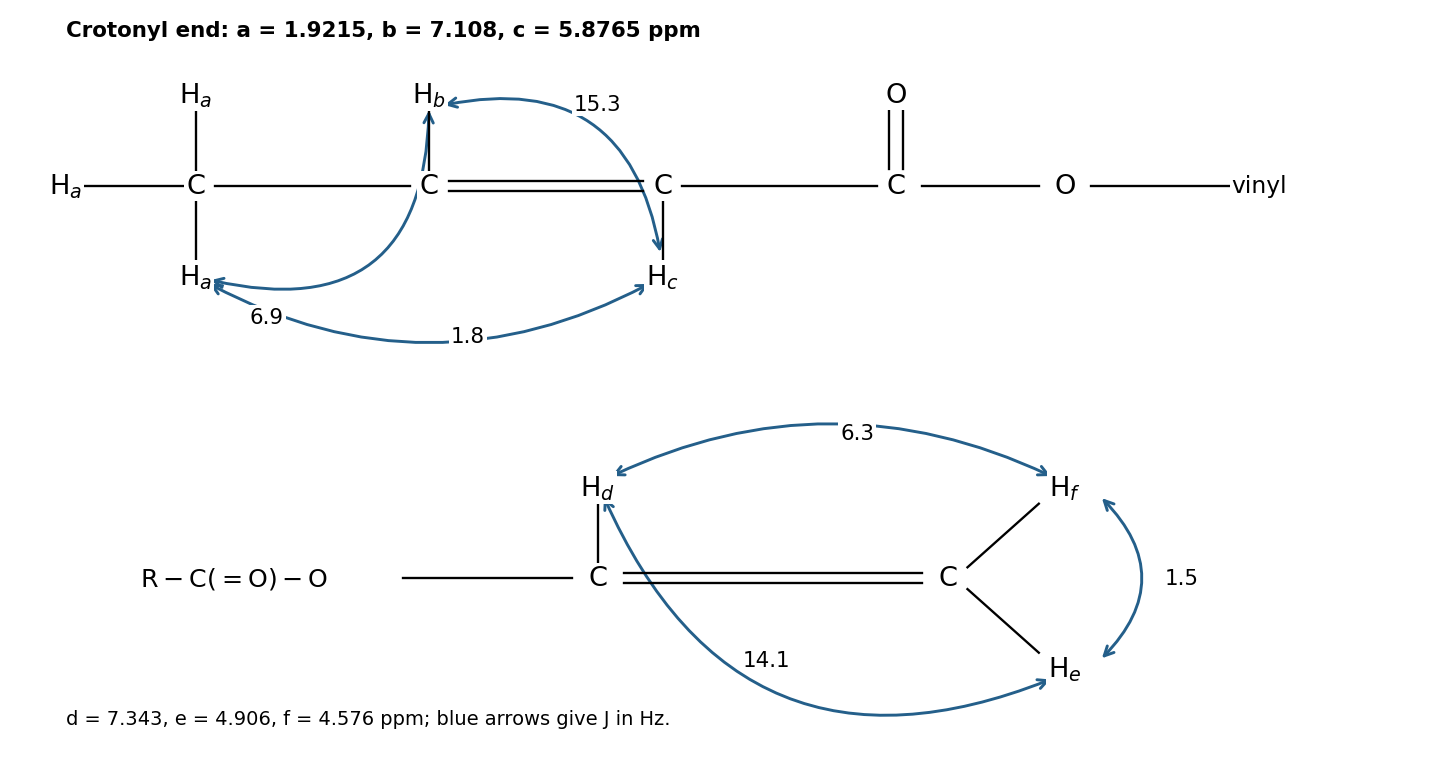
Original structure showing all eight hydrogens, their environments and calculated NMR coupling constants
. Details. 
At , . The six resolved scalar spin-spin couplings areFor example, the two quartets of are and ppm. Their origins differ by ppm, while the spacing within either quartet is ppm. This separates the trans alkene interaction from the smaller allylic methyl interaction.
Articles by others on the same topic
There are currently no matching articles.