The assignments are A → spectrum 3, B → spectrum 4, C → spectrum 1, and D → spectrum 2. The useful infrared spectroscopy evidence is the combination of functional-group absorptions, rather than every feature of the fingerprint region.
A is a saturated diketone: spectrum 3 has a strong ketone C=O band near without the very broad acid O–H absorption. Its two symmetry-related carbonyls do not require two well-separated diagnostic bands.
B is a conjugated dienoic acid: spectrum 4 combines a broad carboxylic acid O–H envelope, approximately –, with a conjugated C=O band near – and C=C absorptions around –.
C is an alkynoic acid: spectrum 1 contains the broad acid O–H absorption, a carbonyl near , and a conspicuous C≡C stretch near . Its alkyne is internal, so no terminal ≡C–H stretch is expected.
D is a conjugated vinyl ester: spectrum 2 has a strong ester C=O absorption around –, alkene features near , and strong C–O fingerprint absorptions, but no broad acid O–H envelope. These are approximate readings of the original axes, not exact assignments of every vibrational mode.
The carbon spectra are A → 5, B → 8, C → 6, and D → 7. Number each acyclic acid or ester chain from its carbonyl carbon. The assignments below account for every carbon-13 NMR environment.
For A, both ketone carbonyl carbons have ppm and all four methylene carbons have ppm. Molecular symmetry and rapid conformational averaging explain why six carbons give only two resonances.
For B, written , assign , , , , , and ppm. The alternation among vinylic chemical shifts reflects polarization of the conjugated chain, especially the deshielded carbon beta to the carboxyl group.
For C, written , assign the carbonyl at , the adjacent sp carbon at , the other sp carbon at , and the terminal methyl at ppm. The two methylene resonances are and ppm. A plausible assignment is and ppm, but their ordering is tentative from the supplied shift list alone; a correlation experiment would resolve it.
For D, written , the carbonyl is at ppm. The crotonyl beta-CH, alpha-CH and methyl carbons are at , and ppm, respectively. The O-bound vinyl CH is at ppm and its terminal is at ppm. The two sides of the ester oxygen therefore produce quite different vinylic environments.
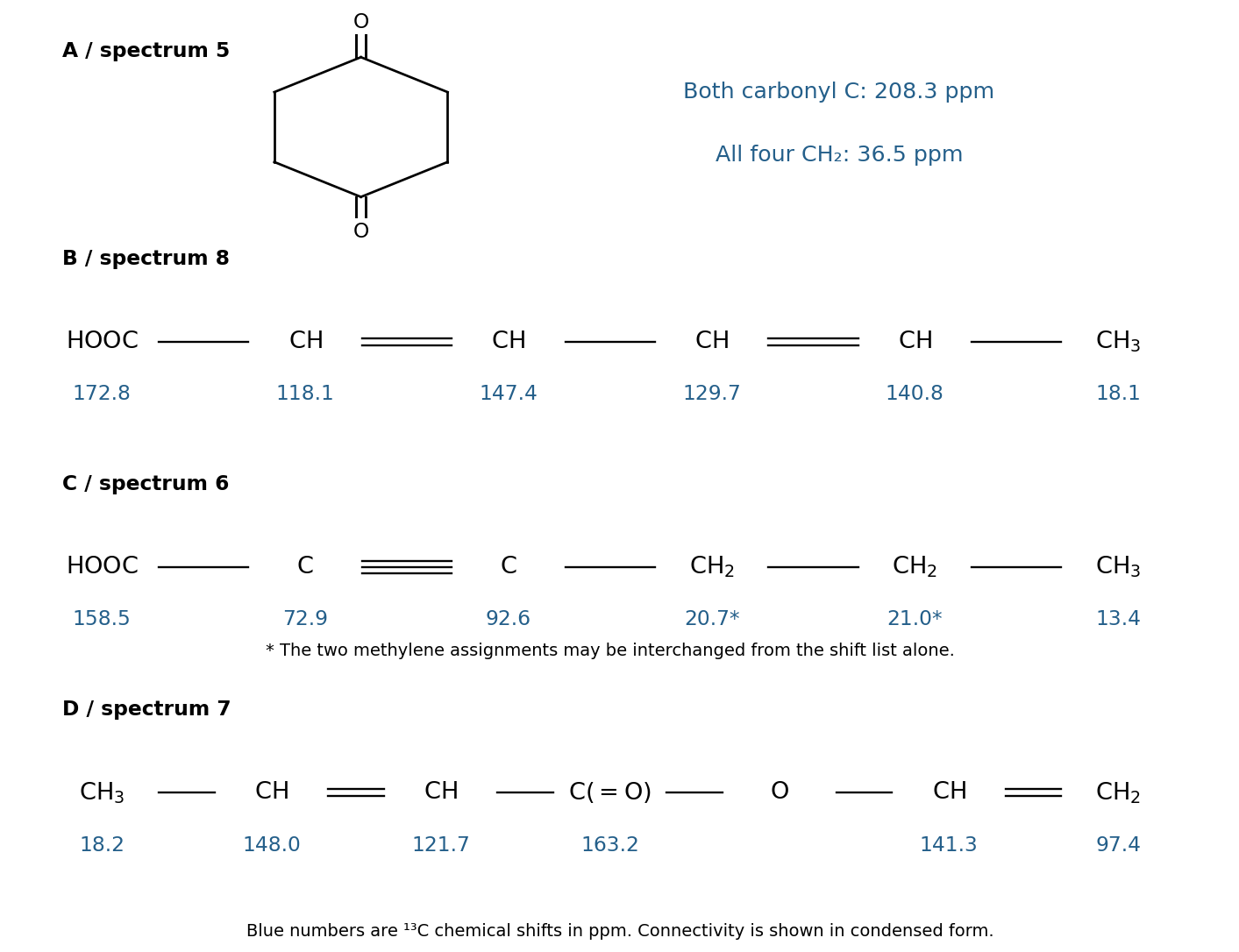
Original structural maps of all supplied carbon-13 NMR assignments
. Details. Use the proton labels in the original drawing below. Let denote the three methyl hydrogens, the crotonyl beta-CH, the crotonyl alpha-CH, the O-bound vinyl CH, and the terminal vinyl hydrogens trans and cis to , respectively.The integrals sum to eight hydrogens. Multiplet centres give the chemical shifts; a peak label at one edge of a multiplet is not its centre. The terminal vinyl hydrogens are chemically nonequivalent because one is cis and the other trans to the O-bound vinyl hydrogen. Each crotonyl CH couples to the other and to the methyl group; the resolved long-range interaction makes the methyl a doublet of doublets rather than a simple doublet.
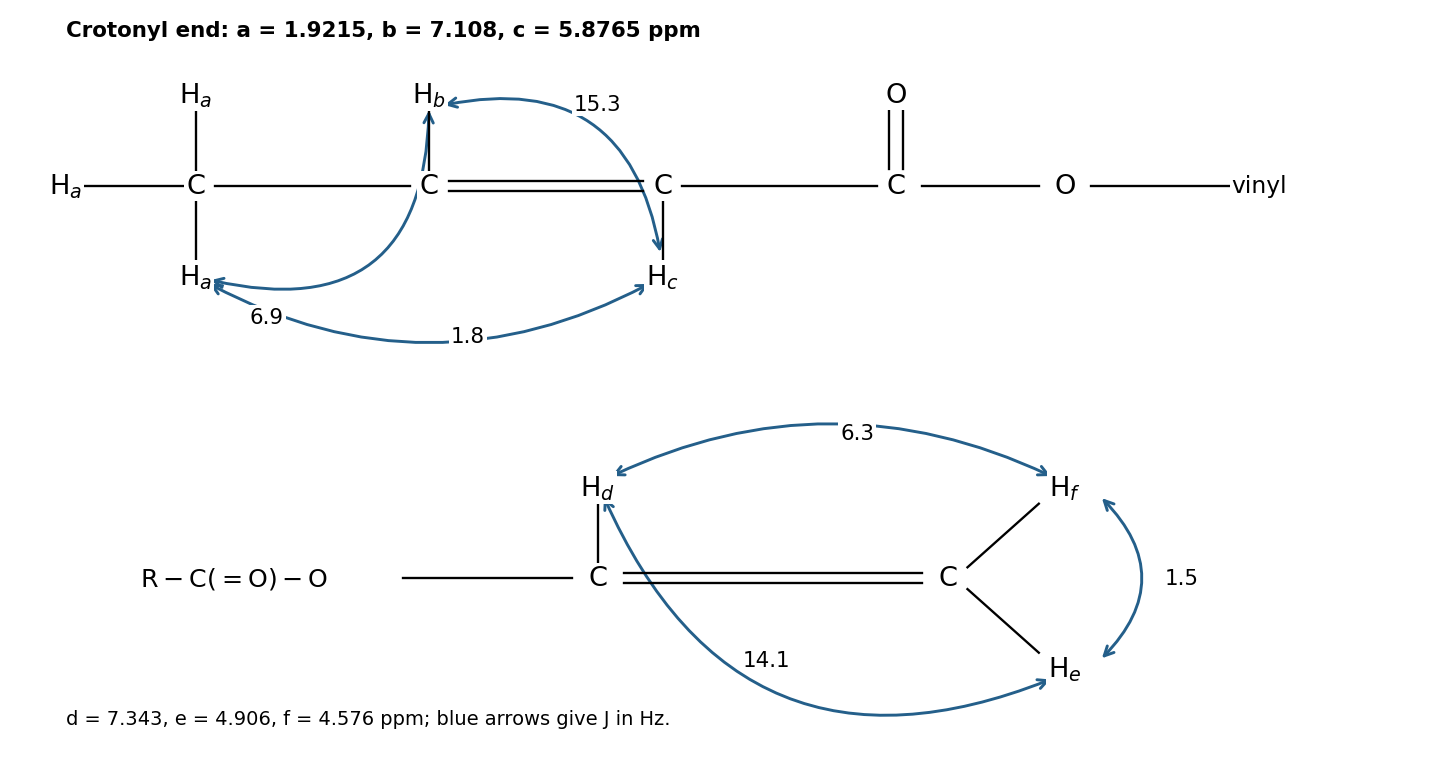
Original structure showing all eight hydrogens, their environments and calculated NMR coupling constants
. Details. At , . The six resolved scalar spin-spin couplings areFor example, the two quartets of are and ppm. Their origins differ by ppm, while the spacing within either quartet is ppm. This separates the trans alkene interaction from the smaller allylic methyl interaction.
The four lines independently give and . The large interaction identifies as trans to ; has the smaller cis interaction. The double-headed arrows in the structural map identify the actual interacting nuclei. Coupling to means the same coupling to each of its three equivalent hydrogens.
Carbon dioxide is linear, with two equivalent C–O bonds of formal bond order two; its Homo is predominantly oxygen nonbonding and its LUMO is C–O antibonding. The carbon uses two opposite hybrids for its sigma bonds and two perpendicular p atomic orbitals for pi bonding. A localized picture assigns each terminal oxygen an sigma/lone-pair framework and one p orbital for its local pi bond.
In a symmetry-adapted description, each of the two perpendicular sets of oxygen and carbon p functions forms bonding, oxygen-centred nonbonding and antibonding combinations. The occupied nonbonding pair is labelled and the lowest empty pi pair . The latter has appreciable amplitude at carbon, explaining its electrophilic reactivity. Hybridization of a terminal atom with only one bonded neighbour is a choice of localized basis, not an independently measurable bond angle; an alternative oxygen plus p basis can represent the same delocalized system.
There are 16 valence electrons: four in the two sigma bonds, four in the two net pi bonds, and eight in the remaining oxygen lone-pair combinations. These local electron counts and the delocalized orbital description are alternative bookkeeping schemes, not additional electrons.
Ozone is bent, with two equivalent O–O bonds of approximate bond order . Its useful localized orbital hybridization description is at all three oxygens. Two hybrids at the central oxygen form sigma bonds and a third contains a lone pair; the three perpendicular p orbitals form a three-centre four-electron pi bond.
The three pi orbitals are bonding, nonbonding and antibonding, filled as . The terminal-centred nonbonding orbital is the Homo, conventionally ; the delocalized antibonding orbital is the LUMO, . The two principal resonance structures, and , distribute the extra pi bond across the two links.
The 18 valence electrons comprise four sigma-bond electrons, ten in five sigma-framework lone pairs, and four in the pi system. This gives a paired ground-state model. More accurate treatments include electron correlation; the simple bond-order picture is not an exact charge-density calculation.[ref]
The central carbon in carbon dioxide has two bonding directions and no lone pair, whereas the central oxygen in ozone has two bonding directions and one lone pair. In the VSEPR model, carbon dioxide therefore has a linear arrangement; ozone has an approximately trigonal-planar electron-domain arrangement but a bent atomic skeleton. Multiple bonding occupies one direction for this geometrical count. The extra central-oxygen lone pair, rather than a different number of atomic nuclei, creates the difference.
The product is carbonic acid, . The oxygen lone pair Homo of water donates into the carbon-centred component of the carbon dioxide LUMO. Draw an electron-pair arrow from the water oxygen to carbon and a second from one C=O pi bond onto its oxygen:The first step bends the original linear electrophile and gives carbon three oxygen neighbours; carbon is approximately trigonal planar in the resulting carbonate framework. Proton transfer from the oxonium oxygen to the negatively charged oxygen produces the neutral acid. In real water, solvent molecules relay that proton rather than requiring a strained isolated intramolecular transfer. The forward mechanism does not assert that most dissolved carbon dioxide is present as carbonic acid at equilibrium.
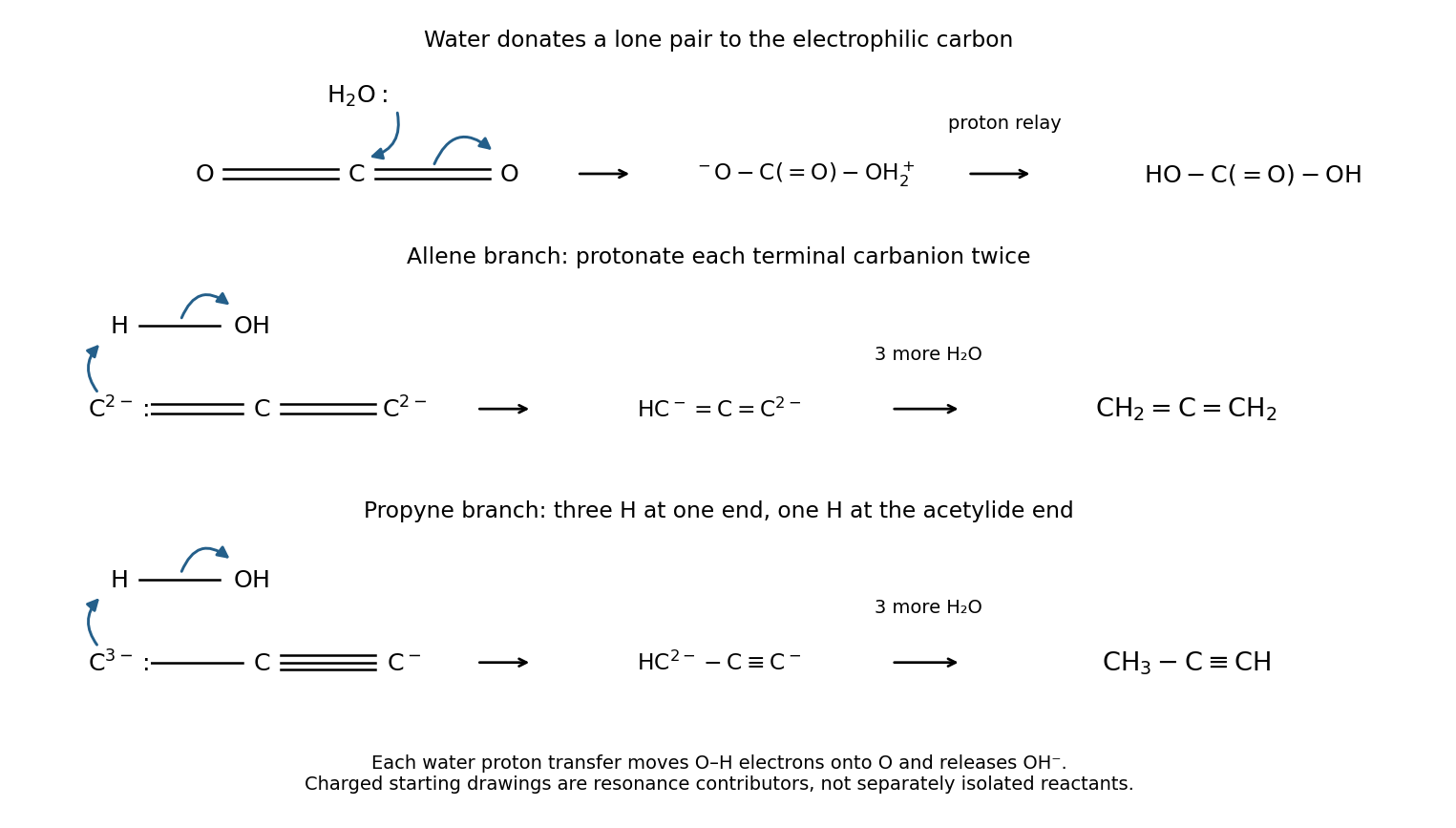
Original electron-pair arrows for carbon dioxide hydration and protonation routes from the tricarbide ion
. Details. The elementary valence-MO model gives . Each carbon supplies four valence electrons, so fill eight electrons in the ordering appropriate to the lighter second-row diatomics:The two orbitals are degenerate, as are the two orbitals. The bonding and antibonding occupations cancel; four net p-bonding electrons remain, giving . Mixing between sigma orbitals of compatible symmetry places the occupied pair below the empty p-derived orbital in this diagram. All occupied orbitals are paired.
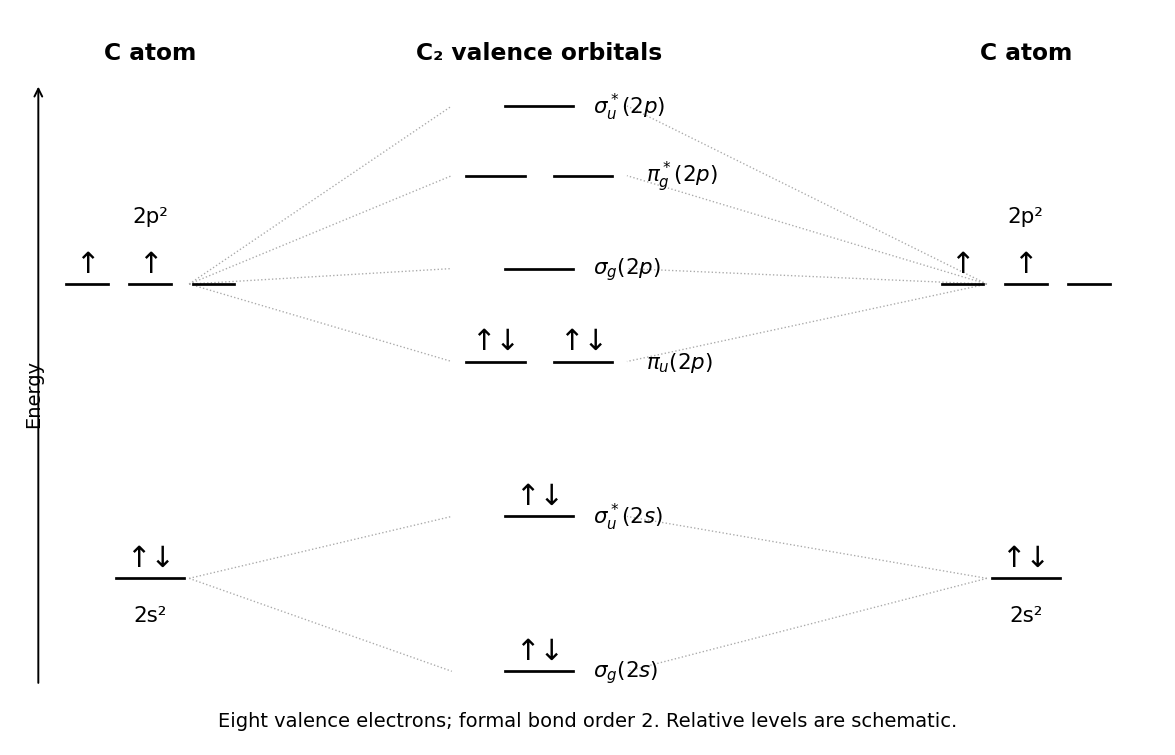
Original valence molecular orbital energy diagram for carbon dimer, with atomic inputs and symmetry labels
. Details. The omitted orbitals form filled and levels. Their contributions to the formal bond order cancel, and their low energies and small spatial extent make them largely core-like. Omitting them simplifies this valence diagram without claiming they do not exist or have exactly no effect on molecular energies.
The acetylide has ten valence electrons, two more than neutral . They fill the p-derived sigma bonding orbital, giving the formal configuration above the cancelling pair. Its bond order is three, with the Lewis structure and a lone pair at each end; each carbon is approximately hybridized.
The tricarbide has valence electrons and is isoelectronic with carbon dioxide. The cumulene contributor has a central carbon, two sigma bonds and two perpendicular pi bonds. The end carbons each have two lone pairs and can be described with an localized basis. Its two C–C bonds have formal order two in this model; the central C–C–C angle is . Other resonance contributors help describe its protonation chemistry.
The extra electron associated with trivalent lanthanum weakens the C–C bond by occupying states with C–C antibonding character. Calcium gives the ten-valence-electron acetylide description , with formal bond order three, consistent with the short pm distance.
A fully ionic count for gives . The eleventh valence electron then enters a orbital, giving the simple estimate . This explains the longer pm bond. In the actual solid that electron is not necessarily localized on an isolated radical: metal–carbon mixing and band delocalization make “triple bond plus partial antibonding occupation” more appropriate than an exact isolated-ion bond order. Bond length alone does not determine a unique numerical bond order.
The intended ordinary-carbide comparison is energetic: the smaller, more strongly polarizing can stabilize a different balance of lattice energy and carbon-anion bonding from the larger . Stabilization of the highly charged group competes with acetylide formation; electron counting alone does not require the same carbide stoichiometries for both metals. Ionic size and charge density provide a qualitative explanation, not a complete phase-stability calculation.
The literal claim that calcium has only one carbide is too broad. Primary calculations and high-pressure synthesis have established additional calcium carbides, including and ; known calcium-carbide chemistry also includes . Thus the conventional comparison must be limited to the familiar salt-like compounds and conditions intended here, rather than treated as a prohibition on other calcium–carbon compositions.[ref]
Investigation of exotic stable calcium carbides using theory and experiment by Yan-Ling Li and others. 2015, abstract, Ca2C3 section and experimental synthesis
The two carbon skeletons are allene, , and propyne, . “Linear” describes the three-carbon skeleton; it does not mean every hydrogen lies on the same line.
For allene, use the contributor . A terminal lone pair attacks a water hydrogen while the O–H pair returns to oxygen, giving and hydroxide. Repeat at the still-dianionic end, then protonate each remaining terminal carbanion. The four successive proton transfers givewith two hydrogens placed on each terminal carbon in this branch.
For propyne, the resonance contributor makes the alternative electron flow clear. Three successive protonations of the singly bonded terminal carbon convert its three lone pairs into C–H bonds; protonation of the acetylide end gives . These are formal protonation pathways for the multiply charged anion, not a claim that the highly charged resonance contributors are separately isolable species. Each transfer produces ; overallAllene has one proton resonance integrating to 4H, ideally a singlet because its four hydrogens are chemically equivalent. Proton-decoupled carbon NMR has two resonances, in ratio two terminal carbons to one central carbon: approximately and ppm, respectively. The unusually downfield central cumulene carbon is not a carbonyl.
Propyne has two proton resonances, integrating 3H near – ppm and 1H near – ppm. If the small four-bond coupling is resolved, they are a methyl doublet and an acetylenic quartet; if unresolved, each can look like a singlet. Proton-decoupled carbon NMR has three resonances: one methyl carbon near ppm and two distinct sp carbons around – ppm. These are approximate predictions, not supplied measured shifts.
The most acidic sites are: acetic-acid O–H, ; phenol O–H, ; ethanal alpha-CH, –; propyne terminal ≡C–H, . These are ordinary approximate organic-chemistry estimates; exact acidities depend on solvent and reference convention.
Acetic acid gives a carboxylate in which negative charge is delocalized over two oxygens through equivalent resonance structures. Phenol gives a phenoxide with delocalization into the aromatic system, but its important contributors are less equivalent and do not stabilize the charge as effectively as a carboxylate.
For ethanal, removal of a methyl hydrogen gives the enolate . The aldehydic hydrogen is not the preferred acidic site: removing it does not give this alpha-carbon/oxygen delocalization. For propyne, loss of the terminal hydrogen gives an acetylide with a lone pair in an orbital. Its greater s character stabilizes negative charge relative to an ordinary or carbanion; the methyl hydrogens are much less acidic.
The first transformation is two successive dehydrohalogenations; the second opens the lactone by two methyl additions and then closes a six-membered cyclic ether. Both schemes must be accounted for within this part.
For the dichloride, write . In the product-forming path, tert-butoxide removes a hydrogen from the methyl group of . Draw arrows from the base lone pair to H, from C–H into the C–C bond, and from C–Cl to Cl. This E2 elimination gives . A second base-induced elimination removes a vinyl hydrogen and the remaining chloride, forming . The second elimination is more demanding because a vinylic bond is involved, consistent with the strong-base, heated conditions. This route explains the displayed product without asserting that no other elimination regioisomer can ever form.
For the lactone, a methyl equivalent from methylmagnesium iodide attacks the ester carbonyl carbon, with its pi pair moving to oxygen. Collapse of the tetrahedral intermediate reforms C=O and cleaves the acyl–oxygen bond, opening the ring to the magnesium alkoxide corresponding to . The newly formed ketone is more susceptible to a second methyl addition; its pi pair again moves to oxygen. After water workup, the product is the diol .
Under acid and heat, protonate its tertiary OH, then move the C–O pair onto oxygen as water leaves. The resulting is trapped intramolecularly by the remaining primary-alcohol oxygen. Its lone pair forms the closing O–C bond, producing a six-membered cyclic oxonium ion. Deprotonation yields 2,2-dimethyloxane, also called 2,2-dimethyltetrahydropyran. Ring closure retains four chain methylenes; it does not form a five-membered ring. The two methyl groups both derive from the two equivalents of Grignard reagent.
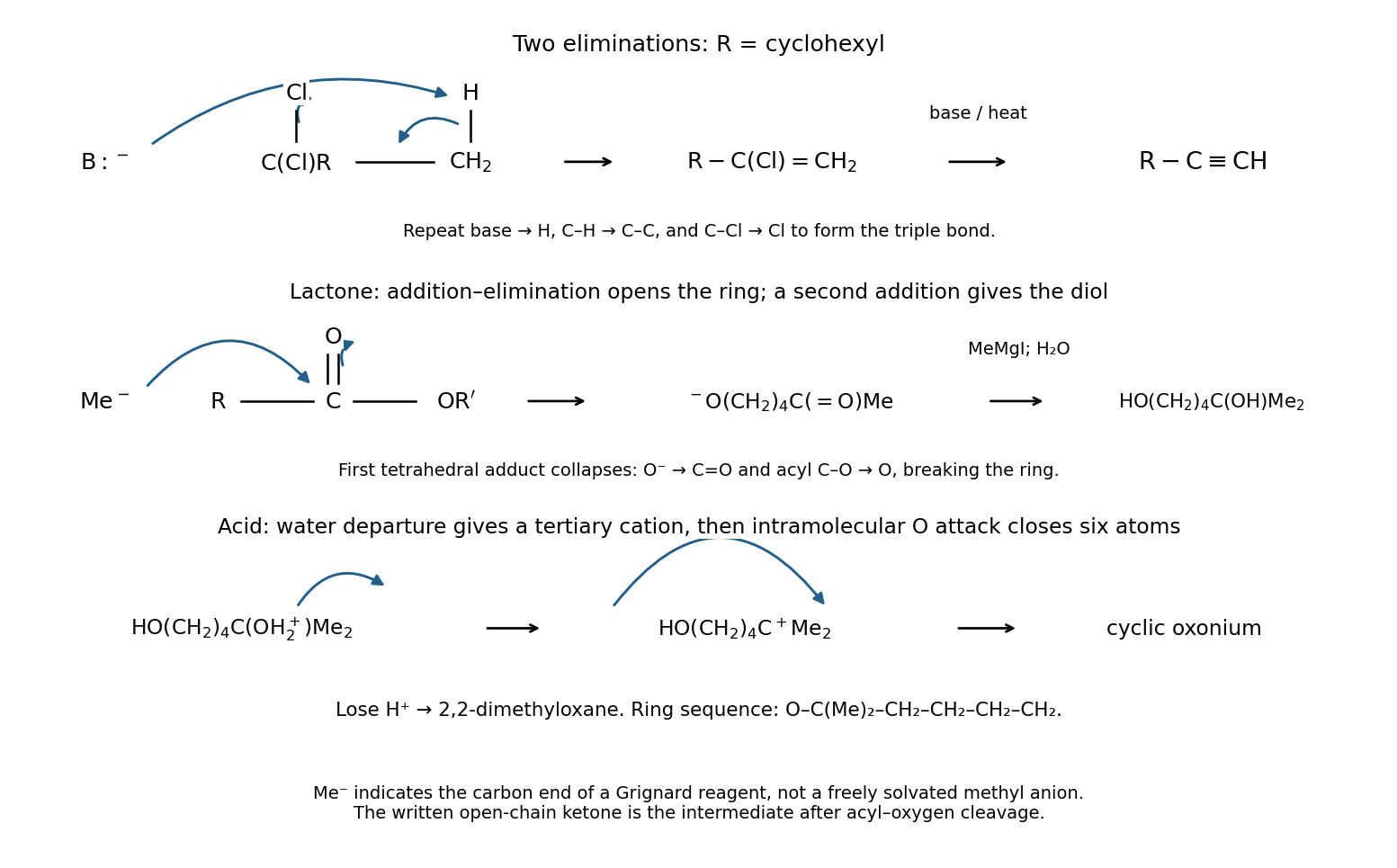
Original electron-flow schemes for double elimination, lactone addition and acid-induced ether formation
. Details. The alcohol is oxidized to cyclohexanone through an alkyl hypochlorite intermediate. Acid converts hypochlorite into electrophilic hypochlorous acid. The alcohol oxygen attacks chlorine, with acid-assisted proton transfers and loss of water giving the O–Cl derivative .
A base such as acetate then removes the hydrogen attached to the carbinol carbon. The three coupled electron-pair motions are: base → H; C–H → C–O to form C=O; and O–Cl → Cl to release chloride. The resulting carbonyl is cyclohexanone. This is an elimination-like oxidation of the hypochlorite ester: the original alcohol oxygen becomes the ketone oxygen, while loss of its O-bound H and the carbinol C-bound H effects the net oxidation.
Methyl addition gives 1-methylcyclohexanol, whose acid-catalysed dehydration yields the shown 1-methylcyclohexene. The methyl end of methyllithium attacks the cyclohexanone carbonyl carbon, and the C=O pi electrons move onto oxygen, giving a lithium alkoxide. Protonation gives the tertiary alcohol.
Protonate OH to make , then cleave its C–O bond with both electrons going to departing water. A base removes a beta hydrogen from either adjacent ring methylene, and that C–H pair forms the C=C bond to the tertiary cationic centre. This E1 elimination regenerates the acid catalyst. The two adjacent ring positions are equivalent, and the displayed endocyclic alkene is more substituted than the possible exocyclic methylene alternative.
D is racemic trans-2-methylcyclohexan-1-ol. E is racemic 1-methyl-2-phenylcyclohexan-1-ol with OH and Ph trans, and Me and Ph cis. Number the starting alkene carbon carrying methyl as and its partner as in the reaction explanation below; the product name of D renumbers the OH-bearing carbon as 1.
For D, hydroboration proceeds through a concerted four-centre transition state: the alkene pi pair donates to boron while B–H supplies the new C–H bond. Boron attaches mainly to less substituted and hydrogen to , on the same face. Under peroxide/base conditions, hydroperoxide attacks B; migration of the C–B bond to the adjacent oxygen, with O–O cleavage, replaces C–B by C–O with retention at carbon. Hydrolysis/proton transfer releases the alcohol. Thus the newly added H and OH are syn, making the pre-existing methyl and OH trans. Attack on either alkene face gives the enantiomeric pair.
For E, the peracid transfers its terminal oxygen across the alkene in concerted epoxidation, through cyclic electron flow that also breaks O–O and transfers the acidic proton to the peracid carbonyl oxygen. The resulting epoxide retains the relative configuration of the alkene substituents. The phenyl equivalent from phenylmagnesium bromide then attacks less substituted from the face opposite the epoxide oxygen. Its C–O bond breaks onto oxygen, an SN2-like ring opening; the oxygen stays attached to . Water workup protonates that alkoxide. Consequently OH at and Ph at are anti, while the methyl at lies on the same relative face as Ph.
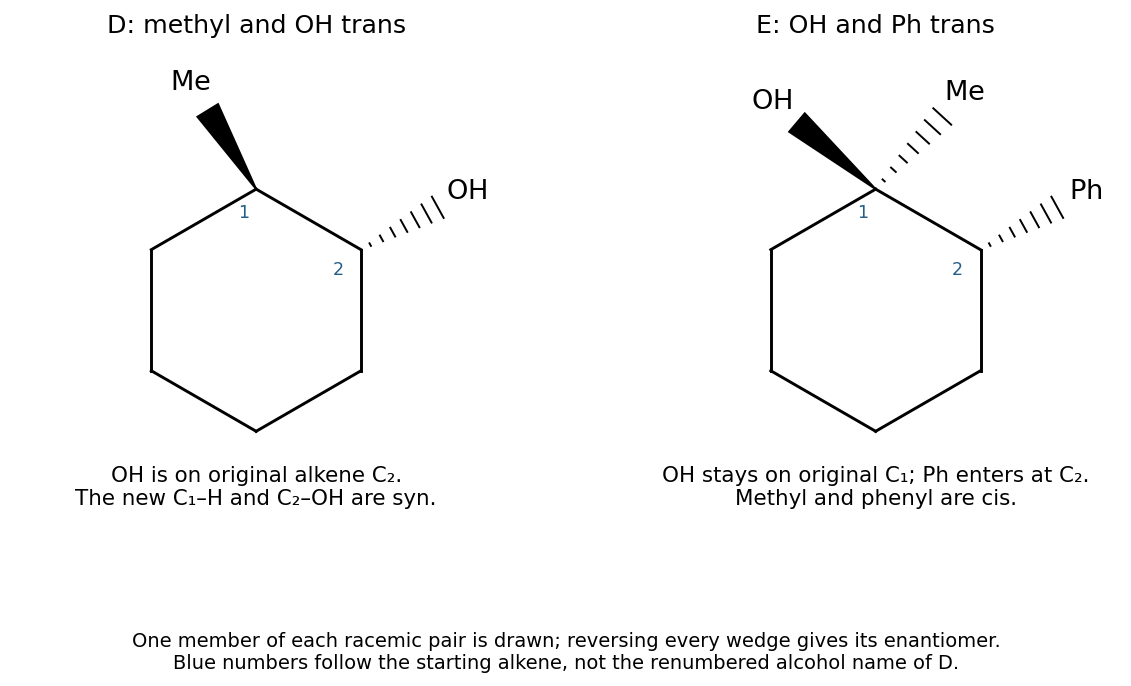
Original product structures showing the relative stereochemistry of hydroboration–oxidation and epoxide opening
. Details. The decadic Beer-Lambert law can be writtenHere is the path length in metres, is concentration in or M, and is the decadic molar attenuation coefficient in . The intensity ratio and the exponent are dimensionless. Equivalently with in the same units. Defining the logarithm convention avoids a missing factor of .
For a first-order reaction with no appreciable reverse contribution in this decay experiment,With fixed path length and attenuation coefficient, and absorbance attributable to ONOO after blank/background correction, the Beer-Lambert law gives . ThereforeThe gradient is , in when time is measured in seconds. Constant illumination wavelength, homogeneous sampling and negligible product absorbance at that wavelength are required for this direct interpretation.
The intermediate balance isSetting this derivative approximately to zero under the quasi-steady-state approximation givesBoth dissociation and reaction with NO remove the intermediate. Its steady concentration is not zero and does not require the first reversible pair to be at equilibrium.
The last elementary reaction creates two nitrogen dioxide molecules per event, soThe factor of two is required for the production rate requested. The conventional reaction rate for would be one half of this production rate.
“Low NO” means , or . ThenThe effective orders are two in NO and one in oxygen, giving overall order three. For the production-rate convention,If the conventional reaction rate is used, its coefficient is . These are the same kinetics under explicitly different normalizations. At high NO the denominator changes, so the effective NO order approaches one rather than remaining two.
Convert the supplied concentrations to and . ThenThe combined loss coefficient is . Neglecting the smaller NO-dependent loss would give , a close low-NO approximation, but the full expression is just as easy to evaluate.
The estimate is . During the initial buildup, assume instantaneous mixing, initially zero ONOO, constant temperature, and negligible depletion of NO and oxygen. Their concentrations can then be held fixed while solving for :The initial-value solution is . Setting givesA constant-initial-rate estimate gives , consistent to about 5%. The intermediate concentration and total reaction progress over this interval are tiny relative to NO, supporting the negligible-depletion approximation. The actual onset could be limited by mixing or instrumental response; a large vessel does not itself guarantee homogeneous mixing in microseconds.
The standard entropy of reaction isUsing ,The formation enthalpy of elemental fluorine gas is zero in its standard state. ThusThe large negative entropy change is consistent with converting two gas molecules to one; it is already included in the Gibbs-energy relation.
For ideal gases and standard pressure ,Since , this gives . ThereforeMore exactly, subtract the tiny fluorine pressure from and divide the remainder in the ratio . The very small fluorine activity reconciles the reactant-rich ClF ratio with the very large equilibrium constant.
For each ideal gas, the chemical potential relative to the pure gas at standard pressure is . HenceAll three shifts are negative because their partial pressures are below . As a check, at equilibrium, within rounding.
Subtract the second supplied reaction from the first. Chlorine trifluoride and aqueous HCl cancel, while one water and two HF remain on their respective sides, giving the required reaction. By Hess's law for Gibbs energy,The subtraction reverses the second reaction before adding it; adding both supplied Gibbs energies without changing its sign would correspond to a different chemical equation.
With the stipulated value and ideal-solution approximations, and the initial oxygen-difluoride pressure is . These are estimates for the hypothetical reaction energetics specified in this part.
Take liquid-water activity as one, ideal gases, and aqueous HF activity as , with . The equilibrium constant isThus .
Let the fixed liquid volume be and headspace volume . If moles react, then , , and the pressure ratio gives , so . The HF amount is . Thereforeusing with molarity in . The equilibrium gas pressures are approximately bar oxygen and bar oxygen difluoride; gas stoichiometry is one molecule to one, so their sum equals the initial gas pressure under these approximations.
Assume negligible gas dissolution, HF vapour, HF dissociation and nonideality, and negligible change of liquid/headspace volumes on reaction. Water consumption is about mol per litre of original liquid, small compared with its roughly mol of water. At nearly HF, the ideal-solution approximation is nevertheless a substantive limitation: without activity coefficients and an acid-speciation model, a precise real-solution pressure cannot be deduced from the supplied data.
The central carbon is approximately hybridized, with two opposite sigma bonds and no carbon lone pair; the electron-rich donor ends are sulfur and nitrogen. The 16 valence electrons allow the principal resonance structuresEach has octets and a linear S–C–N skeleton. Carbon's two perpendicular p orbitals support the pi interactions. The first contributor emphasizes the C≡N bond and sulfur-centred negative charge; the second distributes pi bonding over S=C=N and puts negative charge on N. The real anion has partial multiple-bond character and delocalized charge rather than alternating between these drawings.
Nitrogen's greater Allen electronegativity favours electron accumulation there, while sulfur supports a diffuse, polarizable electron-rich region. Thus both terminal atoms are important electron-rich sites relative to central carbon. “Greatest electron density” should not be interpreted as a literal comparison of all core electrons on different elements; the chemically relevant comparison is valence charge, donor density or electrostatic potential. The exact partition of negative charge between S and N is not uniquely determined by electronegativities or Lewis structures alone.
The Hg–S interaction is expected to be stronger than Hg–N by the hard and soft acids and bases argument. is a soft, readily polarizable Lewis acid. The sulfur end of thiocyanate is a softer and more polarizable donor than its nitrogen end, so it better matches mercury's electronic response and covalent bonding preference.
Nitrogen being more electronegative does not by itself make it the preferred donor to a soft metal. Charge concentration and polarizability are distinct properties. The extended solid can still contain Hg–N contacts that complete the bridging network; the prediction concerns their relative bonding preference, not the absence of N coordination.[ref]
Hard and Soft Acids and Bases by Ralph G. Pearson. 1963, primary classification and matching principle
The ordering reflects different connectivities, bond strengths and charge distributions, rather than different elemental composition. Relative to thiocyanate, the supplied formation enthalpies are higher by and , respectively.
For , carbon can make strong C–N multiple bonding with good 2p–2p overlap while keeping its octet. The contributors and avoid a compulsory positive central atom and place the excess negative charge on terminal heteroatoms.
For , an octet description with four bond-order units forces the central nitrogen to formal charge . A representative contributor is , with both charge separation and negative charge on less electronegative carbon. The alternative does not remove that disadvantage. Connectivity prevents simply transferring the favourable thiocyanate charge pattern to this isomer.
For , a central-sulfur octet with four bond-order units gives sulfur formal charge . One illustrative contributor is , which has severe charge separation. Attempts to avoid it by drawing strong expanded-octet multiple bonding at sulfur do not supply the strong, well-matched second-row pi overlap available in C–N bonds. Sulfur 3p functions are larger and less well matched to 2p functions, and high-energy 3d orbitals are not a remedy for this deficiency.
These arguments rationalize the large differences but do not quantitatively predict the supplied enthalpies from electronegativity alone. Real charge delocalization and geometry relaxation matter; formal charges are bookkeeping, not measured atomic charges.
Balancing Hg first, then sulfur, carbon and nitrogen givesThere are two Hg, four S, four C and four N atoms on each side. This is the stipulated initial decomposition, not a claim that further heating cannot change its products.
HgS and are semiconductors; is a wider-gap, insulating material under the stated conditions. None is a metallic conductor. Their finite electronvolt-scale gaps and very low measured conductivities exclude a partially filled, highly conducting metallic band picture.
The insulator/semiconductor boundary is conventional rather than a sharp universal gap cutoff. Calling the material a wide-bandgap semiconductor is also physically reasonable; the table alone does not establish a unique naming boundary. Conductivity is , so its ordering need not follow gap size alone: carrier density, defects, trapping and mobility also matter.
One possible idealized sheet is a network of alternating C/N triazine rings joined through three-coordinate nitrogen bridges. Every carbon has three sigma neighbours and participates in a conjugated pi framework. Each ring nitrogen has two ring neighbours and a lone pair; each bridging nitrogen joins three ring carbons.
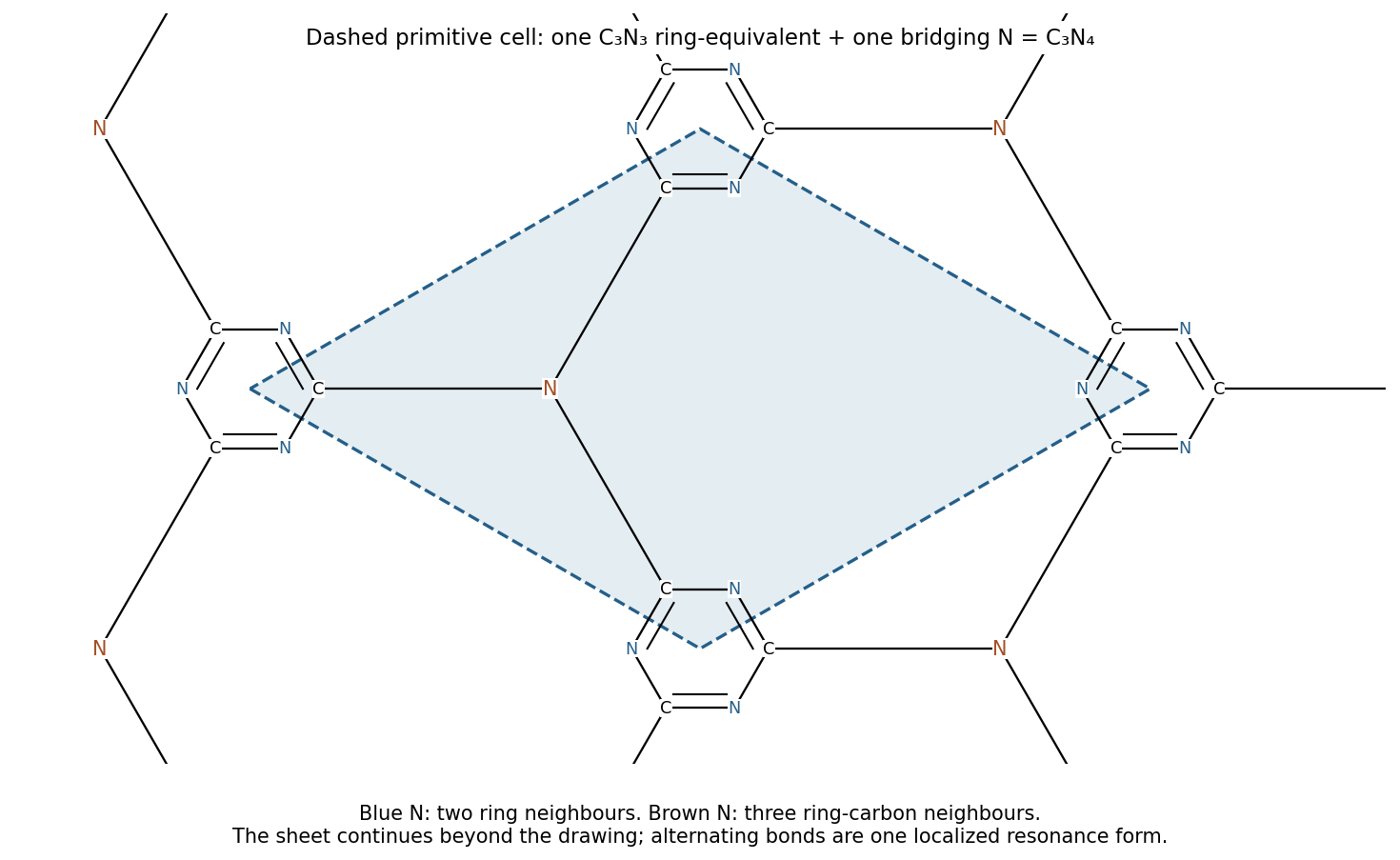


Each triazine ring contributes and has three outward carbon links. A bridging N is shared among three rings, so each ring effectively contributes three thirds of a bridging N: one additional N. The repeat composition is therefore . The highlighted primitive cell contains one ring-equivalent and one bridging nitrogen; the drawn bond alternation is one localized resonance representation.
This is a possible structure, not a unique identification from the empirical formula. Primary synthesis and structural work established triazine-based graphitic carbon nitride as one realizable network. Other commonly prepared carbon nitrides contain heptazine motifs, incomplete condensation and hydrogen, so the name alone should not be treated as an exact structural determination of this decomposition product.[ref]
Three routes are donor doping, acceptor doping and above-gap illumination. All increase mobile carrier populations if the added states or excitations are effective rather than strongly trapped.
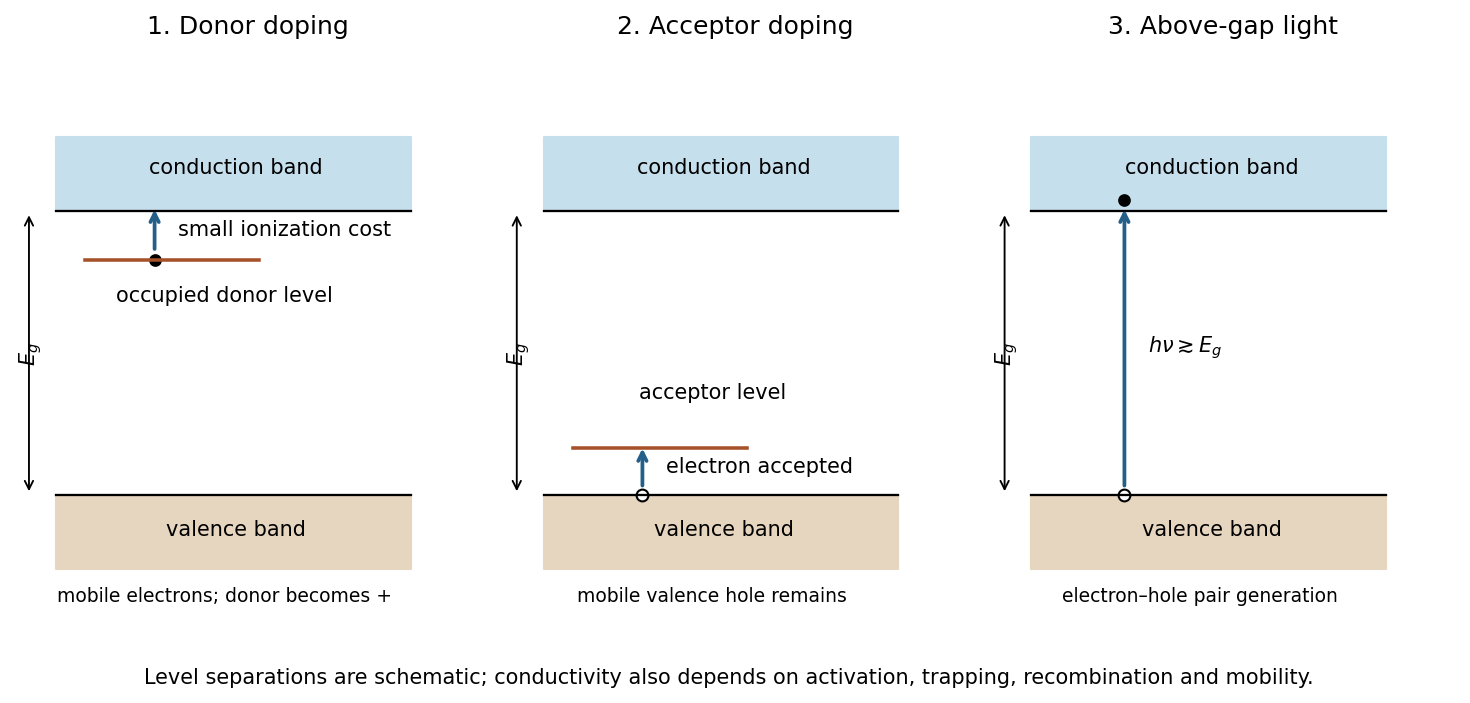
Original band diagrams for donor doping, acceptor doping and photogeneration in a gapped material
. Details. 
An appropriate donor impurity provides an occupied level just below the conduction band. Thermal ionization requires the smaller donor binding energy rather than the full host gap, supplying mobile electrons and n-type semiconductor behaviour. An appropriate acceptor impurity creates an available level just above the valence band; accepting a valence electron leaves a mobile hole, giving p-type semiconductor behaviour. Doping concentrations and compensation must permit useful carriers; an arbitrary impurity need not be an effective dopant.
For photoconductivity, absorbed photons with can excite valence electrons into the conduction band, producing electron–hole pairs. For the stated gap, the nominal threshold is about nm. Optical selection rules and absorption strength can shift the practical onset. The conductivity increase persists only while generation maintains carriers against recombination and trapping; it is not necessarily a permanent change to the material.
In each case, connects increased carrier density to conductivity. Defect-induced reductions in mobility can offset some of the gain, so the diagrams specify mechanisms rather than guarantee a numerical improvement for an unspecified preparation.
Articles by others on the same topic
There are currently no matching articles.