The most acidic sites are: acetic-acid O–H, ; phenol O–H, ; ethanal alpha-CH, –; propyne terminal ≡C–H, . These are ordinary approximate organic-chemistry estimates; exact acidities depend on solvent and reference convention.
Acetic acid gives a carboxylate in which negative charge is delocalized over two oxygens through equivalent resonance structures. Phenol gives a phenoxide with delocalization into the aromatic system, but its important contributors are less equivalent and do not stabilize the charge as effectively as a carboxylate.
For ethanal, removal of a methyl hydrogen gives the enolate . The aldehydic hydrogen is not the preferred acidic site: removing it does not give this alpha-carbon/oxygen delocalization. For propyne, loss of the terminal hydrogen gives an acetylide with a lone pair in an orbital. Its greater s character stabilizes negative charge relative to an ordinary or carbanion; the methyl hydrogens are much less acidic.
The first transformation is two successive dehydrohalogenations; the second opens the lactone by two methyl additions and then closes a six-membered cyclic ether. Both schemes must be accounted for within this part.
For the dichloride, write . In the product-forming path, tert-butoxide removes a hydrogen from the methyl group of . Draw arrows from the base lone pair to H, from C–H into the C–C bond, and from C–Cl to Cl. This E2 elimination gives . A second base-induced elimination removes a vinyl hydrogen and the remaining chloride, forming . The second elimination is more demanding because a vinylic bond is involved, consistent with the strong-base, heated conditions. This route explains the displayed product without asserting that no other elimination regioisomer can ever form.
For the lactone, a methyl equivalent from methylmagnesium iodide attacks the ester carbonyl carbon, with its pi pair moving to oxygen. Collapse of the tetrahedral intermediate reforms C=O and cleaves the acyl–oxygen bond, opening the ring to the magnesium alkoxide corresponding to . The newly formed ketone is more susceptible to a second methyl addition; its pi pair again moves to oxygen. After water workup, the product is the diol .
Under acid and heat, protonate its tertiary OH, then move the C–O pair onto oxygen as water leaves. The resulting is trapped intramolecularly by the remaining primary-alcohol oxygen. Its lone pair forms the closing O–C bond, producing a six-membered cyclic oxonium ion. Deprotonation yields 2,2-dimethyloxane, also called 2,2-dimethyltetrahydropyran. Ring closure retains four chain methylenes; it does not form a five-membered ring. The two methyl groups both derive from the two equivalents of Grignard reagent.
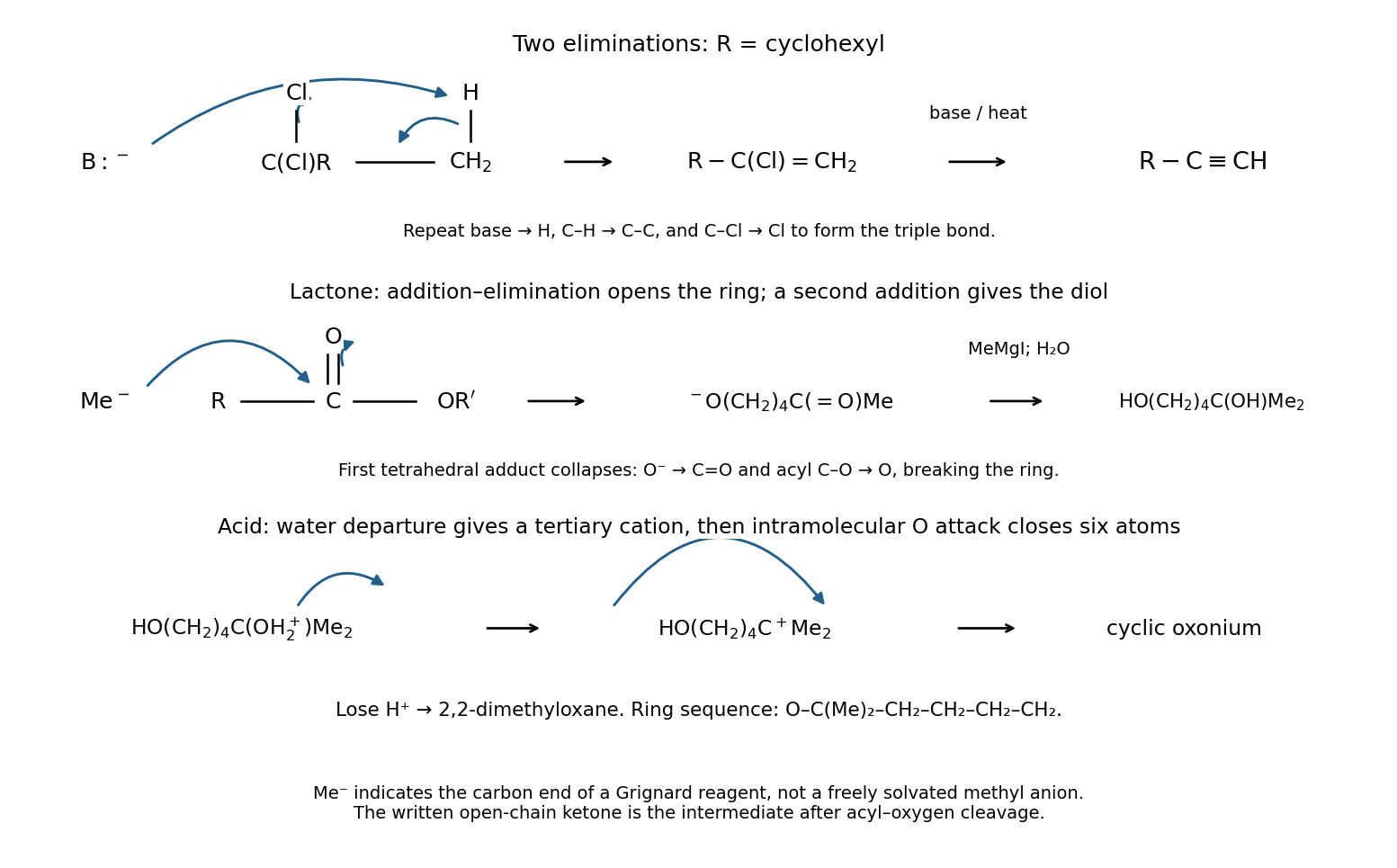
Original electron-flow schemes for double elimination, lactone addition and acid-induced ether formation
. Details. 
The alcohol is oxidized to cyclohexanone through an alkyl hypochlorite intermediate. Acid converts hypochlorite into electrophilic hypochlorous acid. The alcohol oxygen attacks chlorine, with acid-assisted proton transfers and loss of water giving the O–Cl derivative .
A base such as acetate then removes the hydrogen attached to the carbinol carbon. The three coupled electron-pair motions are: base → H; C–H → C–O to form C=O; and O–Cl → Cl to release chloride. The resulting carbonyl is cyclohexanone. This is an elimination-like oxidation of the hypochlorite ester: the original alcohol oxygen becomes the ketone oxygen, while loss of its O-bound H and the carbinol C-bound H effects the net oxidation.
Methyl addition gives 1-methylcyclohexanol, whose acid-catalysed dehydration yields the shown 1-methylcyclohexene. The methyl end of methyllithium attacks the cyclohexanone carbonyl carbon, and the C=O pi electrons move onto oxygen, giving a lithium alkoxide. Protonation gives the tertiary alcohol.
Protonate OH to make , then cleave its C–O bond with both electrons going to departing water. A base removes a beta hydrogen from either adjacent ring methylene, and that C–H pair forms the C=C bond to the tertiary cationic centre. This E1 elimination regenerates the acid catalyst. The two adjacent ring positions are equivalent, and the displayed endocyclic alkene is more substituted than the possible exocyclic methylene alternative.
D is racemic trans-2-methylcyclohexan-1-ol. E is racemic 1-methyl-2-phenylcyclohexan-1-ol with OH and Ph trans, and Me and Ph cis. Number the starting alkene carbon carrying methyl as and its partner as in the reaction explanation below; the product name of D renumbers the OH-bearing carbon as 1.
For D, hydroboration proceeds through a concerted four-centre transition state: the alkene pi pair donates to boron while B–H supplies the new C–H bond. Boron attaches mainly to less substituted and hydrogen to , on the same face. Under peroxide/base conditions, hydroperoxide attacks B; migration of the C–B bond to the adjacent oxygen, with O–O cleavage, replaces C–B by C–O with retention at carbon. Hydrolysis/proton transfer releases the alcohol. Thus the newly added H and OH are syn, making the pre-existing methyl and OH trans. Attack on either alkene face gives the enantiomeric pair.
For E, the peracid transfers its terminal oxygen across the alkene in concerted epoxidation, through cyclic electron flow that also breaks O–O and transfers the acidic proton to the peracid carbonyl oxygen. The resulting epoxide retains the relative configuration of the alkene substituents. The phenyl equivalent from phenylmagnesium bromide then attacks less substituted from the face opposite the epoxide oxygen. Its C–O bond breaks onto oxygen, an SN2-like ring opening; the oxygen stays attached to . Water workup protonates that alkoxide. Consequently OH at and Ph at are anti, while the methyl at lies on the same relative face as Ph.
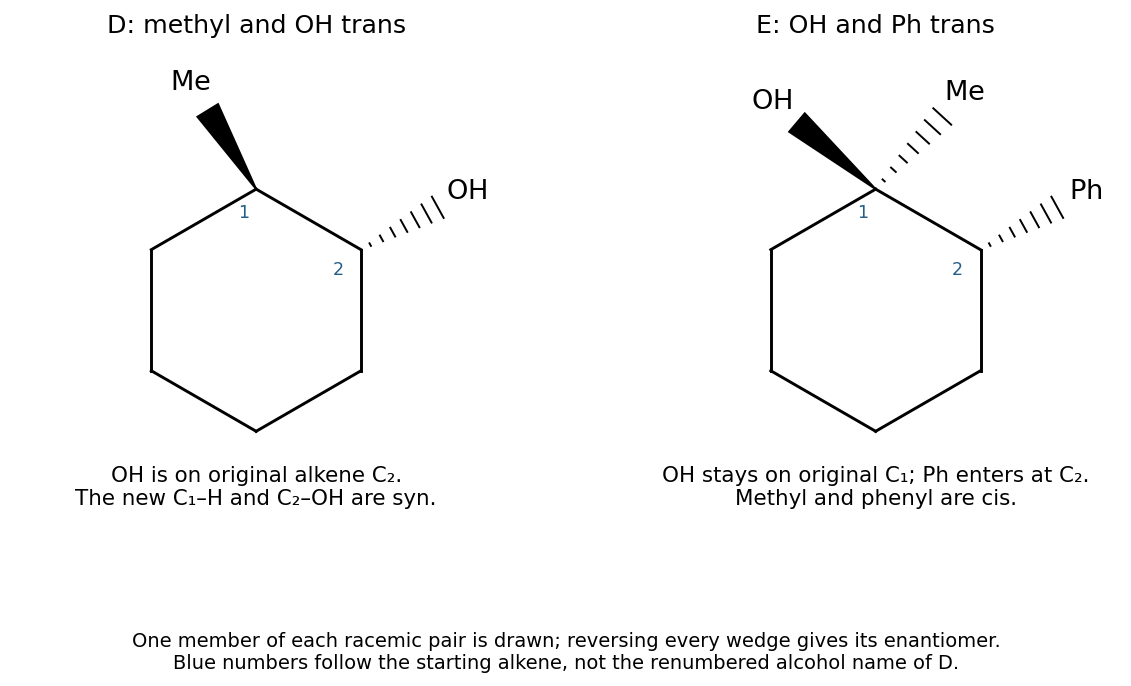
Original product structures showing the relative stereochemistry of hydroboration–oxidation and epoxide opening
. Details. 
Articles by others on the same topic
There are currently no matching articles.