Use the stated local axes: is radial along O–Ru, is tangential within the Ru–O plane, and is perpendicular to that plane. The oxygen's three hybrids make the in-plane sigma framework. Its remaining orbital is perpendicular to the plane and can overlap with one orbital on each Ru.
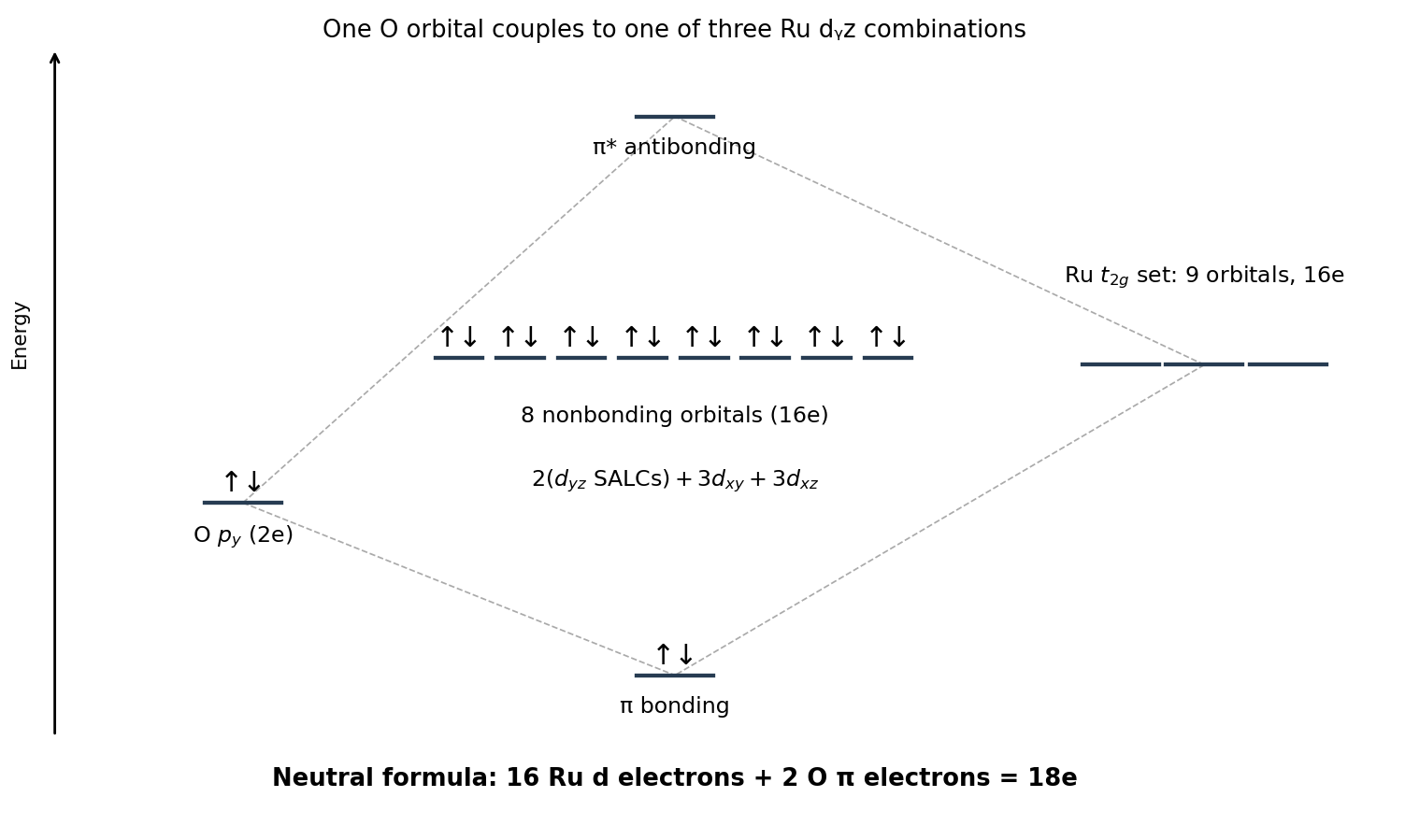
Choose the local orbital phases so their O-facing lobes agree. Of the three metal orbitals, onlyhas the appropriate combination to interact with oxygen . The other two independent combinations have coefficients summing to zero and are nonbonding with respect to the central oxygen. Mixing with gives one lower pi-bonding orbital and one upper pi-antibonding orbital. Each Ru also retains its and orbitals as nonbonding with respect to this central-oxo pi interaction. Thus the complete low-energy diagram contains one bonding level, eight metal-nonbonding levels, and one antibonding level. The eight consist of two combinations, three and three orbitals. They need not be exactly degenerate once other ligands are considered.
For the neutral formula as printed, oxide contributes and six acetates contribute . The Ru oxidation numbers therefore sum to , giving sixteen metal d electrons overall, formally two Ru(III) and one Ru(II), possibly delocalized. Including the oxygen pi pair gives eighteen electrons, filling the bonding orbital and all eight nonbonding orbitals, leaving pi* empty. If the often encountered singly charged cation were intended instead, there would be seventeen electrons and one singly occupied nonbonding level. This charge distinction changes occupancy, not the orbital connectivity.

Articles by others on the same topic
There are currently no matching articles.