Original source: FOI bundle, physical PDF pages 405–420; Chemistry Part II Paper 1, 2021. Solutions cover all printed questions in both sections.
The isolobal analogy compares fragments through their frontier molecular orbitals: their number, approximate energies, shapes, symmetries and electron occupancies should correspond. It does not require the fragments to have the same total number of electrons or the same constituent elements. If the orbitals available for forming new bonds correspond, analogous ways of joining the fragments become plausible.
For example, and are isolobal. The methyl radical has one singly occupied approximately outward-pointing orbital; removing one carbonyl ligand from an octahedral molecular geometry leaves an analogous frontier orbital on the 17-electron fragment. Joining two such fragments pairs the two electrons: the organic example is the C–C bond of ethane, and the organometallic example is the Mn–Mn bond of . The analogy predicts a bonding pattern, rather than equality of bond energies or reaction rates.[ref]
Building Bridges Between Inorganic and Organic Chemistry (Nobel Lecture) by Roald Hoffmann. 1982, discussion of the methyl and metal-carbonyl fragment analogy
Use Wade's rules with the metal included as a skeletal vertex. Each BH vertex supplies two skeletal electrons, each CH supplies three, and the two additional hydrogen atoms supply two more. The fragment supplies skeletal electrons after the metal's non-skeletal orbitals have been accounted for. ThusThe six-vertex cluster is therefore nido, with a pentagonal-pyramidal skeleton: Ru is the apex, bonded to the five vertices of the planar base, and the three carbonyl ligands project away from that base. This is the six-vertex fragment obtained by removing an equatorial vertex from a seven-vertex pentagonal bipyramid. The five ring atoms carry their terminal B–H or C–H bonds; the two additional hydrogens belong to the hydrogen-rich open-face bonding framework. The skeletal electron count does not, by itself, locate every bridging hydride, so a unique detailed hydrogen arrangement should not be inferred from it.
There are two carbon-placement isomers, represented by the cyclic base sequences and . The carbon vertices are adjacent in the first and separated by one boron vertex in the second. Rotation or reversal of a sequence does not produce another constitutional isomer.
Each arrangement has a reflection symmetry that exchanges a pair of boron sites while leaving the third distinct. Consequently each can give two environments, with site populations , in a proton-decoupled NMR spectrum. This assumes that the hydrogen and carbonyl arrangements preserve, or rapidly average to, the corresponding skeletal symmetry. Two peaks alone neither choose between the two skeletons nor establish a unique hydrogen arrangement; accidental overlap or fluxionality can also reduce the number of observed signals.
The usual qualitative prediction is the carbon-separated isomer. It has four B–C ring edges and one B–B edge, whereas the adjacent-carbon isomer has two B–C, two B–B and one C–C edge. Separating the more electron-rich carbon vertices distributes skeletal electron density more evenly and avoids concentrating both carbon vertices on one edge, a useful carborane stability heuristic.
This is a thermodynamic suggestion, not a consequence of the peak count. hydrogen placement, metal–ring interactions and entropy can affect the ordering. Establishing the preferred isomer experimentally would require reversible interconversion and an equilibrium composition, rather than simply identifying the product formed fastest.
A triangular prism has exactly the required nine metal–metal edges: six edges around two triangular faces and three edges joining corresponding vertices of those faces. It naturally offers two symmetry-distinct edge families, of sizes six and three.
With twelve ligands, neutral has total rhenium oxidation number , hence six formally Re(II), centres. After treating the Re–Cl interactions as ligand bonds, the available metal electrons areTwo localized bond order assignments use those fifteen pairs:In scheme I the three inter-triangle edges should be shorter; in scheme II the six triangle edges should be shorter. Both give each Re five electrons' worth of metal–metal bond-order contributions: two singles plus a triple, or two doubles plus a single. The electron count permits both schemes; identifying which family is shorter distinguishes them at this level. Actual cluster molecular orbitals are delocalized, so these integer bond orders summarize bonding rather than asserting isolated textbook multiple bonds on every edge.
The key is coupling redox equilibrium to hydrolysis and precipitation. Ce(IV) has a much greater tendency than Ce(III) to form a hydrated cerium dioxide solid. Raising pH therefore preferentially stabilizes the oxidized form. In the presence of dissolved oxygen a representative net reaction isRemoving drives this reaction towards Ce(IV). Writing the solid as hydrated oxide changes its water content, not this redox argument.
The Nernst equation makes the pH effect explicit. At , the reduction has a pH slope approximately per pH unit at fixed Ce(III) activity. The oxygen/water reduction has slope about per pH unit. Raising pH thus makes oxidation of Ce(III) by oxygen increasingly favourable within the relevant phase-stability region. Conversely strong acid favours soluble Ce(III) relative to the oxide and makes Ce(IV) a stronger oxidizing agent. pH changes the redox driving force; an electron acceptor or donor is still required, and slow oxygen evolution or oxidation kinetics can prevent immediate equilibration.
Not as a general aqueous separation reaction for the other lanthanides. Most strongly favour the trivalent state in ordinary water chemistry. Ce(IV) is unusually accessible because it has the empty shell and is strongly stabilized by oxide formation. Some other lanthanides have accessible alternative oxidation states, such as Eu(II), and higher oxides of Pr or Tb can exist under suitable conditions; this does not imply that they undergo the same Ce(III)/Ce(IV) pH-controlled aqueous oxidation.
A natural feed can contain thorium and uranium, as well as other lanthanides. Th(IV) hydrolyses readily and can accompany the cerium precipitate; uranium speciation depends on its oxidation state and the ligands present. Raising pH too far also precipitates other rare-earth hydroxides. Even before their bulk precipitation thresholds, adsorption and coprecipitation on a high-area hydrated cerium oxide can contaminate the solid. Local high-pH zones during base addition and incomplete Ce(III) oxidation make the separation less reproducible.
Thus a cerium-rich precipitate need not be pure cerium. A sensible test measures the Ce oxidation state, analyses both filtrate and washed solid, and includes thorium-containing and thorium-free mixtures; otherwise low dissolved cerium could be mistaken for selective purification.
A better controlled route is selective solvent extraction in acid, followed by selective stripping, rather than precipitating everything near overlapping hydrolysis thresholds. Oxidize Ce(III) to Ce(IV) in a controlled acidic nitrate medium, extract its nitrate complexes into an organic donor phase, and separate the phases. Then reduce the extracted Ce(IV) to Ce(III) and back-extract it into an aqueous phase. Trivalent rare earths are less strongly extracted under suitable conditions.
This still needs a thorium separation: tributyl phosphate can coextract Th(IV). One demonstrated strategy deliberately coextracts Ce(IV) and Th(IV), then uses reducing peroxide solution to strip Ce as Ce(III), followed by a separate thorium strip. The appropriate controls are distribution measurements for each ion at the chosen acid concentration, a cerium oxidation-state check, and a complete mass balance over extraction and stripping. Selectivity comes from combining oxidation state and complexation, not from assuming that one extraction removes every contaminant.[ref]
Coextraction and successive selective stripping of cerium(IV) and thorium from monazite leach solutions with tributyl phosphate (TBP) by A. H. Ali. 2017, abstract: coextraction from nitric acid and successive peroxide/water stripping
Disconnect the tertiary alcohol at its bond to the alkenyl group. The required carbonyl partner is ; the other partner is an E-configured organometallic reagent. This disconnection fixes the alkene geometry before the alcohol is made.
First form the ethyl-side enolate of butan-2-one under equilibrating conditions, then trap it with ethyl iodide and isolate the required monoalkylated ketone:The incoming group is Et: methylation would give a carbon skeleton one carbon too short. Because an unsymmetrical ketone can form two enolates and undergo repeated alkylation, regioisomer separation and controlled conversion are part of this step.
Independently perform a halo-Wittig reaction on phenylacetaldehyde using and isolate E- from any geometrical mixture. magnesium insertion in dry ether gives the corresponding vinylmagnesium halide; add the isolated ketone at low temperature and protonate the resulting alkoxide. Addition to C=O preserves the pre-existing C=C geometry:The E alkene and the complete fifteen-carbon skeleton are obtained. No absolute configuration is specified at the newly formed alcohol centre, so an unselected stereoisomeric mixture there is acceptable. An alternative carbon–carbon disconnection is acetylide addition to the same ketone followed by a controlled trans-selective alkyne reduction; the vinyl-reagent route avoids relying on reduction of a tertiary propargylic alcohol.
Open the lactone formally at its acyl–oxygen bond, then replace the resulting secondary alcohol by its ketone precursor. With , the useful sequence of retrosynthetic intermediates isDisconnect the last compound as a Michael addition product of the methyl-side enolate of and ethyl methacrylate:The substituted carbon of the methacrylate becomes the methyl-bearing carbon alpha to the lactone carbonyl. The ketone carbon becomes the oxygen-bearing ring carbon. This checks the six-membered ring connectivity.
The required branched methyl ketone itself comes from butan-2-one by ethyl-side aldol addition to acetone, followed by dehydration and selective hydrogenation:Choose and isolate the aldol regioisomer shown. For the subsequent Michael step, use a bulky base at low temperature to favour its less hindered methyl-side kinetic enolate. Reduce the resulting ketone selectively with while retaining the ester, hydrolyse the ester, then acidify and promote intramolecular esterification with water removal. The hydroxy acid closes to the required six-membered lactone. There is no specified stereochemical relationship to enforce, but a stereochemically pure target would require an additional selectivity or resolution step.
An acetal retrosynthesis separates the target into trans-cyclohexane-1,2-diol and cyclohexyl methyl ketone. Both fragments can be prepared using separate portions of cyclohexene.
For the diol, epoxidation with a peroxy acid such as mCPBA gives cyclohexene oxide. Acid-catalysed opening with water occurs by backside attack on the protonated epoxide, giving the anti, hence trans, diol. A syn dihydroxylation would give the wrong relative configuration.
For the ketone, add HBr to another portion of cyclohexene to obtain bromocyclohexane, form its grignard reagent with Mg in dry ether, and add acetonitrile. Hydrolyse the resulting magnesium imine salt to . A nitrile is useful here because addition followed by hydrolysis stops at the ketone instead of giving the double addition associated with an ester.
Finally combine the isolated trans diol and ketone with catalytic acid and remove water to form the cyclic ketal. The ketone carbon becomes the acetal carbon bearing Me and cyclohexyl; the two original diol C–O bonds retain their relative configuration. Anti epoxide opening supplies the required trans relationship before ketal formation. ketal formation is an equilibrium and the trans-fused product may be less favourable than an unstrained acetal, so effective water removal and isolation are necessary; substituting a cis diol is not an acceptable shortcut.
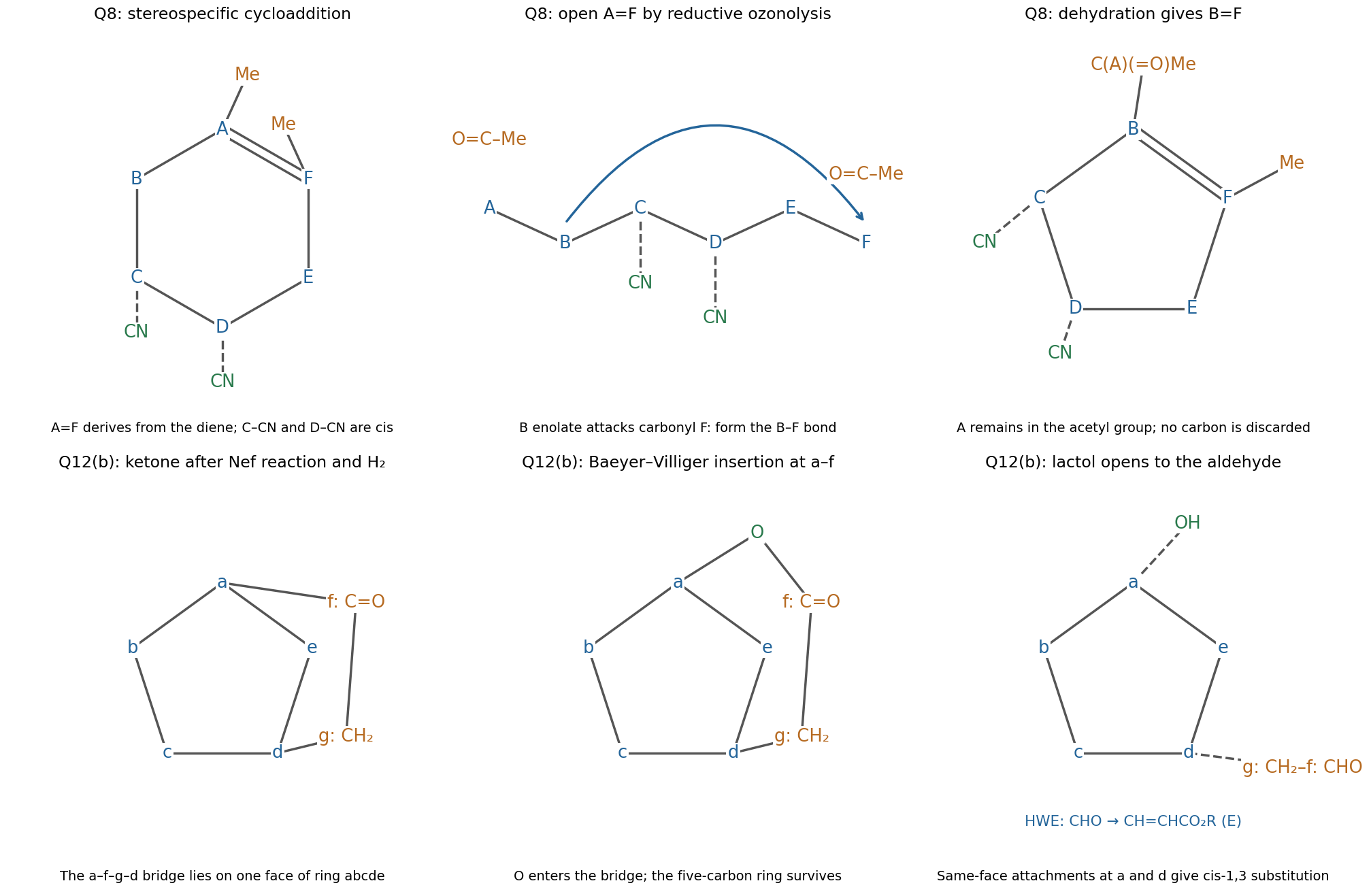
The five-membered enone-like carbon framework can be obtained by an intramolecular aldol condensation ofEnolization at an internal methylene next to one ketone followed by attack on the opposite ketone closes a five-membered ring. dehydration leaves one acetyl group attached to one alkene carbon and one methyl group on the other. The two nitrile-bearing carbons remain adjacent and their original cis relationship is retained if epimerization is avoided.
Now reverse a reductive ozonolysis: the diketone arises by opening a six-membered cyclohexene whose alkene carbons each carry Me. That cyclohexene is the Diels-Alder reaction product of 2,3-dimethylbuta-1,3-diene and maleonitrile. The latter is the supplied cis dinitrile. The stereospecificity of the cycloaddition puts the two CN groups on the same face.
Thus the forward plan is Diels–Alder addition, reductive ozonolysis, then five-membered aldol ring closure and dehydration. Use a reductive ozone work-up that stops at the diketone. During the final step, avoid prolonged strongly basic heating because the carbons bearing CN can be deprotonated and epimerized. Achiral reagents give the racemic pair with the required cis relationship; resolution would be necessary if only the depicted enantiomer were required. The diene supplies six carbons and maleonitrile supplies four, accounting for all ten carbons without an unexplained carbon deletion.
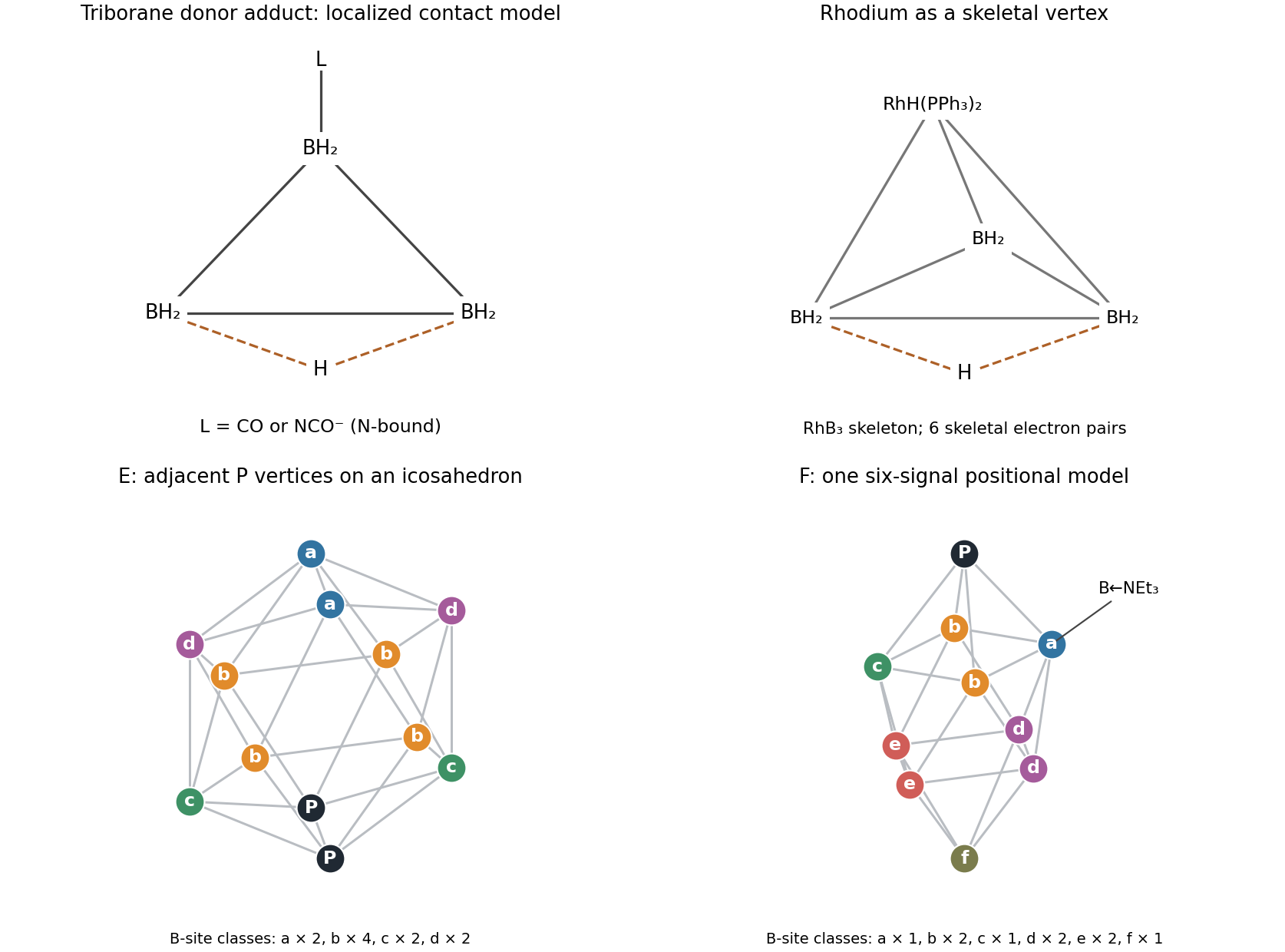
For the CO and NCO cases, the added fragment acts as a Lewis base at boron, rather than becoming a new skeletal vertex. Both have a triangular framework. A useful localized drawing has three groups, one B–H–B bridge between two of them, and the donor attached to the third boron. The boron–boron framework includes three-centre two-electron bonds; its edges should not all be read as ordinary independent two-electron single bonds.
For the neutral carbonyl adduct, attach CO through carbon, giving at the donor-bearing site. For the anionic isocyanate adduct, attach through nitrogen, giving a B–N=C=O connectivity and the overall charge. In both drawings the hydrogen count is . Weak or asymmetric additional B–H contacts can distort this idealized drawing; a hydrogen-rich borane is not fully characterized by a polygon alone. The carbonyl triborane structure was established in the original borane study.[ref]
Boranes. XXXVII. Reactions of triborane(7) and the structure of triborane(7) carbonyl by James D. Glore and others. 1973, pp.2175–2178, structural assignment of the carbonyl adduct
The rhodium fragment is instead a skeletal building block. Its neutral electron count is , so it contributes two skeletal electrons, like a BH vertex. Combining it with gives skeletal electrons, or six pairs, for four vertices. A consistent low-vertex structure is a tetrahedral skeleton, with the fragment capping the boron triangle. Keep the terminal Rh–H ligand distinct from the seven hydrogens on the borane portion. The latter can again be represented by three terminal groups and a B–H–B bridge. The total formula then contains eight hydrogens outside the phenyl groups. Treating Rh as a pendant one-centre Lewis base would miss its skeletal role.
Neutral counting assigns five electrons to cyclopentadienyl ligand and two to CO. Thus each fragment has valence electrons and contributes three skeletal electrons; each fragment has sixteen and contributes four:For A the six-pair four-vertex count is the nido count derived from a five-vertex trigonal bipyramid. Removing an axial vertex leaves a tetrahedron: the three equatorial vertices plus the remaining axial vertex. For B the corresponding arachno fragment is obtained by removing both axial vertices from that same parent, leaving a three-metal triangle. Small clusters require specifying the parent and removed vertices; mechanically calling every nido fragment a square pyramid is wrong.
The Fe tetramer is indeed known to have a tetrahedral core, with four face-capping CO groups. The carbon atoms of those carbonyls and the iron atoms form interpenetrating tetrahedra, giving a cubane-like Fe–C connectivity. Bridging rather than terminal CO changes the distribution of local donation, not the total electron count above.[ref]
Structural Characterization of the Cyclopentadienyliron Carbonyl Tetramer, Fe4(eta5-C5H5)4(CO)4. A Cubane-Type Structure Containing a Completely Bonding Tetrametal Cluster Unit by Melvin A. Neuman and others. 1972, pp.3383–3388, tetrahedral iron core and face-capping carbonyls
For a neutral borane with one terminal B–H bond assigned to each vertex, the skeletal electron number is ; an overall charge adds electrons. Suitable twelve-electron correspondences areFor C, four BH contributions plus four additional hydrogens give electrons. For D, three BH contributions plus five additional hydrogens and the negative charge give . They map to the tetrahedral and triangular low-vertex skeletons respectively. The neutral formal alternative for D is , also with twelve skeletal electrons.
The electron counting correspondence alone must not be read as evidence that the neutral boranes are isolable stable bulk materials. Low-vertex hydrogen-rich boranes can be transient; the triangular octahydrotriborate anion is the established practical three-boron example, whereas neutral is a formal analogy rather than an equally established preparative product. The requested skeletal correspondence should be distinguished from a claim about comparable stability or isolation conditions.[ref]
Reactions of the octahydrotriborate(1-) anion, B3H8-, with some complexes of cobalt(I), cobalt(II), rhodium(I), and iridium(I), and the characterization of the borallyl complex IrIII(eta3-B3H7)(CO)H(PPh3)2 by Norman N. Greenwood and others. 1980, pp.196–200, reactions of the preparatively accessible octahydrotriborate anion
For E, each BH supplies two skeletal electrons and each phosphorus vertex supplies three after retaining a lone pair. Hence electrons, or thirteen pairs, matching a twelve-vertex closo cluster. Place the two adjacent P vertices on a regular icosahedron. The remaining ten boron vertices fall into four symmetry classes: two sites adjacent to both P vertices, four adjacent to exactly one, two adjacent to neither but opposite the common-neighbour pair, and two opposite the P pair. The populations are , so four boron resonances are expected. Interchanging the identical phosphorus vertices is allowed when determining chemical equivalence.
For F, a ten-vertex bicapped square antiprism offers a consistent closo model. There are eight BH vertices, one B vertex bearing the donor instead of H, and one P vertex. Their skeletal contributions are respectively , and , giving 22 electrons, eleven pairs. The donor-bearing B contribution follows from B plus the donated lone pair minus the exoskeletal B–N bond, .
One explicit arrangement consistent with six boron signals puts P at one axial cap and the substituent on one B vertex of the nearer square. The remaining mirror plane through that B, the opposite vertex of its square, and the cap axis leaves three B sites individually fixed: the donor-bearing B, its opposite square vertex and the other axial cap. The other six B sites form three exchanged pairs. Thus the nine borons give three singleton environments and three two-site environments, six signals in all. The original compound has a crystallographically characterized positional assignment; the spectrum alone asks for a compatible structure and does not establish a unique positional isomer. A single-crystal X-ray diffraction determination or assigned heteronuclear correlations would distinguish alternatives.[ref]
Synthesis of polyhedral phosphaboranes: crystal structure of 6-(C2H5)3N·2-PB9H8 by John L. Little and others. 1989, pp.1087–1091, synthesis of diphosphaborane and crystallographic characterization of the amine-containing side product
Strong ligand-to-metal pi donation is favoured by an occupied ligand p orbital and a suitable empty metal d orbital of matching symmetry, with reasonably similar energies and good spatial overlap. Small donor atoms such as O or N can supply short bonds and efficient overlap; oxo, imido and nitrido ligands are familiar examples. Early transition metals in high oxidation states, often , are particularly favourable because the metal acceptor orbitals are vacant and relatively low in energy. More spatially extended and orbitals can strengthen the overlap.
Metal-to-ligand pi backbonding is the complementary case: electron-rich, low-oxidation-state metals donate occupied d orbitals into low-lying ligand antibonding orbitals, as for CO. In both directions, filling a metal–ligand pi-antibonding orbital offsets the multiple-bond stabilization. The relevant prediction is orbital occupancy and overlap, rather than the presence of a formal double-bond line in a drawing.
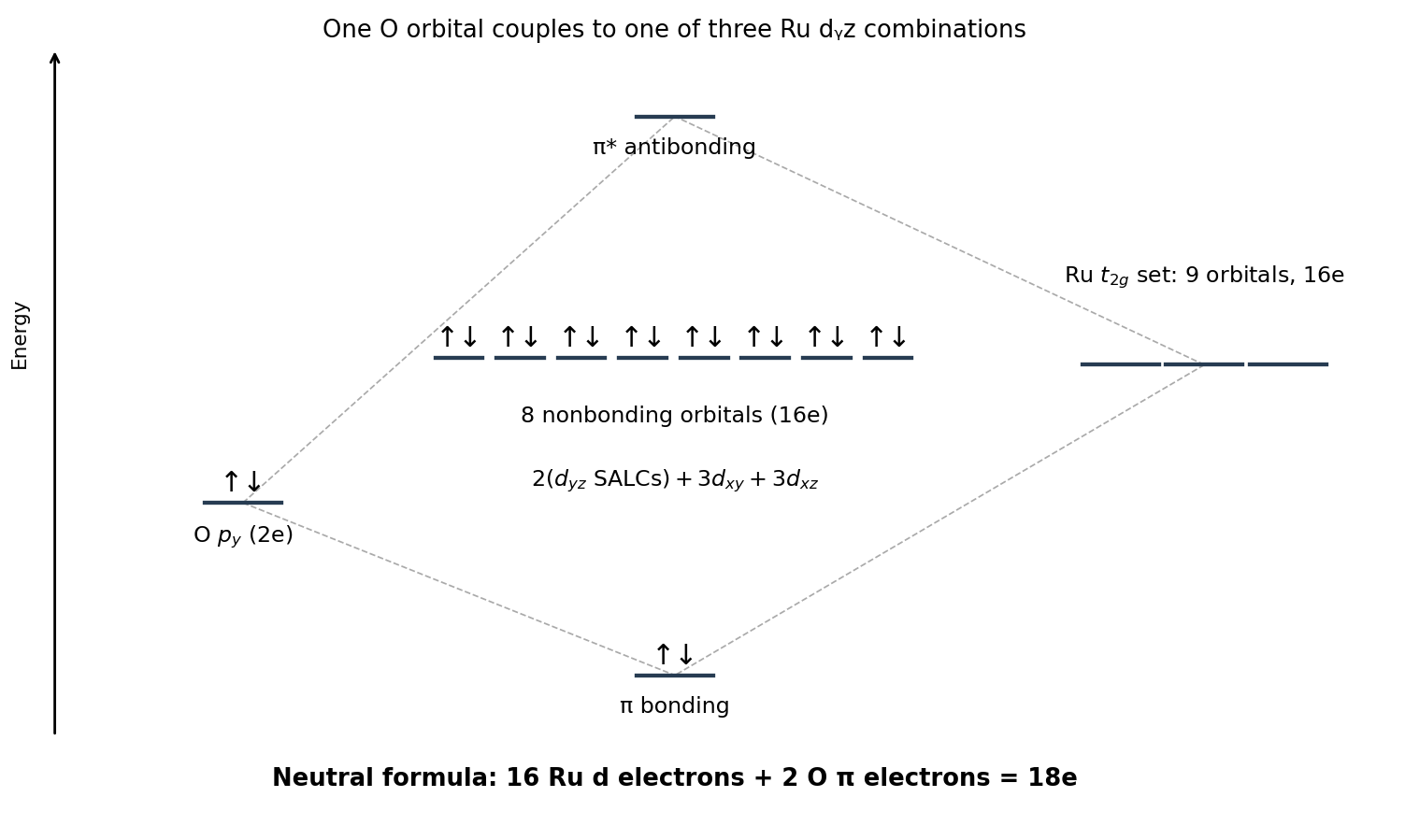
Use the stated local axes: is radial along O–Ru, is tangential within the Ru–O plane, and is perpendicular to that plane. The oxygen's three hybrids make the in-plane sigma framework. Its remaining orbital is perpendicular to the plane and can overlap with one orbital on each Ru.
Choose the local orbital phases so their O-facing lobes agree. Of the three metal orbitals, onlyhas the appropriate combination to interact with oxygen . The other two independent combinations have coefficients summing to zero and are nonbonding with respect to the central oxygen. Mixing with gives one lower pi-bonding orbital and one upper pi-antibonding orbital. Each Ru also retains its and orbitals as nonbonding with respect to this central-oxo pi interaction. Thus the complete low-energy diagram contains one bonding level, eight metal-nonbonding levels, and one antibonding level. The eight consist of two combinations, three and three orbitals. They need not be exactly degenerate once other ligands are considered.
For the neutral formula as printed, oxide contributes and six acetates contribute . The Ru oxidation numbers therefore sum to , giving sixteen metal d electrons overall, formally two Ru(III) and one Ru(II), possibly delocalized. Including the oxygen pi pair gives eighteen electrons, filling the bonding orbital and all eight nonbonding orbitals, leaving pi* empty. If the often encountered singly charged cation were intended instead, there would be seventeen electrons and one singly occupied nonbonding level. This charge distinction changes occupancy, not the orbital connectivity.
The three orbitals are in the Ru–O plane and can overlap directly along the Ru–Ru edges. Their locally rotated lobes have nonzero edge-directed overlap, producing metal–metal bonding and antibonding combinations; a simple triangle model resolves the three orbitals into a singlet and a doublet. The phases and ordering depend on the chosen local basis, so the important feature is the complete set of three combinations.
In the occupancy obtained in (i), this set contains six electrons. All three combinations are filled: the stabilization of the bonding combinations is offset by occupation of their antibonding partners. Equivalently, the sum of the three eigenvalues of a pure off-diagonal interaction matrix is zero. Hence there is no net Ru–Ru bond order from this filled set in the stated model. Overlap alone is not evidence of a net metal–metal bond. This conclusion neglects higher-order mixing and the interactions explicitly excluded from the qualitative diagram.
Nitrogen-bound is favoured. Eu(III) is a small, highly charged hard Lewis acid, whereas the nitrogen end of thiocyanate is harder than its more polarizable sulfur end. The hard and soft acids and bases argument therefore predicts N coordination, together with coordination through both nitrogen atoms of each bipyridine.
Water is the preferred solvent ligand in the qualitative prediction. Its oxygen is a hard donor, it is less sterically demanding than ethanol, and it can occupy a crowded Eu(III) coordination sphere. Actual solvent occupancy also depends on activities and crystallization conditions, so a formula containing only the word solvent is not itself a crystallographic identification.
Two bidentate bipyridine ligands provide four N donors and three terminal NCS ligands provide three more. Adding one water gives and coordination number eight:Eight-coordinate arrangements, distorted between familiar ideal polyhedra, are plausible for a sterically crowded Eu(III) centre. A second water would give coordination number nine, which is not forbidden for a lanthanide; the requested value is a chemically motivated prediction, not something fixed by charge balance. Diffraction or a direct hydration-number measurement is needed to establish it uniquely.
An N-bound thiocyanate need not make an exactly linear Eu–N–C linkage. Eu(III) bonding is predominantly electrostatic, with weak directional covalent contributions from the shielded orbitals. There is consequently less energetic reward for enforcing a precisely collinear metal–donor arrangement than in a strongly directional transition-metal pi bond. In the crowded eight-coordinate sphere, bending the external NCS groups can reduce ligand–ligand repulsion while retaining favourable Eu–N distances. Angles of – are compatible with bent N coordination; they do not require changing the linkage to sulfur. This concerns the Eu–N–C angle, not bending the internal N–C–S skeleton.
The bipyrimidine ligand has two distinct N,N-chelating pockets. It can use one pocket as a terminal bidentate ligand, or use both to bridge two Eu centres. Take all three nitrates per Eu to be bidentate O,O donors.
A consistent structure for B is , with two terminal, singly chelating bpm ligands. Six nitrate oxygens plus four bpm nitrogens give coordination number ten. The unused pocket of each terminal bpm points away from that Eu centre.
For C, use a dimer . Place one bpm between the metals, chelating each Eu through a different N,N pocket. Add one terminal bidentate bpm to each Eu and three bidentate nitrates to each Eu. Each metal again has donor atoms, while the overall Eu:bpm ratio is . In this model all four nitrogens of the bridging bpm are used, but only two of each terminal bpm are used.
Both structures have their accessible coordination sites occupied by multidentate ligands, and the chelate effect favours retention of those donors over adding or exchanging a solvent molecule. This accounts for the absence of coordinated solvent while allowing a higher coordination number than the thiocyanate example. Stoichiometry alone does not exclude polymeric alternatives or different nitrate binding modes; the monomer/dimer pair is an explicit internally consistent prediction.
Disconnect the amide into 2-propylhexanoic acid and N-methyl-2-(4-hexylphenyl)ethylamine. This keeps the nitrogen substituents distinct: one is Me and the other is the two-carbon aryl side chain. The acid's alpha carbon must bear both n-butyl and n-propyl groups.
For the acid fragment, esterify the supplied hexanoic acid, form its ester enolate with LDA, and alkylate with 1-iodopropane:hydrolysis gives 2-propylhexanoic acid; conversion with gives the acyl chloride for the final coupling. Limit the alkylating reagent and isolate the monoalkylated ester to avoid overalkylation.
For the aryl fragment, use another portion of hexanoic acid to make hexanoyl chloride. A Friedel-Crafts acylation of bromobenzene with this reagent and gives ortho and para products; isolate the para bromoaryl ketone. A Wolff-Kishner reduction converts into without deliberately hydrogenolyzing the aryl bromide. Acylation followed by carbonyl reduction installs an unrearranged n-hexyl group; direct Friedel–Crafts alkylation is a less reliable way to do that.
Convert the retained aryl bromide into its grignard reagent, open ethylene oxide, and work up to obtain . Oxidize the primary alcohol to under conditions that stop at the aldehyde, then perform reductive amination with methylamine and sodium triacetoxyborohydride. Excess methylamine helps favour the desired secondary amine over further alkylation. Finally acylate that secondary amine with the isolated acyl chloride, using a separate base to capture HCl.
The final amide has an N-methyl group, the para n-hexyl phenethyl group, and the required n-butyl/n-propyl acyl branching. The carbon check is in the acyl fragment plus in the amine fragment, giving overall. No absolute stereochemistry is specified at the acid alpha carbon.
Disconnect the internal Z alkene by a non-stabilized Wittig reaction:The aldehyde carbon becomes the right-hand internal alkene carbon; the ylide carbon becomes the left-hand one. Both the methyl ester and the remote terminal alkene survive the olefination.
Make the aldehyde from pentanal by Stork enamine reaction: form its pyrrolidine enamine, react at carbon with allyl bromide, then hydrolyse to . The original alpha carbon of pentanal now bears allyl and n-propyl substituents. Control the alkylation to avoid multiple substitutions.
The other branch needs a three-carbon extension of the supplied four-carbon bromo alcohol. Protect the OH of as a tetrahydropyranyl ether. Convert the bromide into an organocuprate and add it conjugatively to methyl acrylate:Here the organocopper formula is shorthand for a suitable cuprate preparation, not a claim that an isolated monomer is necessary. The acrylate contributes two methylenes and the ester carbonyl. Remove the THP group, replace the resulting terminal OH by Br, and react with to form . Deprotonate adjacent to phosphorus to generate the non-stabilized ylide. This proton is much more acidic than the ester alpha protons, but controlled base stoichiometry and low temperature remain important.
Add the allylated aldehyde under conditions favouring the usual kinetic Z-selective Wittig olefination, and separate any E isomer. The result isThe four-carbon starting alcohol plus the three-carbon acrylate backbone supplies the seven-carbon acid-derived chain; the ester Me gives an eighth carbon. Pentanal plus allyl gives the other eight. The total is sixteen carbons, including the terminal alkene. A two-carbon extension would produce the wrong chain length.
Disconnect the N–cyclohexyl bond as a late reductive amination of a primary amine with cyclohexanone. Disconnect the exocyclic methylene as a Wittig methylenation of a substituted cyclohexanone. The useful ring precursor is 3-methyl-5-substituted cyclohex-2-en-1-one, accessible by a Robinson annulation. The pendant substituent throughout ring construction should be .
Start with nucleophilic substitution of the supplied bromo ester by cyanide:Reduce the nitrile selectively to the primary amine while retaining the ester, for example by controlled catalytic hydrogenation with Raney nickel in the presence of ammonia, and trap the amine promptly as its Boc carbamate. Avoid heating or concentrating the free amino ester, which can cyclize to a lactam. lithium aluminium hydride would be unsuitable at this stage because it also reduces the ester.
Partial reduction of the protected ester with DIBAL at low temperature gives . The carbon of the original nitrile is now the methylene nearest nitrogen; the original ester carbonyl is the aldehyde carbon. Condense this aldehyde with acetone and dehydrate to .
Now add the enolate of a second acetone molecule in a Michael addition. With , the resulting chain isIntramolecular aldol condensation gives 3-Me-5-R-cyclohex-2-en-1-one. The beta methyl derives from the carbonyl end attacked in the ring closure; the pendant aminoalkyl chain remains at C5. Hydrogenate the ring C=C selectively, retaining the ketone, then methylenate the ketone with preformed . Do the hydrogenation before installing the exocyclic methylene so that it is not hydrogenated away.
Remove Boc under brief mild conditions, checking for acid-induced exocyclic alkene isomerization. reductive amination of the resulting primary amine with cyclohexanone, followed by selective imine reduction, installs the secondary N-cyclohexyl group. Use controlled stoichiometry to suppress tertiary amine formation. The methyl and four-carbon aminoalkyl substituents occupy the required 1,3-related ring positions, with the exocyclic methylene at the former carbonyl. No ring stereochemistry is specified. The target contains eighteen carbons: six ring carbons, one ring methyl, one methylene, four in the linker, and six in the N-cyclohexyl group.
The key stereochemical disconnection is the cis-1,3-disubstituted cyclopentane, not a direct functionalization of two arbitrary cyclopentane positions. A Diels-Alder reaction of cyclopentadiene with nitroethylene fixes both ends of the new two-carbon bridge on the same face of the original five-membered ring.
Isolate the useful nitronorbornene adduct, convert its secondary nitro group to a ketone by a Nef reaction, and then hydrogenate the remaining ring alkene to norcamphor. Performing the nitro-to-ketone conversion before catalytic hydrogenation avoids simply reducing the nitro group to an amine.
Use a Baeyer-Villiger oxidation to insert oxygen between the carbonyl carbon and its adjacent bridgehead carbon. Bridgehead migration is favoured over migration of the competing methylene; isolate the required lactone regioisomer if necessary. This opens the way to a hydroxy cyclopentyl side chain without breaking the original five-carbon ring. In the resulting bridged lactone, one original cyclopentadiene terminus is bonded to O and the other bears the segment.
Reduce the lactone selectively with DIBAL to its lactol. Ring opening of that lactol gives the aldehyde equivalent cis-3-hydroxycyclopentyl-. The ring OH and the two-carbon aldehyde side chain are cis because their original attachments were the two ends of the Diels–Alder bridge; neither the migration nor lactol opening inverts those cyclopentane carbons.
Perform a Horner-Wadsworth-Emmons reaction on the lactol/aldehyde equilibrium using , where . Preform the phosphonate anion and allow for consumption of base by the lactol OH. Standard stabilized-phosphonate conditions favour the required E- unit. No further hydrogenation should follow it.
The required ester substituent can be prepared by reducing 4-methylpentan-2-one to 4-methylpentan-2-ol, esterifying with bromoacetic acid, and performing an Arbuzov reaction with triethyl phosphite to make the phosphonoacetate. No absolute configuration is indicated at that alcohol-derived centre.
Bridge-derived cis ring stereochemistry plus E-selective phosphonate olefination gives both specified relationships. Achiral cycloaddition and subsequent reagents give a racemic pair with this relative configuration; isolation of one absolute enantiomer would require resolution or an asymmetric variant. The acid fragment contains nine carbons: five from cyclopentadiene, two from nitroethylene and two from the phosphonoacetate. The ester alkyl group adds six, giving fifteen overall. The atom tracing in the original schematic in question 8 shows why oxygen insertion retains the five-membered ring rather than producing a six-membered carbocycle.
The two course covers share one question body. Questions occupy physical pages 424–440 of the public bundle; the printed question numbers run from 13 to 24.
Natural broadening is about times narrower than the thermal Doppler width and is negligible for this comparison. The supplied Doppler broadening formula is a half width at half maximum. Using the integer molecular mass ,For an excited-state population lifetime , the radiating amplitude decays as . Its Lorentzian line shape has natural linewidthEquivalently, compare full widths and . Using the same linewidth convention in both expressions matters more than the small isotope-mass correction. This estimate assumes that the lower state's lifetime is long and leaves any pressure broadening as a separate contribution.
The Stokes vibrational band has O, Q and S branches, with , respectively. Here denotes end-over-end rotational angular momentum; treating electronic fine structure as unresolved gives the usual elementary rotor calculation. The absolute incident wavenumber isand energy conservation for Stokes Raman scattering givesFor the actual ground state, only odd have nonzero nuclear-spin statistical weight. Thus the lowest initial levels are for O and for Q and S. Ignoring the small change in upon vibration, the lines are:
The odd- restriction follows from the zero nuclear spin and exchange symmetry of ; the electronic spin splits each such into several levels without changing this simplified branch-centre calculation.[ref]
O2 A-band line parameters to support atmospheric remote sensing Part II by David A. Long and others. Section 3, manuscript page 4: only odd lower-state N has nonzero statistical weight for oxygen-16 and oxygen-18
If the phrase simplest approximation is instead taken to discard nuclear-spin statistics as well, a fictitious unrestricted rotor gives O at and S at , with Q still at . Those even- lines are not physical ground-state lines.
The terms are , and . Closed molecular orbital shells contribute no net spin angular momentum or axial orbital projection, so only the two equivalent electrons need be coupled. Their individual projections are .
Putting both electrons in the same projection gives and forces opposite spins by the Pauli exclusion principle, yielding . With one electron in each projection, the spin-adapted symmetric and antisymmetric spatial combinations give a singlet and a triplet . Their reflection parities are and , respectively. Both open-shell electrons are gerade, so their product is gerade. The dimensions exhaust the microstates. By Hund's rules, the triplet is the lowest term, and is the lower singlet.
The terms are , , , , and . The active configuration is . Each nearly filled shell has the angular-momentum possibilities of one hole, so coupling two distinguishable hole sets gives or with or .
For , the two arrangements of opposite projections combine with either reflection parity, hence both and . Unlike the equivalent-electron case in part (a), neither spatial combination is excluded for either spin: the holes belong to different orbital shells. The inversion parity is . Counting degeneracies gives , equal to the choices of the two holes.
Only is electric-dipole allowed within the listed terms. For a diatomic molecule, the electric-dipole selection rule requires , , and . The lower singlet of part (a) is . Every candidate from the same configuration fails the inversion rule, while the terms of part (b) require . Triplet destinations fail the spin rule. The surviving transition uses the axial dipole component, so it is a parallel electronic transition. Weak spin-orbit or other intensity-borrowing transitions are outside this leading electric-dipole classification.
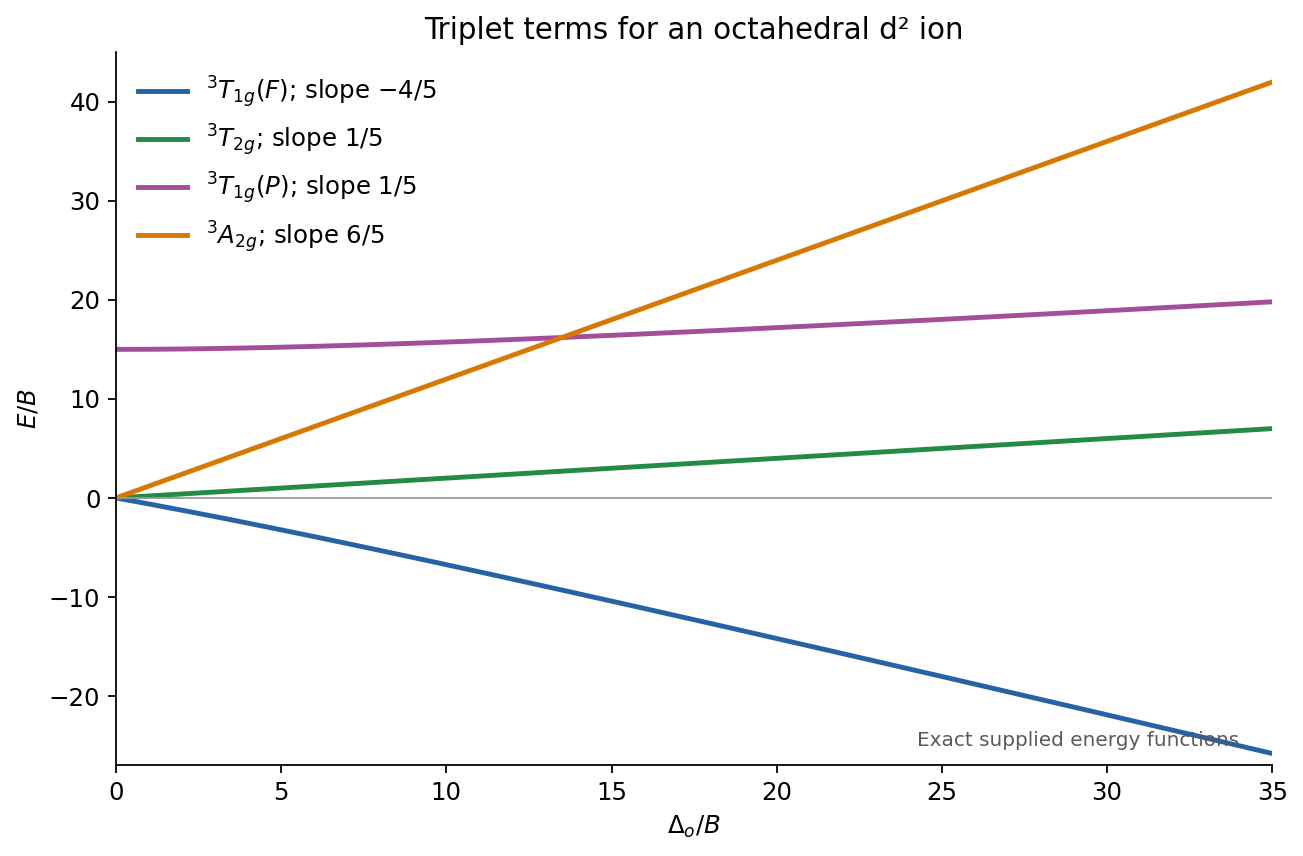
For positive , expand the common radical asSubstitution into the stated crystal field theory energies givesThe leading straight-line asymptotes retain the terms linear in and constant in . The terms show from which side the interacting levels approach them.
For , the corresponding asymptotic expansion isHenceAt zero field, converge to the atomic term and to at . The branch therefore has zero initial slope; its high-field slope is not zero.
The descending line is ; the low rising line is ; the steep line is ; and the branch starting at is . Their high-field slopes, in the same order, areThese are slopes of the supplied absolute term energies relative to their chosen reference, not slopes of transition energies measured upward from the ground state. The two states share a symmetry and mix, whereas the crossing of and the upper branch is allowed because they have different irreducible representations.
and . The Hückel method gives benzene's occupied frontier level as and its unoccupied frontier level as . ThereforeUsing the Koopmans' theorem approximation for the ionization energy, , gives and the stated parameters. This calibration neglects orbital relaxation, electron correlation and any distinction between a measured optical excitation and an independent-particle orbital gap.
The model predicts . For a uniform ten-site cyclic Hückel method model,Ten pi electrons fill with two electrons per orbital. The Homo is the degenerate pair, soThis is the prediction for the stipulated planar conjugated ring. It does not assert that an unconstrained all-cis ten-membered ring actually adopts a strain-free planar geometry.
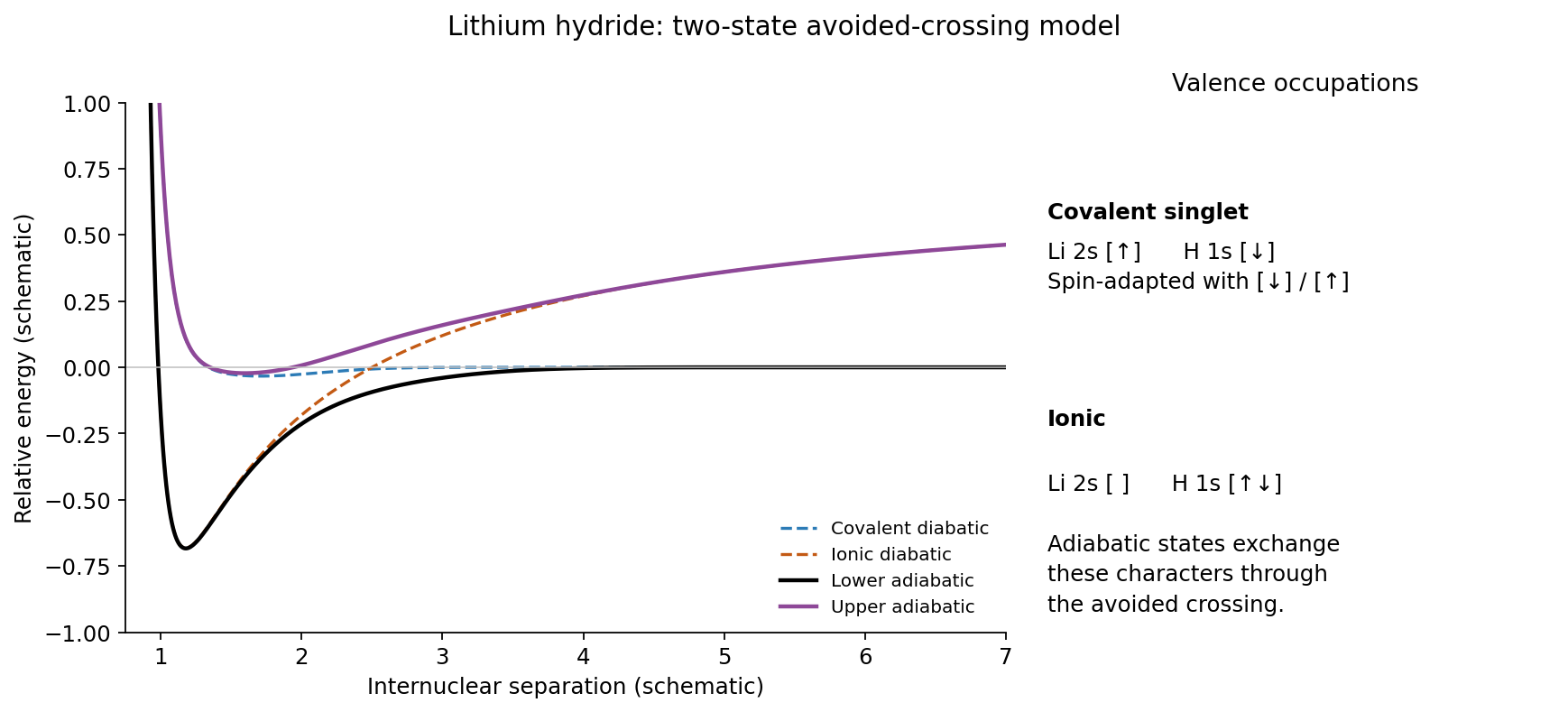
The ionic and covalent diabatic curves cross; coupling replaces the crossing by an avoided crossing of the adiabatic curves. Take the separated neutral atoms as the zero of valence energy. A covalent diabatic state has one electron in a lithium-centred orbital and one in a hydrogen-centred orbital, coupled to an overall singlet. An ionic diabatic state has an empty lithium valence orbital and a doubly occupied hydrogen orbital.
At large internuclear separation , the ionic limit lies above the neutral one by . At smaller , its attractive Coulomb term lowers it; short-range repulsion eventually raises both curves. A two-state Hamiltonian givesWhere the diabatic energies would coincide, nonzero coupling opens a gap . The lower adiabatic state changes continuously from predominantly ionic character near the bond minimum to predominantly neutral covalent character at dissociation. The upper state exchanges character in the opposite direction. Near the crossing both are mixtures, so a sketch assigning a fixed charge pattern to an entire adiabatic curve would miss the important physics.
Each site has a pi-electron population , and each adjacent pi bond order is . The two carbon sites supply one pi electron each and the nitrogen lone pair supplies two, giving four electrons in two occupied molecular orbitals. Orthogonality to the given Homo and LUMO fixes the remaining occupied normalized orbital, up to overall sign, asFor doubly occupied orbitals, the Hückel orbital charge density and Hückel pi bond order follow fromThe diagonal sums to four electrons. The negative is an off-diagonal density-matrix element between nonadjacent sites, not an additional directly connected chemical bond.
Relative to neutral pi contributions , the pi-system charges are : electron density has moved from nitrogen toward the two carbon sites. Thus the physical electric dipole moment vector points from the midpoint of the carbon pair toward nitrogen along the molecular symmetry bisector. The conventional chemical dipole arrow, with a crossed positive tail, points oppositely: from nitrogen toward the carbon pair. This is only the pi contribution, not a prediction of the full sigma-plus-pi molecular dipole.
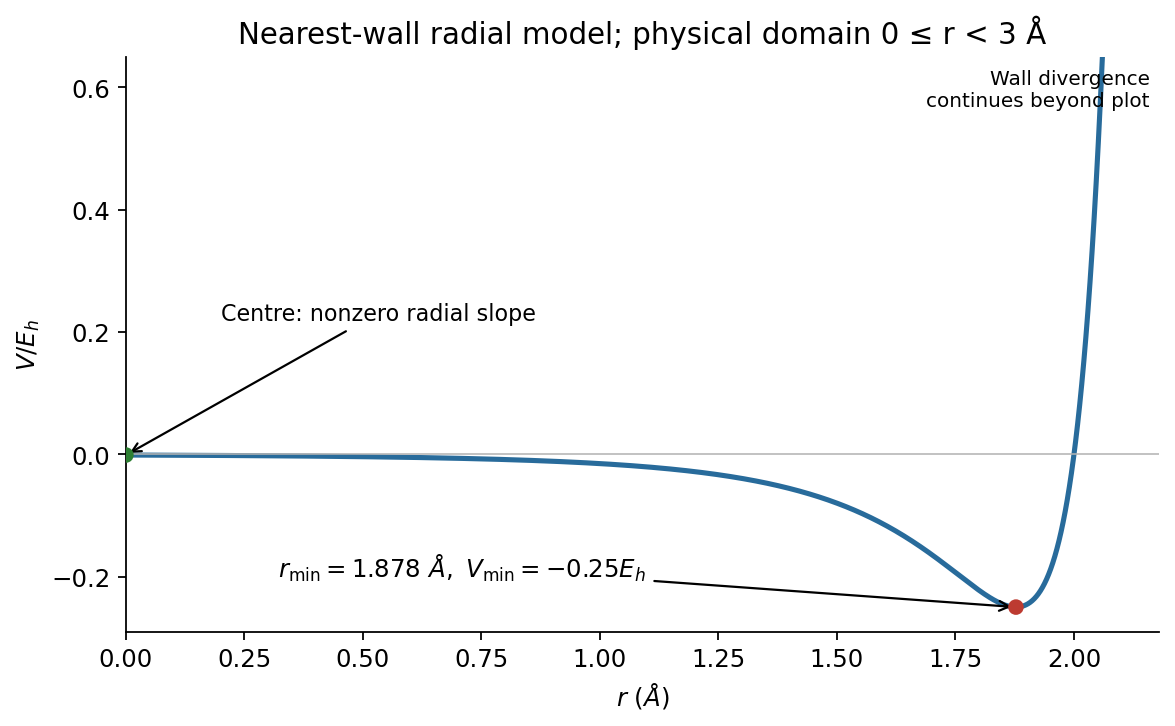
The minimum is at with depth ; the model is not a smooth physical potential at the cage centre. Put and . Thenso is the minimum. ThereforewhileThe positive inverse-twelfth-power term mimics short-range overlap repulsion, while the negative inverse-sixth-power term mimics London dispersion force. These powers are used in the Lennard-Jones potential; they are not a microscopic derivation for an atom inside a carbon cage.
The relevant domain is . As the atom approaches the wall the model diverges positively, which is qualitatively sensible. However, the energy depends only on the nearest radial wall distance and omits all the other cage atoms. More decisively, : a radial function of the Cartesian position must have zero first radial derivative at the centre to be differentiable there. The model produces a cusp and a nonvanishing directional force as the centre is approached. An off-centre minimum is not by itself forbidden, but this centre behaviour is inconsistent with a smooth symmetric cage potential.


Articles were limited to the first 100 out of 183 total.
Articles by others on the same topic
There are currently no matching articles.