Strong ligand-to-metal pi donation is favoured by an occupied ligand p orbital and a suitable empty metal d orbital of matching symmetry, with reasonably similar energies and good spatial overlap. Small donor atoms such as O or N can supply short bonds and efficient overlap; oxo, imido and nitrido ligands are familiar examples. Early transition metals in high oxidation states, often , are particularly favourable because the metal acceptor orbitals are vacant and relatively low in energy. More spatially extended and orbitals can strengthen the overlap.
Metal-to-ligand pi backbonding is the complementary case: electron-rich, low-oxidation-state metals donate occupied d orbitals into low-lying ligand antibonding orbitals, as for CO. In both directions, filling a metal–ligand pi-antibonding orbital offsets the multiple-bond stabilization. The relevant prediction is orbital occupancy and overlap, rather than the presence of a formal double-bond line in a drawing.
Use the stated local axes: is radial along O–Ru, is tangential within the Ru–O plane, and is perpendicular to that plane. The oxygen's three hybrids make the in-plane sigma framework. Its remaining orbital is perpendicular to the plane and can overlap with one orbital on each Ru.
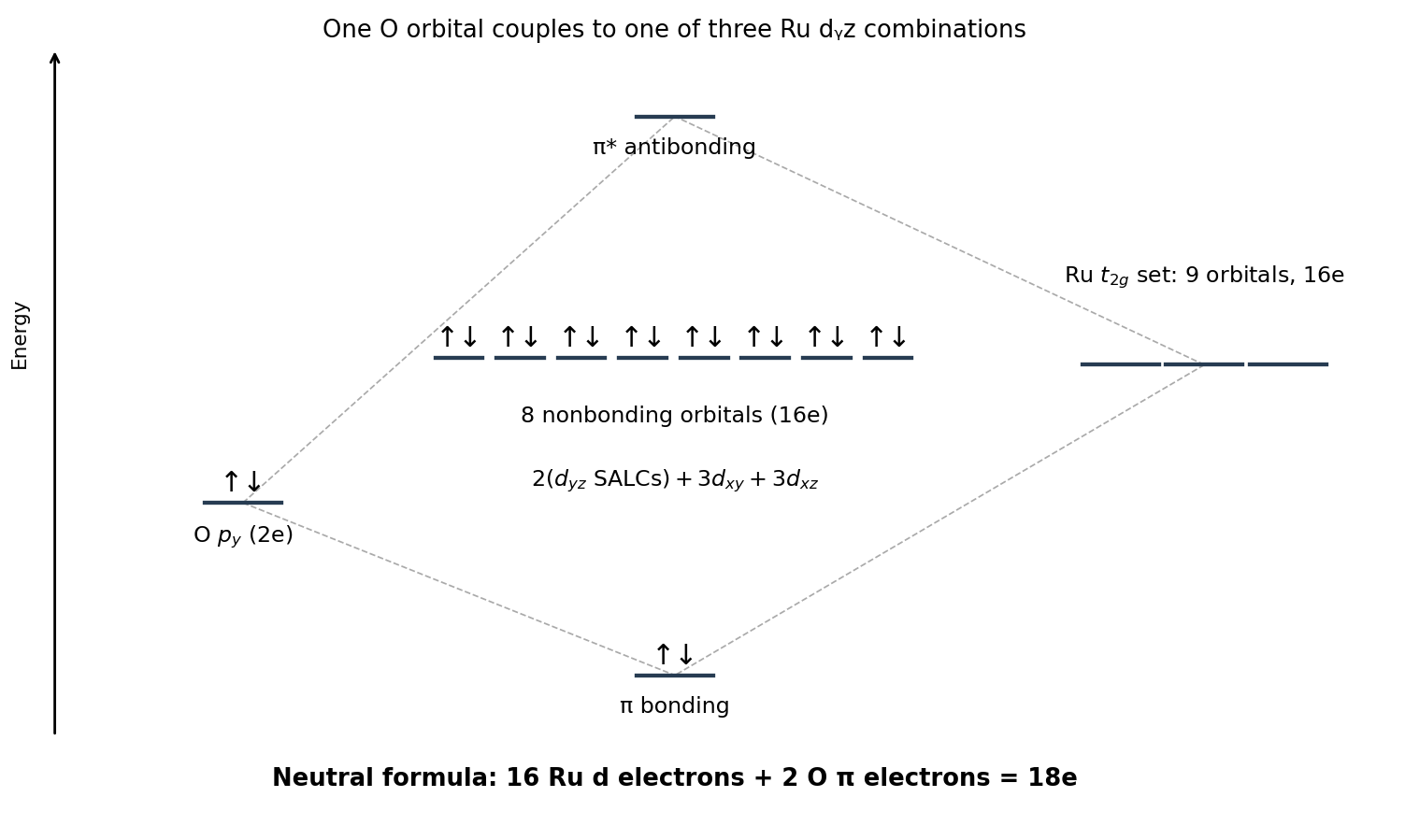
Choose the local orbital phases so their O-facing lobes agree. Of the three metal orbitals, onlyhas the appropriate combination to interact with oxygen . The other two independent combinations have coefficients summing to zero and are nonbonding with respect to the central oxygen. Mixing with gives one lower pi-bonding orbital and one upper pi-antibonding orbital. Each Ru also retains its and orbitals as nonbonding with respect to this central-oxo pi interaction. Thus the complete low-energy diagram contains one bonding level, eight metal-nonbonding levels, and one antibonding level. The eight consist of two combinations, three and three orbitals. They need not be exactly degenerate once other ligands are considered.
For the neutral formula as printed, oxide contributes and six acetates contribute . The Ru oxidation numbers therefore sum to , giving sixteen metal d electrons overall, formally two Ru(III) and one Ru(II), possibly delocalized. Including the oxygen pi pair gives eighteen electrons, filling the bonding orbital and all eight nonbonding orbitals, leaving pi* empty. If the often encountered singly charged cation were intended instead, there would be seventeen electrons and one singly occupied nonbonding level. This charge distinction changes occupancy, not the orbital connectivity.

The three orbitals are in the Ru–O plane and can overlap directly along the Ru–Ru edges. Their locally rotated lobes have nonzero edge-directed overlap, producing metal–metal bonding and antibonding combinations; a simple triangle model resolves the three orbitals into a singlet and a doublet. The phases and ordering depend on the chosen local basis, so the important feature is the complete set of three combinations.
In the occupancy obtained in (i), this set contains six electrons. All three combinations are filled: the stabilization of the bonding combinations is offset by occupation of their antibonding partners. Equivalently, the sum of the three eigenvalues of a pure off-diagonal interaction matrix is zero. Hence there is no net Ru–Ru bond order from this filled set in the stated model. Overlap alone is not evidence of a net metal–metal bond. This conclusion neglects higher-order mixing and the interactions explicitly excluded from the qualitative diagram.
Nitrogen-bound is favoured. Eu(III) is a small, highly charged hard Lewis acid, whereas the nitrogen end of thiocyanate is harder than its more polarizable sulfur end. The hard and soft acids and bases argument therefore predicts N coordination, together with coordination through both nitrogen atoms of each bipyridine.
Water is the preferred solvent ligand in the qualitative prediction. Its oxygen is a hard donor, it is less sterically demanding than ethanol, and it can occupy a crowded Eu(III) coordination sphere. Actual solvent occupancy also depends on activities and crystallization conditions, so a formula containing only the word solvent is not itself a crystallographic identification.
Two bidentate bipyridine ligands provide four N donors and three terminal NCS ligands provide three more. Adding one water gives and coordination number eight:Eight-coordinate arrangements, distorted between familiar ideal polyhedra, are plausible for a sterically crowded Eu(III) centre. A second water would give coordination number nine, which is not forbidden for a lanthanide; the requested value is a chemically motivated prediction, not something fixed by charge balance. Diffraction or a direct hydration-number measurement is needed to establish it uniquely.
An N-bound thiocyanate need not make an exactly linear Eu–N–C linkage. Eu(III) bonding is predominantly electrostatic, with weak directional covalent contributions from the shielded orbitals. There is consequently less energetic reward for enforcing a precisely collinear metal–donor arrangement than in a strongly directional transition-metal pi bond. In the crowded eight-coordinate sphere, bending the external NCS groups can reduce ligand–ligand repulsion while retaining favourable Eu–N distances. Angles of – are compatible with bent N coordination; they do not require changing the linkage to sulfur. This concerns the Eu–N–C angle, not bending the internal N–C–S skeleton.
The bipyrimidine ligand has two distinct N,N-chelating pockets. It can use one pocket as a terminal bidentate ligand, or use both to bridge two Eu centres. Take all three nitrates per Eu to be bidentate O,O donors.
A consistent structure for B is , with two terminal, singly chelating bpm ligands. Six nitrate oxygens plus four bpm nitrogens give coordination number ten. The unused pocket of each terminal bpm points away from that Eu centre.
For C, use a dimer . Place one bpm between the metals, chelating each Eu through a different N,N pocket. Add one terminal bidentate bpm to each Eu and three bidentate nitrates to each Eu. Each metal again has donor atoms, while the overall Eu:bpm ratio is . In this model all four nitrogens of the bridging bpm are used, but only two of each terminal bpm are used.
Both structures have their accessible coordination sites occupied by multidentate ligands, and the chelate effect favours retention of those donors over adding or exchanging a solvent molecule. This accounts for the absence of coordinated solvent while allowing a higher coordination number than the thiocyanate example. Stoichiometry alone does not exclude polymeric alternatives or different nitrate binding modes; the monomer/dimer pair is an explicit internally consistent prediction.
Articles by others on the same topic
There are currently no matching articles.