These are inner-sphere electron transfer pathways distinguished by where Cr(II) attacks the coordinated thiocyanate. Cr(II) is substitution-labile and can replace an aqua ligand to form a bridged Co(III)/Cr(II) precursor.
- Remote attack at nitrogen: form . Electron transfer through the bridge gives Co(II)/Cr(III). Cleavage on the now labile Co(II) side leaves the N-bound product . This is the faster channel.
- Adjacent attack at sulfur: Cr binds the same sulfur that is attached to cobalt, giving a shared-S bridge, . Electron transfer and Co-S cleavage leave , the channel.
In both cases the product Co(II) rapidly loses its ammines to give the hexaaqua ion, whereas substitution-inert Cr(III) retains the bridge-end information. The two chromium linkage isomers are therefore a record of two precursor geometries, rather than evidence that one outer-sphere electron-transfer event somehow selects two arbitrary new ligands afterwards.
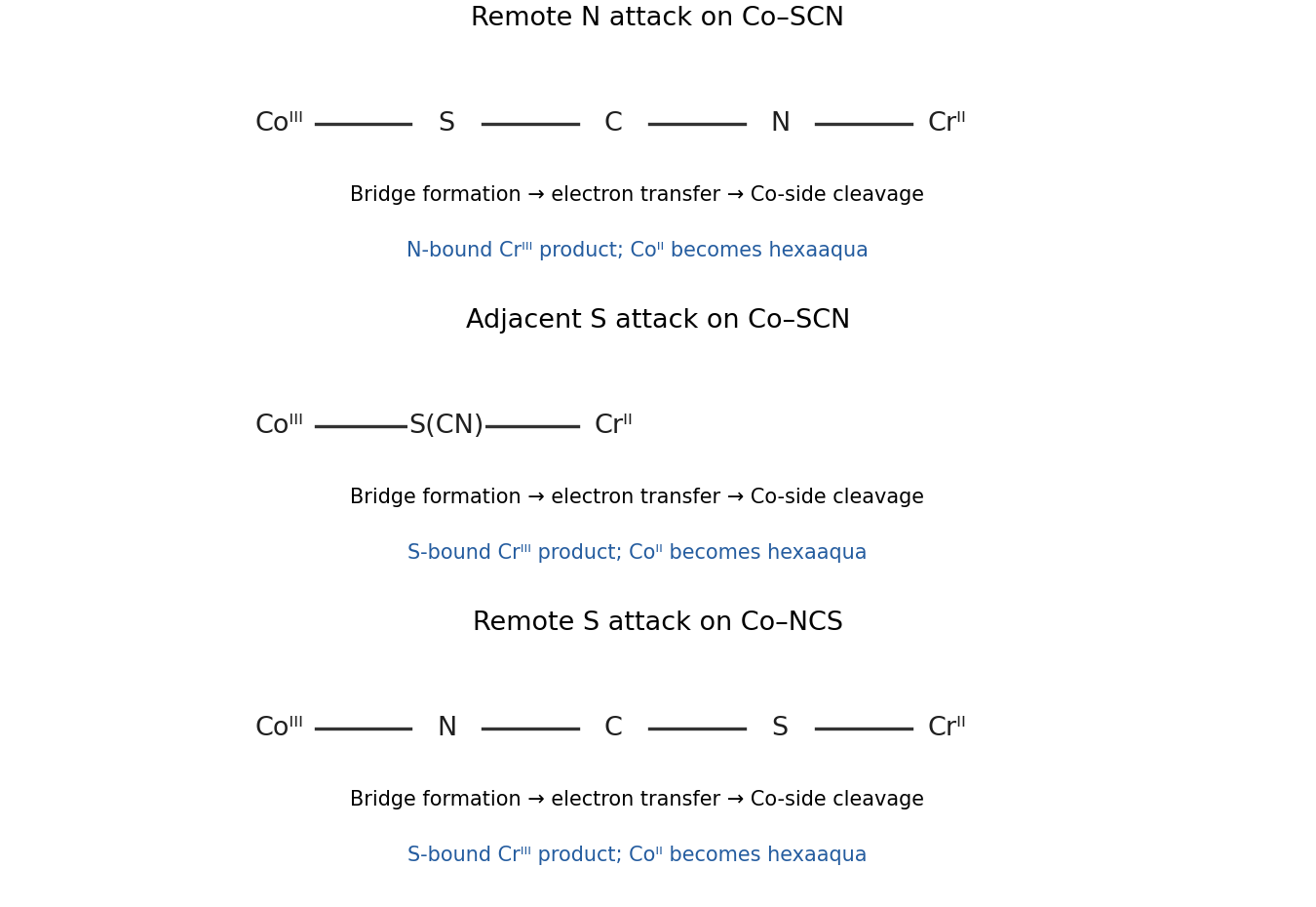
Remote and adjacent bridges retain different thiocyanate linkage information
. Details. 
The free end of N-bound is sulfur. Cr(II) binds there, giving the remote bridge . Electron transfer and cleavage of the Co-N bond leave S-bound Cr(III), ; labile Co(II) becomes hexaaquacobalt(II).
The much smaller rate constant shows that the efficiency of bridge formation/electron transmission is strongly sensitive to linkage orientation. Efficient donation and coupling in a Co-S-bound precursor need not be reproduced when cobalt is N-bound. Its reduction is still consistent with inner-sphere electron transfer; a slow rate alone is not a criterion for outer-sphere transfer.
Articles by others on the same topic
There are currently no matching articles.