C has the original cyclohexadiene connectivity but trans, rather than cis, adjacent methyl groups. Draw one methyl wedge and the other dash, keeping both phenyl groups at the diene termini. One enantiomer is shown below; reversing both stereobonds gives its mirror image. For the symmetric achiral starting framework under achiral conditions, the two trans enantiomers are not distinguished by this orbital-symmetry argument.
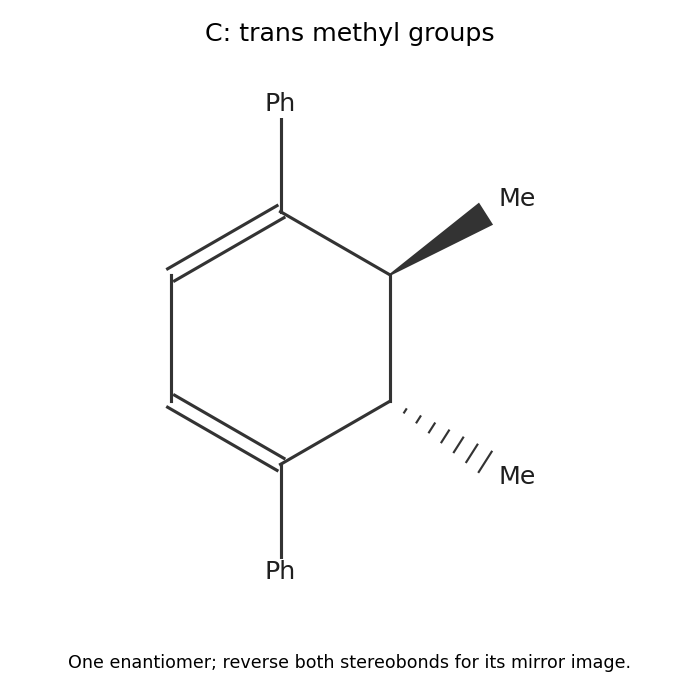
Trans dimethyl cyclohexadiene from thermal closure of the photogenerated triene
. Original product drawing. Opposite stereobonds specify the two methyl faces; the mirror image is obtained by reversing both. Details.
The six pi electrons of B reorganize in a concerted electrocyclic reaction: the two terminal p orbitals form the new sigma bond, and the other two pi bonds shift to give the conjugated cyclohexadiene. Thermal six-electron closure is disrotatory, so the termini rotate in opposite senses. Applied to the terminal configurations drawn for B, this gives the trans methyl relationship. There is no need to invoke a radical chain or a sigmatropic transfer of a methyl group.
A to B is a photochemical six-electron electrocyclic ring opening; B to C is a thermal six-electron electrocyclic ring closure. The broken or formed sigma bond is between the two methyl-bearing saturated carbons of the cyclohexadiene. Both transformations conserve the carbon skeleton. The light-induced and thermal processes differ in their orbital occupation and therefore in their stereochemical selection rule.
The Woodward-Hoffmann rules for a electron electrocyclic reaction permit thermal disrotation and photochemical conrotation. Here six electrons mean . For the ground-state six-electron chain, opposite terminal rotations match the terminal phases of its highest occupied orbital as the closing sigma bond forms. A one-electron excitation changes the relevant occupancy and reverses the allowed rotational mode. Thus A opens conrotatorily under light to the specified B, while B closes disrotatorily on heating. Reversing the rotational mode changes the adjacent methyl relationship from cis to trans, exactly as in C.
Articles by others on the same topic
There are currently no matching articles.