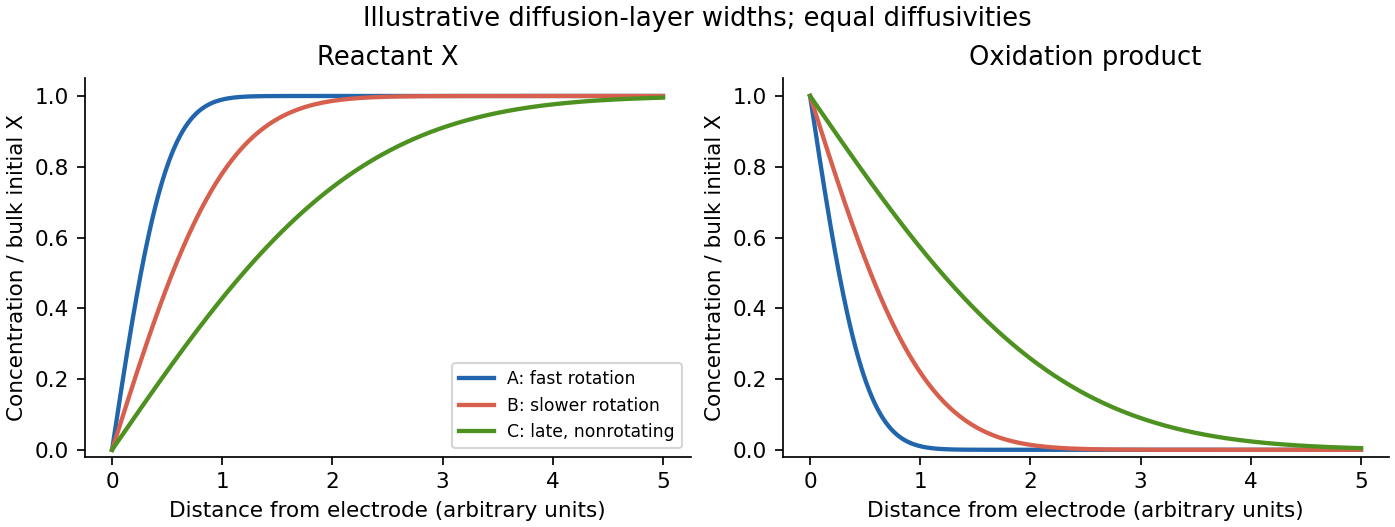
All three marked points are at strongly oxidizing potentials, where X is depleted at the electrode: . Assuming only X initially in bulk, and . Oxidation produces X at the interface.
- A: the largest steady limiting current corresponds to the fastest rotation and thinnest diffusion boundary layer. X rises steeply from zero to ; X falls steeply from its surface value to zero.
- B: slower rotation gives a thicker layer and shallower gradients, hence a smaller limiting current.
- C: the nonrotating electrode gives the peaked, subsequently decaying current. Its diffusion layer continues to broaden with time, approximately as , giving the broadest and shallowest profiles at the indicated late-scan point.
For equal diffusion coefficients, the two concentration profiles are complementary, . More generally equality of their interfacial molar fluxes requires , so the product surface concentration need not equal . A and B are approximately steady hydrodynamic profiles; C is a time-dependent diffusion profile.

Articles by others on the same topic
There are currently no matching articles.