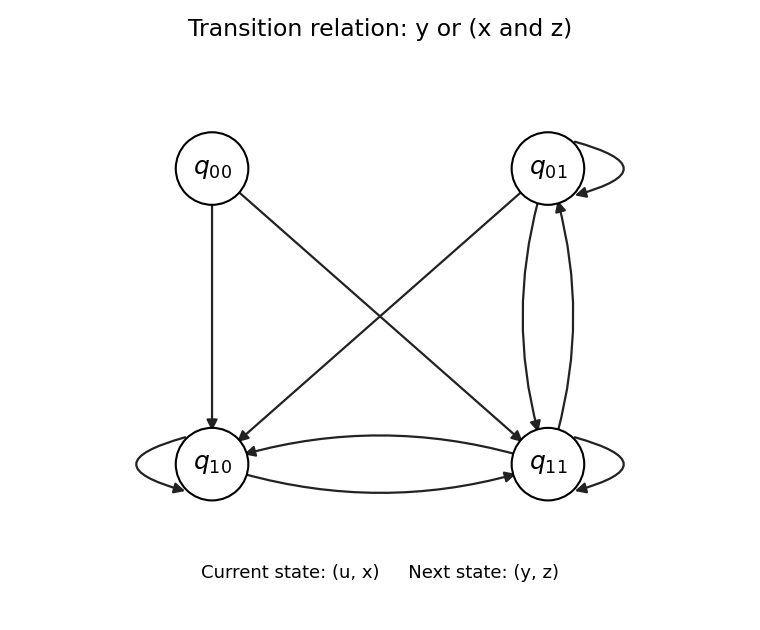
A transition relation requires an explicit interpretation of the Boolean variables as current and next state bits. Take the four states . Encode the current state by and the next state by , and defineThe extra current bit is deliberately unused by the Boolean formula. A four-state transition system normally needs four bits to describe a pair of states; a Boolean formula using only three of them simply describes a transition relation independent of the fourth bit.
When , the condition is , so the permitted next states are and . When , the condition is , so the permitted next states are . The resulting adjacency matrix, with rows and columns both ordered , isThe directed graph below plots all ten directed edges, including the three self-loops. No arrow enters , but it is a valid state with two outgoing arrows. Every state has a successor. As permitted, no initial states are distinguished.

Articles by others on the same topic
There are currently no matching articles.