Use an entity-relationship model with
Customer, Conference, Event, Venue and Building. The following entity-relationship diagram uses minimum–maximum cardinalities at each end: the label beside an entity counts how many instances of that entity can be associated with one instance at the opposite end. A double link into the specialization circle means total specialization; its d means disjoint.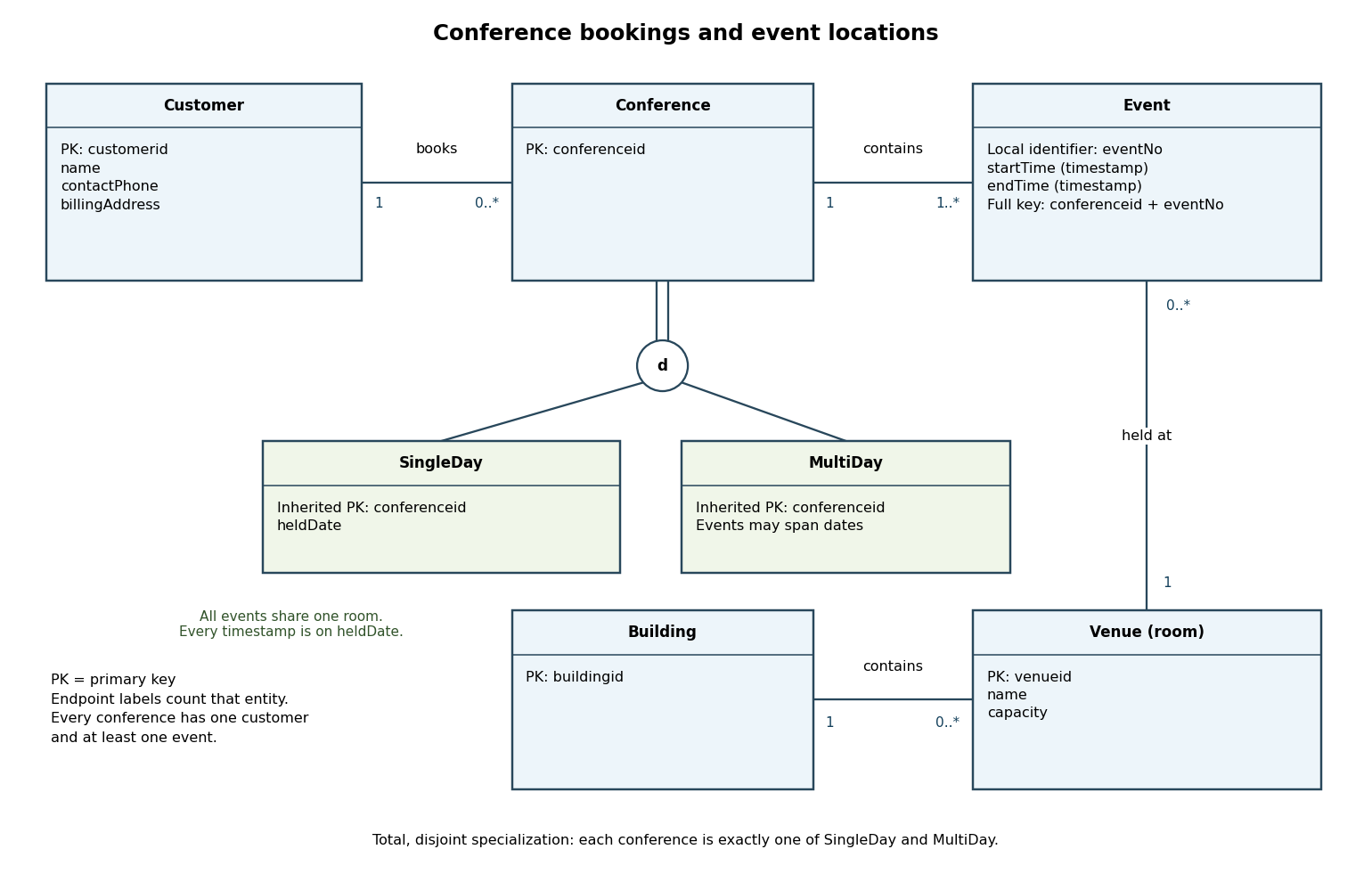

Every conference belongs to exactly one customer and contains at least one event. A customer may book zero or more conferences. Every event belongs to exactly one conference and occurs at exactly one venue; a venue may host zero or more events. The event identifier is local to its conference, so its full candidate key is
(conferenceid, eventNo). Choosing an event number is an explicit additional identifier assumption; a globally unique event identifier would be another valid design.Every conference is exactly one of the two entity subtypes,
SingleDay and MultiDay. Both inherit the conference identifier and the customer and event relationships. For SingleDay, store heldDate, and enforceThese cross-event database integrity constraints accompany the diagram; simple endpoint cardinalities alone cannot express them. Since there is at least one event, their common venue determines the conference's single room.For this design, a venue is a room with the given identifier, name and capacity, and each room belongs to exactly one building. A building may contain zero or more rooms. Introducing
Building and its identifier is an explicit modeling choice that makes the single-building requirement enforceable: one common room implies one common building. If an application also used non-room venues, it could instead introduce a room entity subtype and restrict SingleDay events to it.The start and end values are full timestamps, not times of day alone, and each event has .
MultiDay events may use different dates and rooms; the design does not force every pair of events to use different rooms or dates. It imposes no uniqueness of customer names, no venue-exclusivity rule, and no attendance–capacity rule because no attendance data are supplied. Such extra scheduling restrictions could be added as further database integrity constraints without altering the basic entity-relationship model.Abbreviate the database attributes by for
EventId, ConfId, BuildingId, StartTime, EndTime and ConfOrganizer. Write for the full relational schema.The explicit event assumptions give the functional dependencyI additionally interpret the conference's organizer as a single organizer for the whole conference, giving . This is the natural reading of
ConfOrganizer, but it is stronger than saying only that each event has one organizer. Under this interpretation a compact generating basis of functional dependencies isThere is no premise that an EventId is globally unique, that a conference has one building, or that a start time determines an end time. In particular, the single-room requirement for one subtype in part (a) must not be imposed on this entire database relation.To specify all non-trivial functional dependencies without listing every augmented version, the attribute closure isExactly the functional dependencies with and are non-trivial consequences of the assumptions. In particular, is the only candidate key: both and must be present because neither is generated from other database attributes.
Every functional dependency implies the corresponding multivalued dependency. Thus and, by complementation, hold. Also holds for every , with the usual trivial cases omitted. A complete compact description, including all augmented and complemented cases, isFor a non-trivial multivalued dependency, additionally require and . To see the criterion, if either side of the split is determined by , swapping that side requires no new database tuple. Conversely, if both sides contain a database attribute outside , choose two database tuples agreeing exactly on . They satisfy every functional dependency in , but a mixed database tuple required by the proposed multivalued dependency is neither of them. The two-row database relation is therefore a counterexample.
There is no independent many-valued fact such as buildings freely combining with event times. For example, two events of one conference might have and . A multivalued dependency would require the building to be swappable independently of the event and its times, which these assumptions do not require and the event functional dependency may forbid.
Since is not a superkey, violates Boyce-Codd normal form. The corresponding non-trivial multivalued dependency violates fourth normal form. Use the decompositionTheir common database attribute is , which determines the whole first component. Consequently the decomposition is a lossless-join decomposition: each event joins to exactly its own conference's organizer, producing no spurious database tuples.
In the first component, the only basic non-trivial functional dependency is , whose determinant is a candidate key. In the second it is , again with a candidate key determinant. No independent non-trivial multivalued dependencies with determinants that are not superkeys are implied in either component, so both are in fourth normal form, and therefore in Boyce-Codd normal form. This reaches the strongest normal form tested here. The decomposition is a dependency-preserving decomposition: is enforced in the first component, in the second, and together they imply .
If only the explicitly stated event-level organizer uniqueness is assumed, omit . The basis is then just ; when and otherwise. Under those weaker assumptions the original database relation is already in fourth normal form and Boyce-Codd normal form, so no decomposition is necessary. In particular, separating under that reading could create extra database tuples when different events of one conference have different organizers.
Take the relational schema and functional dependencyThe attribute closure of is , so is a candidate key. The attribute closure of is just , so it is not a superkey. The set is a superkey but is not a candidate key, because removing leaves the superkey . Thus the only candidate key is , and occurs in none.
For example, records illustrate that the same value may occur at different values. The conclusion about candidate keys follows from the declared functional dependencies, rather than from accidental uniqueness in any one sample.
Let contain the database attributes of , and let contain the given functional dependencies for . To compute the attribute closure , start with and repeatedly add for every functional dependency with , stopping when a full scan adds nothing.
Enumerate every . For each, test whether is not a superkey but becomes one on adding :If no enumerated passes both tests, return no. A direct implementation isIf a candidate key contains , choose . Minimality makes fail the superkey test while passes it, so the algorithm finds a witness.
for each subset X of attributes(R) minus {a}:
    if closure(X, F) != attributes(R):
        if closure(X union {a}, F) == attributes(R):
            return yes
return noConversely, suppose an enumerated passes. Starting from , repeatedly discard any database attribute other than whose removal preserves the superkey property. The process terminates at a superkey minimal with respect to these deletions. Removing cannot leave a superkey: , and a subset of , which is not a superkey, cannot determine more database attributes than . Hence is a candidate key containing . The algorithm need not carry out this minimization to return the correct yes/no answer; it establishes why the witness test suffices.
For an explicit analysis of algorithms, let be the total encoded length of the functional dependencies, counting their left and right database attribute occurrences and delimiters. With Boolean membership arrays, one complete dependency scan costs . There are at most productive scans, followed by one unproductive scan, so a naive attribute closure costs . There are subsets and at most two attribute closure computations per subset. ThusThis is an exponential-time algorithm in the number of database attributes, not a polynomial-time claim. Subsets can be generated successively rather than stored all at once. The argument applies to functional dependencies within the database relation ; dependencies belonging to unrelated database relations do not constrain its candidate keys.
Articles by others on the same topic
There are currently no matching articles.