Insert the points in their given order, starting from . Use outward face orientation and regard as the interior side. The initial tetrahedron is nondegenerate becauseThus its volume is . The following table gives consistently oriented faces, conveniently scaled plane equations, and the omitted old vertex of a polyhedron test:
| Face order | Interior inequality | Value at the opposite vertex |
|---|
Every opposite vertex of a polyhedron is strictly on the interior side, so these orientations are correct. The intersection of these four half-spaces is exactly the initial tetrahedron.
Now test . In the same row order the face expressions giveTherefore and are visible and must be removed; and are retained. The common edge lies inside the deleted patch and is removed. The directed horizon isCone this cycle to , giving outward face orders . Their equations and tests of the two old vertices of a polyhedron not belonging to each face are:
| New face | Interior inequality | Tests of the other vertices |
|---|
Each new plane contains its three named vertices of a polyhedron and has all remaining input points strictly on the interior side. Together with the two retained half-spaces, these six supporting inequalities describe the final convex hull:Equivalently assemble the closed oriented boundary from , with adjacent face loops traversing shared edges in opposite directions. It is a triangular bipyramid with base triangle and apices ; is internal, so it is not a boundary face. There are five vertices of a polyhedron, nine edges and six faces, giving the check . The initial tetrahedron similarly has .
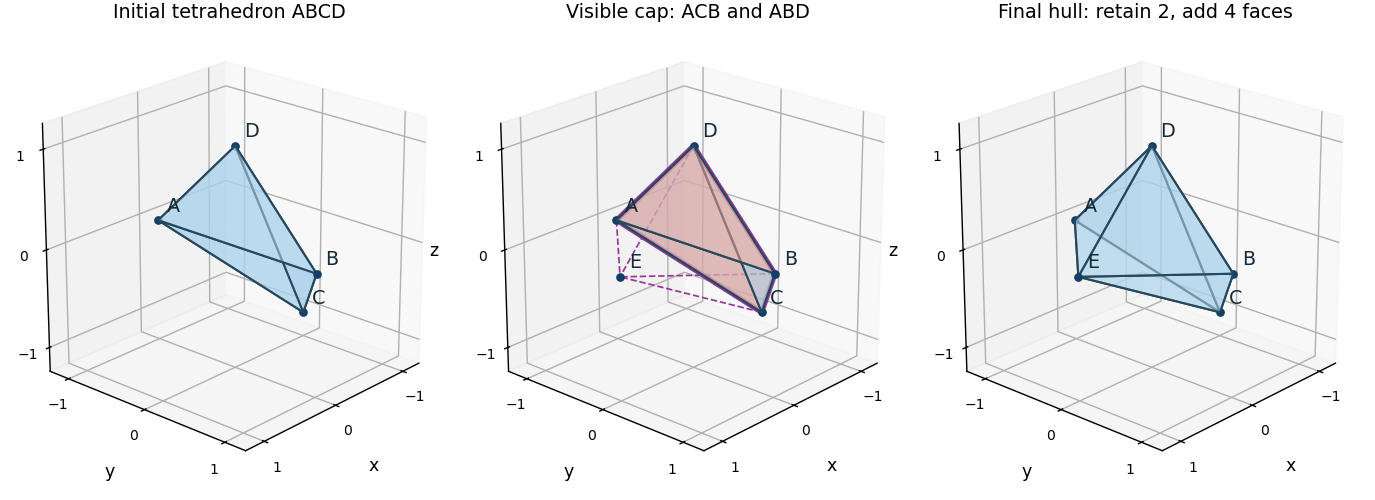
Initial tetrahedron, the two faces visible from E and their horizon, and the final six-face convex hull
. Details. 
Articles by others on the same topic
There are currently no matching articles.