Solutions to all three questions of the paper dated 11 June 2015.[ref]
Principles of Programming Languages examination paper by the University of Oxford (2015). Cover and pp. 2–8, A12079W1
In the equations below, and denote the base computational monad's result and sequencing operations. All equalities of computations are extensional: apply both sides to the same remaining arguments. Haskell fragments use result and bind for the paper's and . The FunMem programs use the language's own syntax.Thread the explicit program state through the computation, using the base computational monad to sequence its effects:In Haskell notation, with
resultM and bindM standing for the base operations:result :: Monad m => a -> MemT m a
result x s = resultM (x,s)
bind :: Monad m => MemT m a -> (a -> MemT m b) -> MemT m b
bind p f s = bindM (p s) (\(x,s') -> f x s')This is the state monad transformer. The first computation's final program state, rather than its initial program state, becomes the second computation's input. The base computational monad decides whether that pair is available at all.
Use the three monad laws of the base computational monad. For left identity, at an arbitrary program state ,The last step is the base left identity law. For right identity,The penultimate equality identifies the pair-destructuring function with ; the last uses the base right identity law.
For associativity, expand the two successive uses of sequencing and apply base associativity:No program state is duplicated or reset during these rearrangements: both sides pass to , its output to , and the output of to . By function extensionality,
Reading preserves the computer memory; writing returns the unit type value; allocating returns both the fresh memory location and the allocator's updated computer memory:
get :: Monad m => Location -> MemT m Value
get a s = resultM (contents s a,s)

put :: Monad m => Location -> Value -> MemT m ()
put a v s = resultM ((),update s a v)

new :: Monad m => MemT m Location
new s = resultM (fresh s)
These use the memory interface in [ref]
Principles of Programming Languages examination paper by the University of Oxford (2015). Printed p. 3, Figure 1
. In particular, fresh already returns its outputs in the order required by the state monad transformer:There is one undifferentiated exception, so use the two alternatives of the Haskell algebraic data type
Maybe: Just x succeeds and Nothing fails. A suitable exception monad transformer is:type ExT m a = m (Maybe a)
result :: Monad m => a -> ExT m a
result x = resultM (Just x)
bind :: Monad m => ExT m a -> (a -> ExT m b) -> ExT m b
bind p f = bindM p (\r -> case r of
Nothing -> resultM Nothing
Just x -> f x)
orelse :: Monad m => ExT m a -> ExT m a -> ExT m a
orelse p q = bindM p (\r -> case r of
Nothing -> q
Just x -> resultM (Just x))
failure :: Monad m => ExT m a
failure = resultM NothingThe distinction between
bindM and bind matters. The handler must inspect the failed alternative using the base computational monad; the transformed bind would propagate failure without running that inspection. The alternative computation q runs only after p returns Nothing; any effects already performed by the base computational monad remain subject to that base's semantics.Left identity follows by selecting
Just x. Right identity follows because either alternative is passed back to resultM. For associativity, base associativity exposes the first alternative: Nothing propagates through both remaining steps; Just x runs f x, with its Nothing and Just alternatives treated identically on both sides. Thus this representation also satisfies the monad laws.type IdM a = a
result :: a -> IdM a
result x = x
bind :: IdM a -> (a -> IdM b) -> IdM b
bind x f = f xAll three monad laws reduce to substitution in function application. There is no additional program state, failure alternative or continuation layer:
Expand the two type synonyms to see what survives an exception:In the first order, a failed computation can still produce
(Nothing,s'). The exception handler therefore runs with , including writes made before failure. In the second order, failure produces Nothing, with no returned computer memory. A handler defined by applying the underlying orelse pointwise runs its alternative from the original input computer memory . This gives rollback of this explicit program state for the failed branch.For example, start with a memory location holding , write , fail, and handle the failure by reading that memory location. The first order returns ; the second returns . This rollback concerns the explicit computer memory only: arbitrary effects in the base computational monad are not thereby reversed.A conventional programming language normally retains writes made before an exception is caught. Its mutable computer memory and exception handling therefore correspond more closely to .
Fix an answer type and let the continuation return its answer inside the base computational monad:
type ContT m a = (a -> m Answer) -> m Answer

result :: Monad m => a -> ContT m a
result x k = k x

bind :: Monad m => ContT m a -> (a -> ContT m b) -> ContT m b
bind p f k = p (\x -> f x k)
The continuation monad transformer changes the continuation supplied to
p: it first runs f on the produced value, then uses the original final continuation k. Base sequencing is unnecessary in these two definitions because p already accepts a continuation returning m Answer. The customary lift, if desired, is lift q k = bindM q k.The continuation receives both the computed value and the current computer memory. Therefore return invokes it with unchanged computer memory, while sequencing installs a continuation that passes the produced value and updated computer memory to the next computation:
result :: a -> M a
result x k s = k x s

bind :: M a -> (a -> M b) -> M b
bind p f k s = p (\x s' -> f x k s') s
For left identity, expand the two definitions:For right identity,For associativity, both groupings reduce to the same expression:By function extensionality, these establish all three monad laws:
Apply the memory interface before invoking the supplied continuation:
get :: Location -> M Value
get a k s = k (contents s a) s

put :: Location -> Value -> M ()
put a v k s = k () (update s a v)

new :: M Location
new k s = let (a,s') = fresh s in k a s'
A read preserves computer memory; a write changes it but returns the unit type value; an allocation uses the updated computer memory returned by
fresh. The continuation always receives the latest computer memory:Capturing a continuation retains the destination, while the computer memory is supplied when that destination is eventually invoked. The required Haskell definitions are:
callcc :: (Cont a -> M a) -> M a
callcc f k s = f k k s

withc :: Cont a -> M a -> M a
withc saved p _current s = p saved s

callccPrim :: [Value] -> M Value
callccPrim [Function f] =
  callcc (\k -> f [Continuation k])

withcPrim :: [Value] -> M Value
withcPrim [Continuation k,v] = withc k (result v)
In
callcc, the handler f k initially runs with the same current continuation k. If it returns normally, its result goes there. If it invokes withc with a saved continuation, the current destination is discarded. In particular,The primitive interface receives values, because the surrounding call-by-value interpreter has already evaluated its arguments. Thus the expression supplied as the second argument of withc is evaluated once, before withcPrim transfers its value. Wrapping that value with result implements precisely the remaining transfer; the primitive must not try to evaluate it a second time. Neither operation restores a saved snapshot of computer memory.Keep a FIFO queue of runnable continuations in shared computer memory. Removing a continuation from its head transfers control with
nil; suspending a runnable computation appends its continuation at the rear. A single scheduler group also needs a terminal continuation so that finishing the last computation cannot return through an obsolete invocation of fork.The following is
FunMem, including the shared initialization and helper definitions. run(main) starts a scheduler group; nested fork calls use that same group.val ready = new(); ready := nil;
val stop = new();
rec append(xs,ys) =
if xs = nil then ys else head(xs) : append(tail(xs),ys);
val enqueue(k) =
ready := append(!ready,k:nil); nil;
val dispatch() =
if !ready = nil then withc(!stop,nil)
else let val k = head(!ready) in
ready := tail(!ready); withc(k,nil);
val run(main) =
callcc(lambda (done)
stop := done; ready := nil;
main(); dispatch());
val fork(f) =
callcc(lambda (parent)
enqueue(parent); f(); dispatch());
val yield() =
callcc(lambda (current)
enqueue(current); dispatch())At
fork, the parent is queued before f() starts. The child runs immediately. Its ordinary return value is ignored by sequencing into dispatch(). At yield, the current computation joins the rear, then the oldest runnable computation is removed from the front. If there was no other runnable computation, these operations select the just-captured continuation, so the caller resumes immediately with nil.The invariant is that each suspended runnable computation has exactly one entry in
ready, ordered by the time it most recently became suspended and runnable. A running computation is absent from that FIFO queue. Neither appending nor removing an entry suspends, so these operations are indivisible relative to this cooperative multitasking scheduler. Completing a child removes the child from consideration permanently; it is never enqueued by its completion wrapper.For the paper's example, call the initial computation and the forked computation . The FIFO queue and writes evolve as follows:
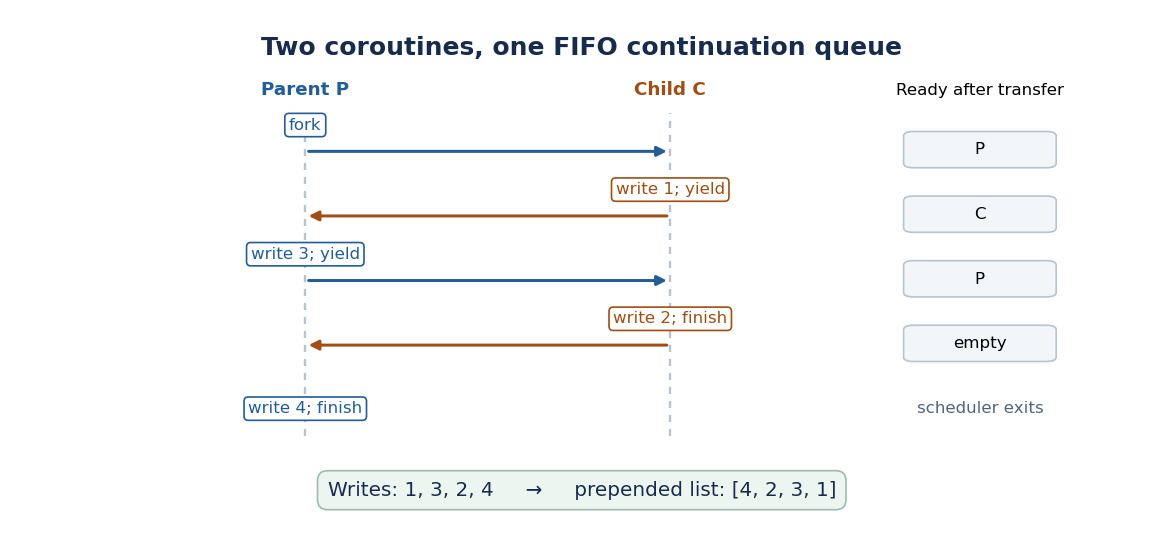

Thus the observable list, read after the scheduler group finishes, isThe scheduler exit is used only when no runnable continuations remain. A main computation can place its desired final observable value in shared computer memory and read it after
run returns. This wrapper also permits already-forked computations to finish if the initial computation finishes before them. Each run creates one active scheduler group; calls of run are not nested.Represent a binary semaphore by a two-element list containing the addresses of its busy flag and its waiting FIFO queue. A blocked continuation belongs to the waiting FIFO queue, not the scheduler's runnable FIFO queue. These definitions extend the
FunMem scheduler from the preceding part:val semaphore() =
let val busy = new() in
let val waiting = new() in
busy := false; waiting := nil; busy : waiting : nil;
val acquire(s) =
let val busy = head(s) in
let val waiting = head(tail(s)) in
if !busy then
callcc(lambda (blocked)
waiting := append(!waiting,blocked:nil); dispatch())
else (busy := true; nil);
val release(s) =
let val busy = head(s) in
let val waiting = head(tail(s)) in
if !waiting = nil then (busy := false; nil)
else let val next = head(!waiting) in
waiting := tail(!waiting); enqueue(next); nilA newly created semaphore is free. Acquiring it while free marks it busy and immediately returns
nil. Acquiring it while busy captures the remainder of the caller, appends that continuation to the waiting FIFO queue, and dispatches a runnable computation. No runnable copy of the blocked caller is retained.When a waiting caller exists,
release keeps the busy flag true: the released permit is reserved for that caller. It removes exactly one waiting continuation and appends it to the scheduler's runnable FIFO queue. It does not invoke dispatch, so the releasing computation keeps running. A newcomer cannot steal the reserved permit during the interval before the released caller resumes. That caller's captured continuation resumes after acquire with nil, already possessing the permit.These are FIFO semaphores; the question only requires selecting one waiter, so choosing the oldest is a valid stronger discipline. The updates contain no suspension except at the explicit blocking point, making them atomic relative to this cooperative multitasking scheduler. As allowed in the paper, invalid releases and executions in which every remaining computation is blocked need no error handling; the latter are deadlocks, not a way to make progress.Use programming closures that receive evaluated arguments and return a computation in the chosen computational monad. A sufficient core of the semantic value domain is:
data Value = IntVal Integer
           | BoolVal Bool
           | Function ([Value] -> M Value)
Additional constructors may represent the other built-in values. Assume a semantic environment abstract data type with operations
lookupEnv :: Env -> Ident -> Value and extend :: Env -> [(Ident,Value)] -> Env. The latter simultaneously adds the listed bindings, shadowing old bindings. Parameter names in one binding list are distinct, and calls have the expected arity.Define programming closure construction separately; it does not run the body:
close :: Expr -> Env -> Value
close (Lambda xs body) rho =
  Function (\args -> eval body (extend rho (zip xs args)))

apply :: Value -> [Value] -> M Value
apply (Function f) args = f args
The four expression forms have the following semantic equations. Function position is evaluated first, followed by argument expressions from left to right:
eval :: Expr -> Env -> M Value

eval (Variable x) rho = result (lookupEnv rho x)

eval (Apply e es) rho =
  bind (eval e rho) (\f ->
    bind (evalArgs es rho) (\args -> apply f args))

eval e@(Lambda xs body) rho = result (close e rho)

eval (Let d body) rho =
  bind (defn d rho) (\rho' -> eval body rho')

evalArgs :: [Expr] -> Env -> M [Value]
evalArgs [] rho = result []
evalArgs (e:es) rho =
  bind (eval e rho) (\v ->
    bind (evalArgs es rho) (\vs -> result (v:vs)))
The two definition forms are:
defn :: Defn -> Env -> M Env

defn (Val x e) rho =
  bind (eval e rho) (\v -> result (extend rho [(x,v)]))

defn (Rec x e@(Lambda xs body)) rho = result rho'
  where
    rho' = extend rho [(x,v)]
    v = close e rho'
The ordinary definition evaluates its right-hand side in the old semantic environment; its own name is not yet bound there. The recursive definition creates a recursive closure in the extended semantic environment containing itself. Because the right-hand side is a lambda abstraction, constructing that programming closure does not evaluate its body. Haskell's lazy evaluation can tie this recursive data structure without requiring any extra fixed-point operation from the arbitrary computational monad.
Lexical scope is explicit: calling a programming closure extends the defining semantic environment, and its parameters shadow bindings in that semantic environment. The six requested constructs are therefore covered by
The equivalence holds for every lawful computational monad with the semantic equations above. In particular, effects in are neither discarded nor evaluated twice. Fix an initial semantic environment , and writeExpanding
Let and Val givesThe two steps use associativity and left identity from the monad laws.For the application, evaluating the lambda abstraction yields
result c, where the programming closure satisfies . The singleton argument evaluator reduces toUse left identity to remove the initial result c, then associativity and left identity again:Consequently,The argument relies on the lambda abstraction itself being effect-free, as specified in part (a), and on using the same semantic environment for on each side. No commutativity of effects is assumed. In particular, the proof applies to state monads, exceptions and continuation monads, not merely to the identity monad.Add the abstract syntax tree alternative
Fix Ident Expr. Its syntactic sugar expansion and the semantic equations from part (a) givewhere and . The final step uses left identity from the monad laws and the lookup rule for the newly bound identifier.eval (Fix x e@(Lambda xs body)) rho = result v
where
rho' = extend rho [(x,v)]
v = close e rho'Equivalently, spelling out programming closure construction,The result is a recursive closure, not the result of calling its body. Its self-binding is visible inside that body but does not extend the caller's surrounding semantic environment.
Add
Fixes [Ident] [Expr] to the abstract syntax tree. For the stipulated nonempty, equally long lists of distinct names and lambda abstractions, define all programming closures against one common extended semantic environment:eval (Fixes xs es) rho = result (head vs)
where
rho' = extend rho (zip xs vs)
vs = map (\e -> close e rho') esExpanding the auxiliary function, if ,Every body can therefore call every member of the family, including itself. Constructing the family performs no body computations in the arbitrary computational monad. As in part (c), host lazy evaluation ties the recursive semantic environment; a monadic fixed-point operator is unnecessary.
For example, with two bodies implementing evenness and oddness, respectively, each programming closure sees both names in . Returning the first programming closure still retains access to the second. Building each programming closure in an independently extended old semantic environment would lose this mutual recursion. For , the definition agrees with
Fix. Articles by others on the same topic
There are currently no matching articles.