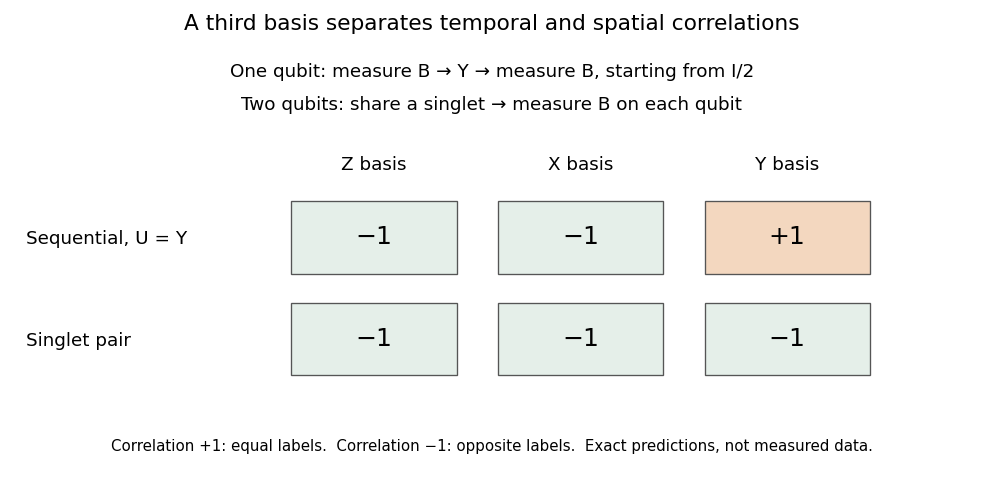
Only the two-qubit experiment is possible. Choose the spin singlet stateIt has eigenvalue under each of , and . Thus measuring either qubit in the same Pauli basis as the other always gives opposite eigenvalue labels. Each opposite-label pair occurs with probability . More generally, collective-unitary covariance of the two-qubit singlet ensures opposite outcomes in any common orthonormal qubit basis.
For the sequential experiment, the first outcome is uniformly distributed and the Lüders rule prepares the corresponding eigenstate. Certain opposite outcomes in the computational basis force the fixed unitary matrix to have the formCertain opposite Hadamard basis outcomes require , hence . Therefore . But this operator preserves the two Pauli Y eigenstate rays: it gives the same Y-basis label on the second measurement, rather than the opposite one. This contradicts the third set of observations.
Equivalently, flipping all three bases would require , , and . Conjugating in these two ways gives both and , an impossibility. This three-axis obstruction to unitary qubit orthogonalization is a finite test of the obstruction behind the universal NOT gate.

Articles by others on the same topic
There are currently no matching articles.