No test on Alice and Bob's systems gives any information about which global state was prepared, even with arbitrarily many independent copies. In the pure GHZ density matrix, the off-diagonal terms contain or its adjoint. Their partial traces vanish. Hence both preparations have the same reduced density matrixFor any POVM effect acting jointly on , the outcome probability is in either case. Equal reduced states give identical local statistics, where local here means local to the entire accessible laboratory , not separate operations on and .[ref]
Foundations I: States and Ensembles by John Preskill. §2.3.1, printed pp. 14–17, reduced density operators and accessible expectation values
For independent copies, taking the partial trace of each inaccessible system yields under either hypothesis. Even an arbitrary collective quantum measurement on all accessible qubits therefore has identical outcome probabilities. Adaptive local processing cannot change equality of the accessible density matrices. With equal prior probabilities the optimal guessing probability remains ; with other priors, no observation updates their ratio.
Charlie's Hadamard basis measurement, Alice's Bell-basis measurement and communicated correction bits give deterministic GHZ-assisted quantum teleportation. Let the unknown input be . Charlie measures in the Hadamard basis and labels by , by . The identityshows that is conditionally a Bell pair with phase label . Charlie sends that one classical bit to Bob. The procedure for localizing a Bell pair from a GHZ state supplies precisely the missing conditional information; forgetting leaves the mixed reduced state of the preceding part.
Alice performs the usual Bell-basis measurement on . Operationally, she applies , applies , and measures and in the computational basis, obtaining bits . She sends both bits to Bob. To track the correction without a convention ambiguity, conditional on the normalized state on isProjecting Charlie's factor onto his recorded Hadamard basis state gives Bob, up to the global phase ,Consequently the inverse Pauli correction isBob applies first and second. The measurements on Charlie and on Alice commute because they act on different systems, so deriving the conditional state with Alice's measurement first gives the same protocol as Charlie measuring first. Each triple has probability , independent of the unknown input, and every triple succeeds after correction.
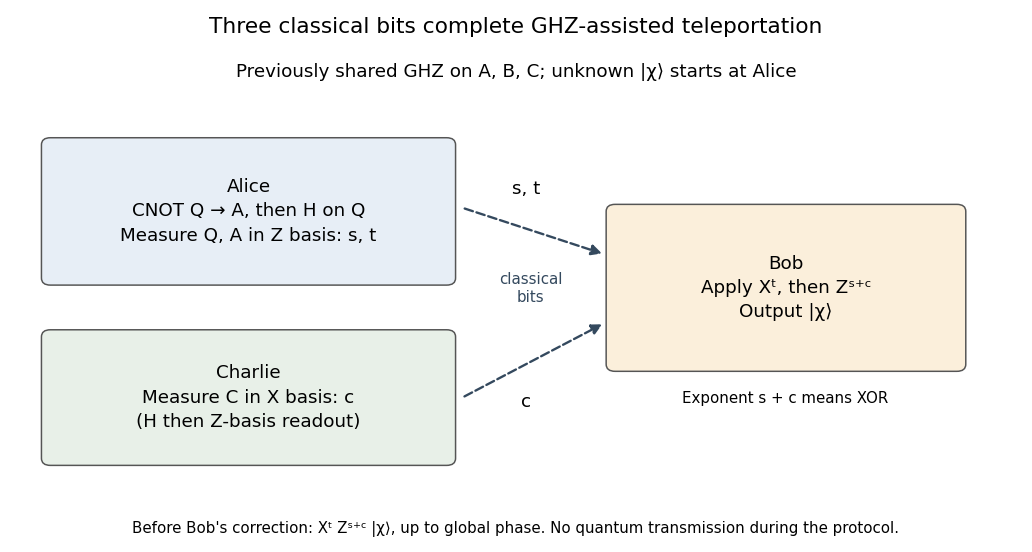
Three classical bits complete GHZ-assisted teleportation
. Original protocol diagram for a previously distributed GHZ resource on A, B and C. Alice performs CNOT from Q to A, then H on Q and Z-basis readout of Q and A. Charlie performs H followed by Z-basis readout, equivalent to X-basis measurement. Bob receives s, t and c, applies X to the power t, then Z to the power s XOR c. The dashed lines carry classical bits. Details.
This uses one previously shared GHZ state, two classical bits from Alice and one from Charlie, with no quantum transmission during the transfer. The standard Bell-measurement/Pauli-correction mechanism was established in the original quantum teleportation proposal.[ref]
Teleporting an unknown quantum state via dual classical and Einstein-Podolsky-Rosen channels by Charles H. Bennett and others. 1993, printed p. 1896, equations (5)–(6): outcome-conditioned states and unitary corrections
Here Charlie's record supplies the Bell-pair phase, giving a controlled quantum teleportation protocol. Alice's input is consumed by her measurement; Bob reconstructs its state without learning and without making a second surviving copy. Articles by others on the same topic
There are currently no matching articles.