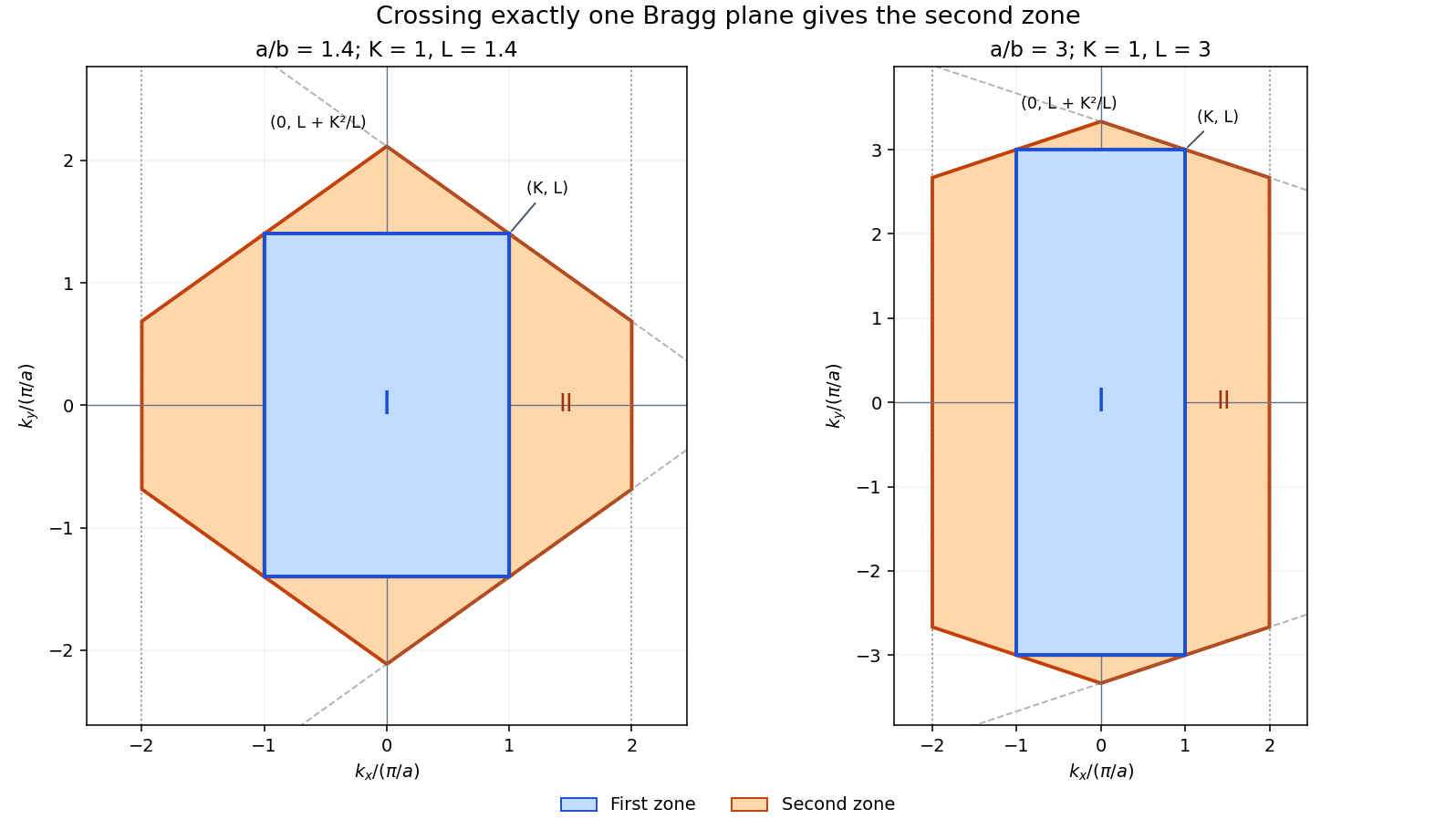
For the first two Brillouin zones of a rectangular lattice, write and , so and the reciprocal lattice vectors are . The perpendicular bisectors to the four nearest axial reciprocal points encloseThe second Brillouin zone consists of points beyond exactly one Bragg plane. In the first quadrant, it is the union of the following two regions:Reflect these regions in both axes. The first is a trapezoidal side lobe; the second is half of a triangular top lobe. The sloping boundary is the bisector for . On the side lobe, is the bisector condition for : crossing that plane too would enter the third or a higher zone. These additional bisectors are why four rectangles pasted onto the first zone would be incorrect.
Equivalently, the full right lobe has verticesand the top lobe has vertices . Add their left and bottom reflections. Their total area isequal to the first-zone area, as required by reciprocal-space state counting. These formulas remain valid for every , including very elongated rectangles; boundaries themselves can be shared by convention.

Articles by others on the same topic
There are currently no matching articles.